
Marketplaces
Marketplace automation in 2026: stock sync, repricers and marketplace APIs — what to automate first and what it costs
Start marketplace automation with stock synchronisation: one system holds the real quantity and pushes it to Amazon, other marketplaces and your own site, so you stop cancelling orders for items you no longer have. Prices and repricing, order statuses and reports come next. Custom API work pays off once your rules no longer fit a ready-made tool.

What should a marketplace seller automate first?
Marketplace automation means stock, prices, orders and reports move between your seller accounts and your own records without anyone retyping them. Stock goes first because a mistake there costs the most: the last unit sells twice and one of the two orders has to be cancelled.
| Process | What goes wrong by hand | How it is automated | Priority |
|---|---|---|---|
| Merchant-fulfilled stock | The last unit sells twice | One system pushes quantities | First |
| Prices and discounts | A forgotten promotion or a typo | Rules with a floor, or a repricer | Second |
| Order statuses | Late dispatch, hand-made labels | Orders and tracking over the API | Second |
| Reports | Three exports pasted into one sheet | A daily load into a dashboard | Third |
| Listings | One SKU, different descriptions | Publishing from one catalogue | At hundreds of SKUs |
| Review replies | Reviews unanswered for weeks | A template draft a person sends | At dozens a day |
Automate what repeats, has clear inputs and an obvious action on failure. If a rule is argued over every time, such as how to price a new product, write it down before shopping for a tool.
Self-check
Is it time to automate your marketplaces?
Tick every statement that is true for your shop today.
ticked 0 of 8
Your result: Too early: manual work still costs less. First get one trusted stock figure and a minimum price for every SKU.
How do you sync stock across Amazon, other marketplaces and your own site?
Stock is synchronised through one system of record: inventory software or a warehouse system that knows the real quantity and pushes it to every channel. Marketplaces do not share stock with each other, so without that hub a sale on one channel leaves the others showing an out-of-date number.
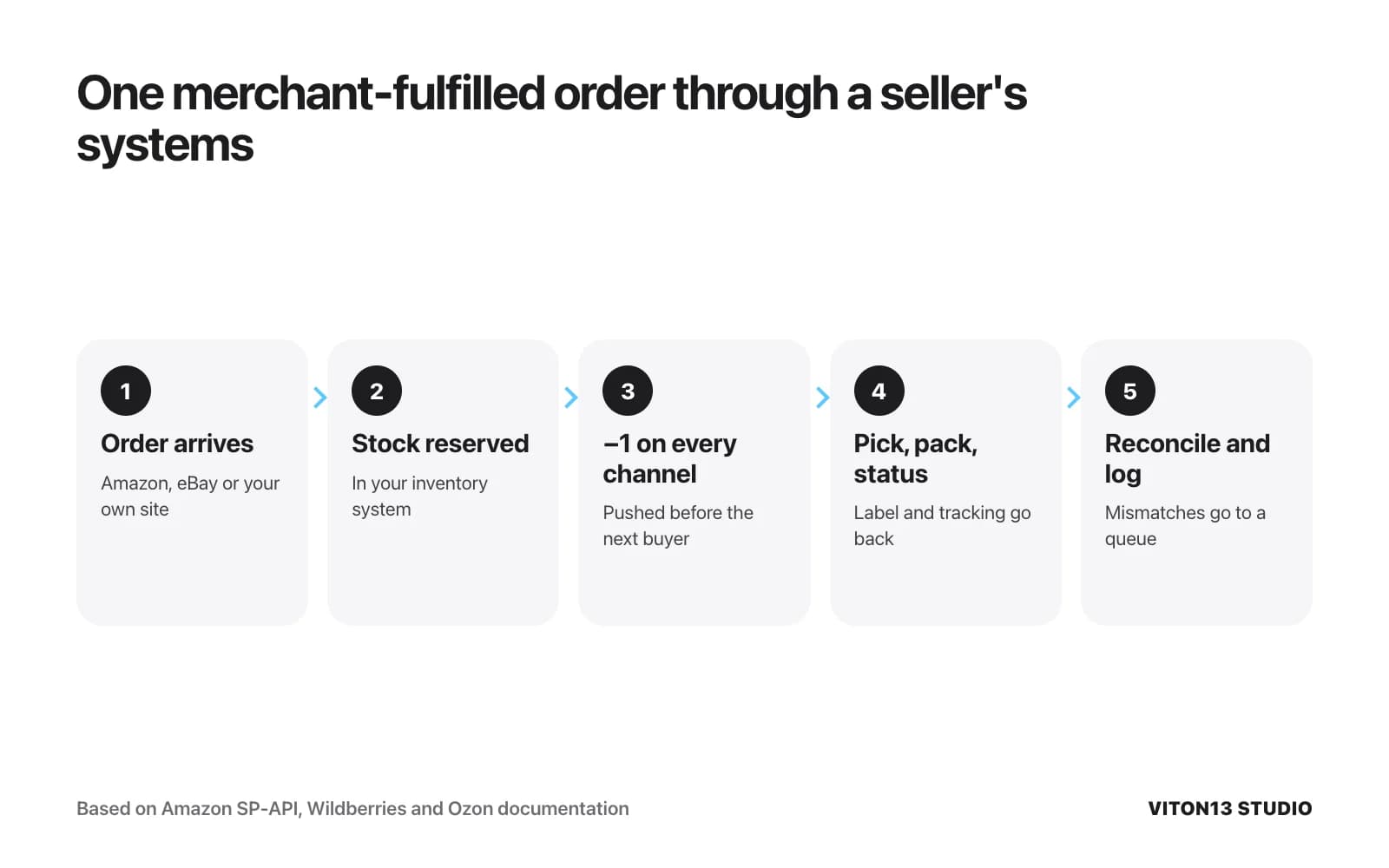
Stock in Amazon's fulfilment network is counted by Amazon and needs reports, not synchronisation; the problem starts when one shelf of your own feeds several storefronts.
Every sync has a delay, so on fast-moving lines sellers show one or two units fewer than the shelf holds. The buffer is cheaper than a cancellation: Ozon, for one, records an out-of-stock cancellation against the seller and tracks the cancellation rate in its seller rating.
What do the Amazon, Wildberries and Ozon APIs allow?
Each API has its own access model, batch size and speed limit, so an integration is designed around the strictest. VITON13 also serves sellers on Russian marketplaces, hence Wildberries and Ozon beside Amazon.
| Amazon SP-API | Wildberries API | Ozon Seller API | |
|---|---|---|---|
| Access | A private developer profile in Seller Central, reviewed by Amazon | A token from the seller account: personal, service, basic or test | An API key from Settings → Seller API, or an OAuth app token |
| Rate model | Token bucket per operation; listings at 5 requests a second | Token bucket per method category; stock at 300 requests a minute | 50 requests a second per Client ID unless a method sets its own limit |
| Batch size | Listings Items API: 1 item; JSON listings feed: up to 25,000 messages | Stock and prices: up to 1,000 items a request | Stock: 100 product-warehouse pairs; prices: up to 1,000 items |
| Watch out for | Feeds are processed asynchronously and not necessarily in order | Tokens last 180 days; a misspelt stock field still returns success | Keys last 3 months; a product's price can change 10 times an hour |
A throttled call returns 429, which Amazon calls retryable, though repeated throttling needs back-off. Amazon suggests the JSON feed from about 1,500 items; below that, the Listings Items API is faster within a five-minute window.
Do you need a repricer, and how do you set one up safely?
A repricer changes prices by rule: following competitors, holding a recommended retail price or reacting to stock. It earns its fee with hundreds of SKUs and rivals who reprice daily; for twenty SKUs a spreadsheet rule is cheaper.
- A floor from unit economics, or the algorithm follows a discounter into a loss; our unit economics guide shows the break-even price.
- Platform limits: Ozon allows 10 price changes per product an hour and rejects a minimum below 50% of your price.
- Wildberries quarantine: below a price threshold, the item keeps selling at the old price until you fix it.
- Native tools: Mercado Libre and Ozon have their own competitor-based pricing rules, and Mercado Libre blocks API price edits on items using its automation.
- Typo protection: the tool should refuse any price under the floor and alert someone.
Published repricer prices give a sense of scale: Informed lists a Launch plan at $99 a month for sellers under $5k in monthly revenue, Professional at $199 and Enterprise from $499.
Ready-made software or a custom API integration: which should you choose?
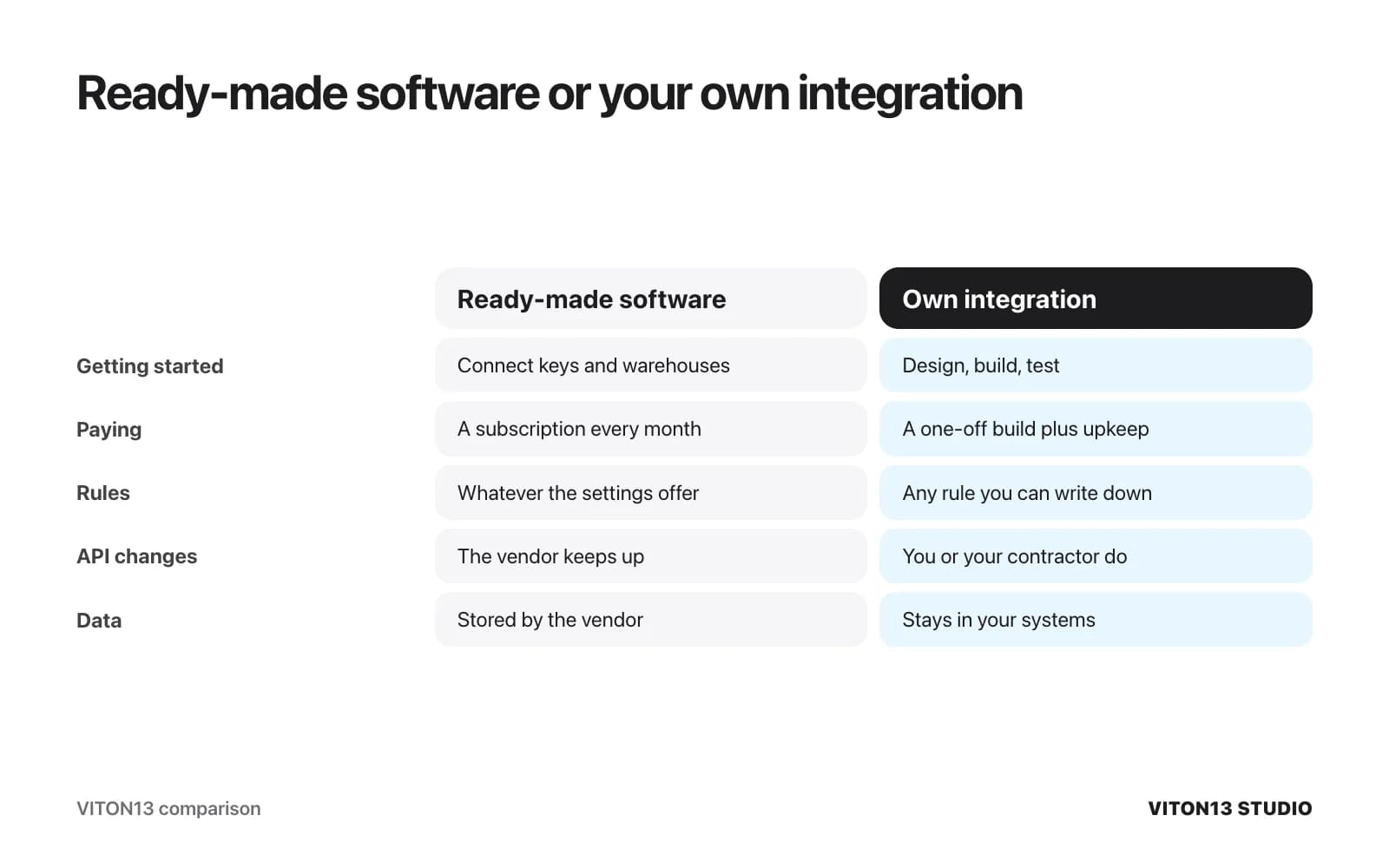
Choose ready-made software when processes are standard and speed matters, and a custom integration when your rules, systems or volumes do not fit. With software the vendor tracks API changes; with your own integration, you or your contractor do.
| Option | Price | What you get |
|---|---|---|
| Veeqo Inventory plan | From $19 a month, set by order volume | Automated inventory sync across channels; owned by Amazon |
| Veeqo High Volume | From $350 a month | ERP integrations and API consulting |
| Mirakl Connect Growth | $699 a month, up to $50,000 GMV | Connectors, order management, stock and price sync |
| Linnworks | Quote on request; priced on order volume | Inventory, orders and listings; onboarding is a one-off fee |
| Informed repricer | From $99 a month | Repricing rules for Amazon and Walmart |
| VITON13: API integration | $73 AI-assisted or $93 human-led | Integration map, secure data flow, failure monitoring; 5–8 working days |
| VITON13: n8n workflow | $73 AI-assisted or $93 human-led | One production workflow across up to 3 services, retries, alerts, runbook; 5–8 working days |
What breaks, and why do you need a log and an exception queue?
Code rarely breaks; the agreement between systems does: a key expires, a method changes, an unknown value arrives. The dangerous failures are silent: the marketplace says 'success' and nothing changes.
- Silent success: the Wildberries stock method does not validate parameter names, so a misspelt field returns 204 and nothing updates.
- Ignored fields: since 18 March 2026, Mercado Libre answers 200 OK to an update carrying a price for an auto-priced listing, but drops the price with a warning.
- Expired access: Wildberries tokens last 180 days, Ozon keys 3 months, and Ozon may revoke a key early over suspicious activity.
- Throttling: all three return 429 when you go too fast, and Ozon may restrict access without warning after a stream of faulty requests.
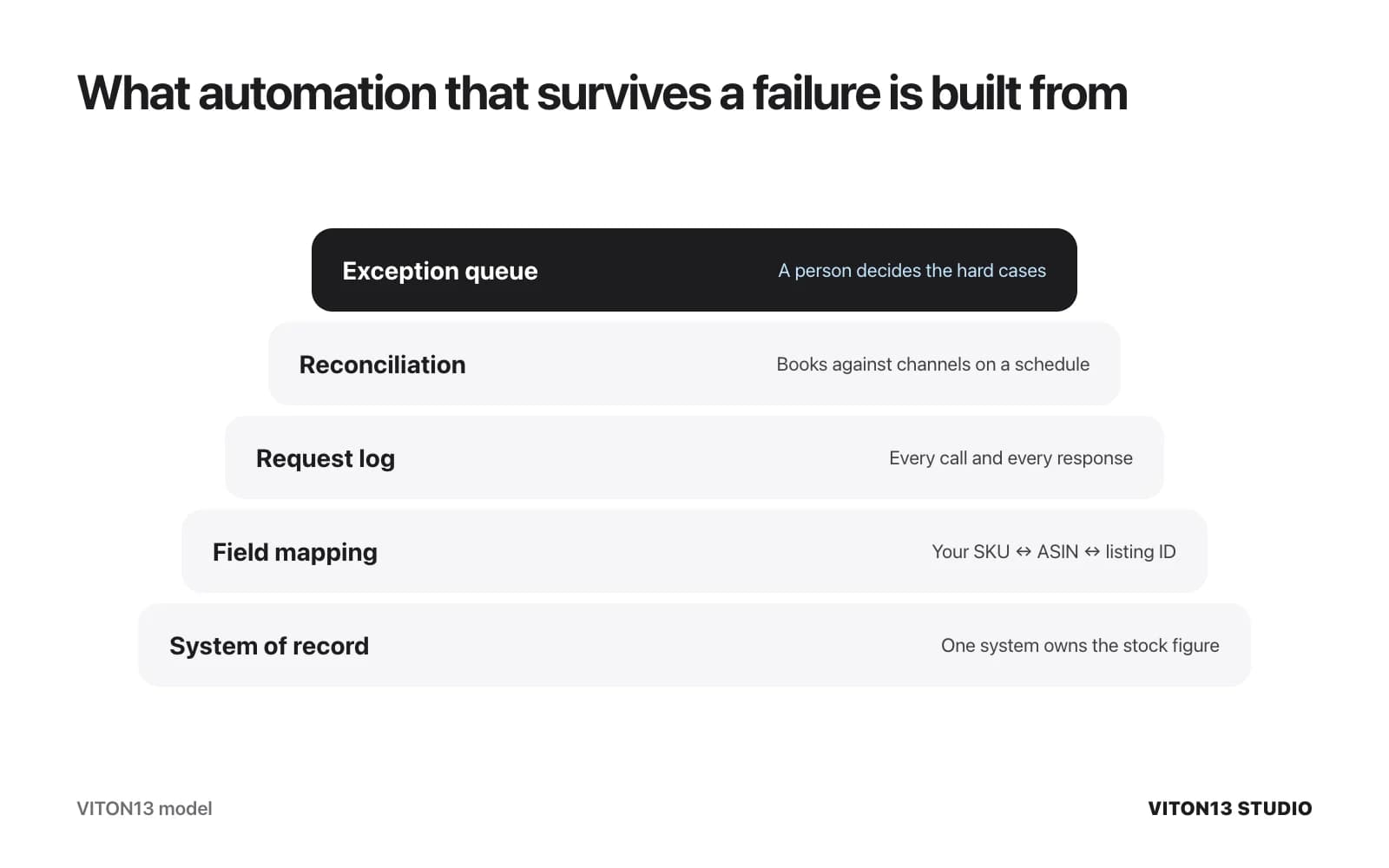
An exception queue lists the cases software will not decide alone: an unknown SKU, a price under the floor, negative stock. Each has an owner and a deadline; otherwise errors pile up in unread logs until the first wave of cancellations.
How do you roll out marketplace automation step by step?
- List the manual workWrite down what is done by hand every day, where its data comes from and who owns the result.
- Pick the system of recordDecide which system owns stock, price and product data. Two systems that both think they are in charge cause most mismatches.
- Map products and warehousesLink your SKU to each marketplace's own identifier and your warehouses to theirs. A mapping error ships the wrong product.
- Run a pilotConnect one category or one warehouse, reconcile your records against each channel every day for two weeks and record every mismatch.
- Switch on the log and the queueKeep every request and response, send human decisions to the queue and diary every key expiry date.
- Write the recovery planDescribe the fallback to manual work: who exports stock, how to pause the sync and how to catch up on missed orders.
How much does marketplace automation cost?
The cost has three parts: tool subscriptions, one-off design and build work, and upkeep after launch. Subscriptions recur, so compare them with a one-off build over a full year.
Cost calculator
Build the automation your channels need
Tick the work you need before the sync goes live.
Your estimate
- AI-assisted
- from $53
- Human-led
- from $73
- Timeline
- 3–5 working days
stages can overlap; the written estimate fixes the dates
Get a written estimate in 1 working dayAdds up the starting prices of one-off VITON13 packages; software subscriptions and marketplace fees are not included, and a written proposal confirms the total.
A worked example: Mirakl Connect Growth at $699 a month is $8,388 a year before add-ons, while Veeqo's inventory plan starts at $19 a month. A custom integration is a one-off build plus hosting and upkeep; your processes, not the price list, decide which is cheaper.
How VITON13 prepares marketplace automation
Marketplace automation at VITON13 is a decision package that comes before any build. From your accounts, exports and records we map the repetitive processes and decide which step is stable enough to automate and what happens when it fails, then test the design on one representative batch with named owners and acceptance criteria. Separate VITON13 packages or your contractor build the integration; we work only through official APIs, exports and account permissions.
Marketplace automation
- Price
- $53 AI-assisted or $73 human-led
- Timeline
- 3–5 working days
API and system integration
- Price
- $73 AI-assisted or $93 human-led
- Timeline
- 5–8 working days
n8n automation
- Price
- $73 AI-assisted or $93 human-led
- Timeline
- 5–8 working days
AI-assisted: AI drafts inside defined steps, a person directs and checks every result. Human-led: a specialist does the work and AI assists.
What is included
- Workflow inventory: what is done by hand and where the data comes from
- Automation decision map: what to automate and what to leave to a person
- Field and event mapping between your records, marketplaces and site
- An exception queue with conditions and owners
- An audit log and a recovery playbook for failures
- Delivery: 3–5 working days
Not included
- Building and maintaining the integration: separate packages or your contractor
- Software subscriptions, marketplace fees, logistics and legal review
- Scraping or bypassing account access
- Any promise of sales, rankings or listing approval
Revisions: 1 revision round on the deliverables
Get an estimate in 1 working dayWritten estimate within 1 working day
Example
PILOTPilot in progress
No published marketplace automation case yet
VITON13 has not yet published a marketplace automation case with client data, so this guide invents no results. API rules come from official documentation, tool prices from vendor pages.
What this does not prove
- The $8,388 a year for Mirakl Connect Growth excludes add-ons and any GMV above the plan's limit.
Questions and answers
Do I need a developer to connect the Amazon SP-API?
Not for a ready-made tool: you authorise it from Seller Central. For your own integration you register as a private developer, which covers apps that integrate only your company; Amazon reviews the profile, and if it asks for more information you have five days to reply.
Does Amazon charge for SP-API access in 2026?
Not at present. According to PPC Land, Amazon announced a $1,400 annual fee and GET-call charges in November 2025, then dropped them in May 2026. Sellers using the API only for their own business were never in scope.
Can I sync stock between marketplaces without inventory software?
Yes, if another system becomes the record: a warehouse system, an ERP, your shop platform or, for a small range, a reconciled spreadsheet. What matters is that exactly one place owns the quantity and every channel only receives it.
What should I do if the integration sells something I do not have?
Pause the stock push for that product and set it to zero by hand on every channel. Then cancel the extra order and find the request in the log after which the numbers diverged. Without a log you are guessing, so switch it on before launch.
How much does marketplace automation cost at VITON13?
The automation map, with workflow inventory, field mapping, exception queue, audit log and recovery playbook, costs $53 AI-assisted or $73 human-led and takes 3–5 working days. Building it is a separate package: an API integration from $73 or an n8n workflow from $73.
Sources
- Amazon SP-API: usage plans and rate limits —
- Amazon SP-API: Listings Items API rate limits —
- Amazon SP-API: listings management workflows —
- Amazon SP-API: register as a private developer —
- PPC Land: Amazon drops SP-API fees —
- Wildberries API: tokens and rate limits —
- Wildberries API: prices and stock —
- Ozon Seller API documentation —
- Mercado Libre: price automation —
- Veeqo pricing —
- Mirakl Connect pricing —
- Linnworks pricing —
- Informed pricing —