
CONCEPTConcept — not a commissioned project
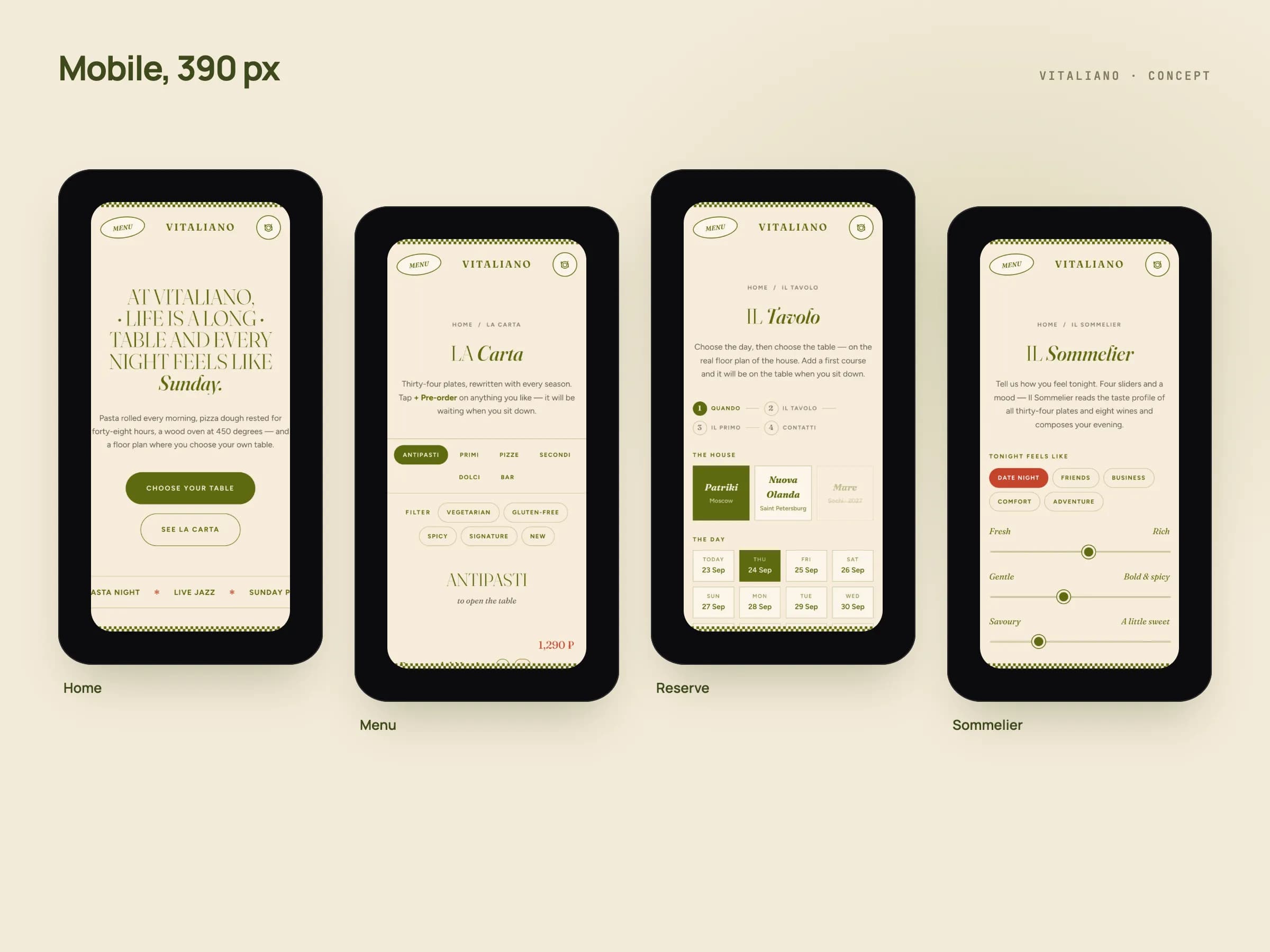
VITALIANO: a concept restaurant site where guests choose their exact table
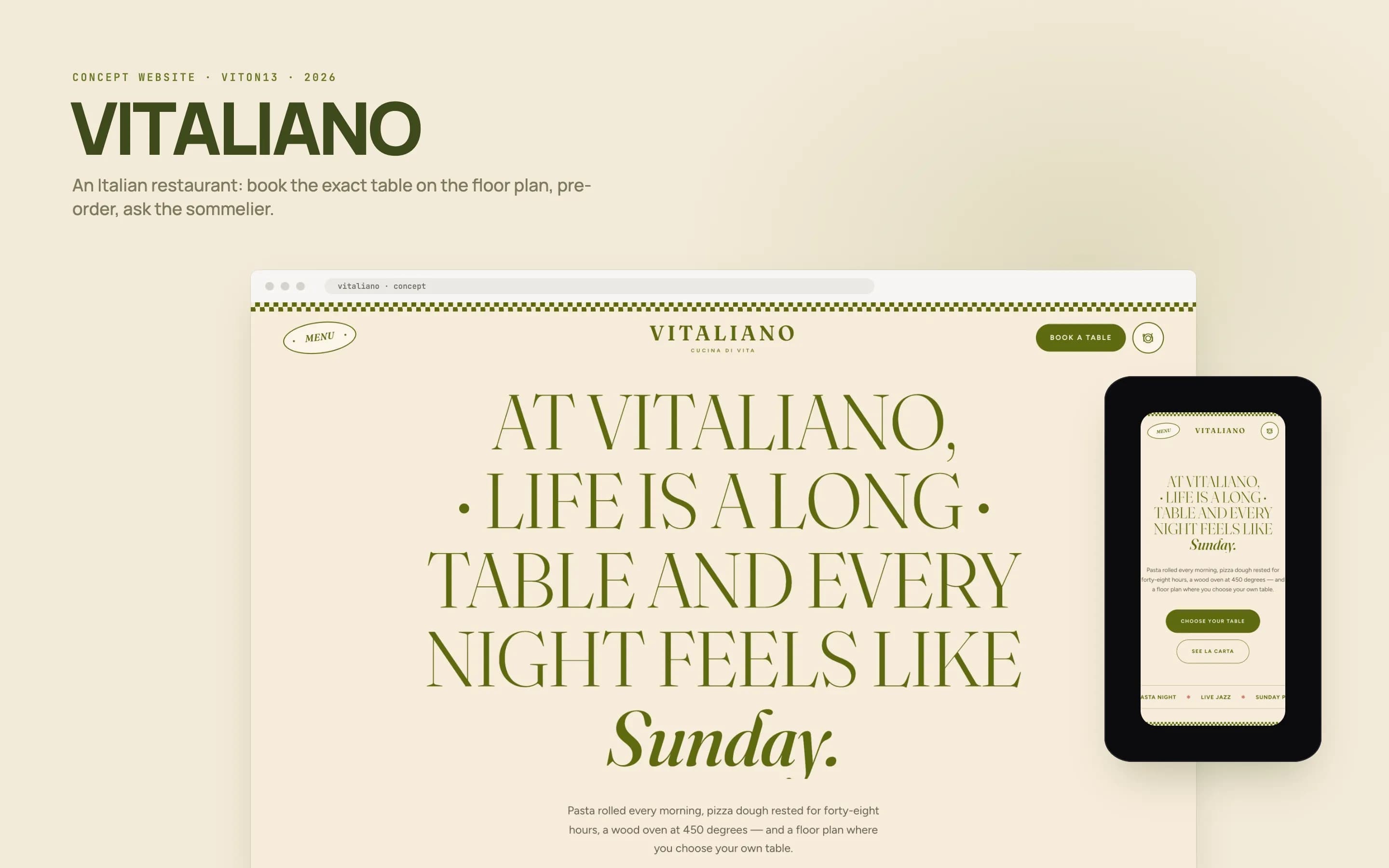
A concept by VITON13 for a fictional Italian restaurant group with three houses. Guests pick their exact table on a floor plan, let a sommelier tool compose a dinner and pre-order the first course with the booking.
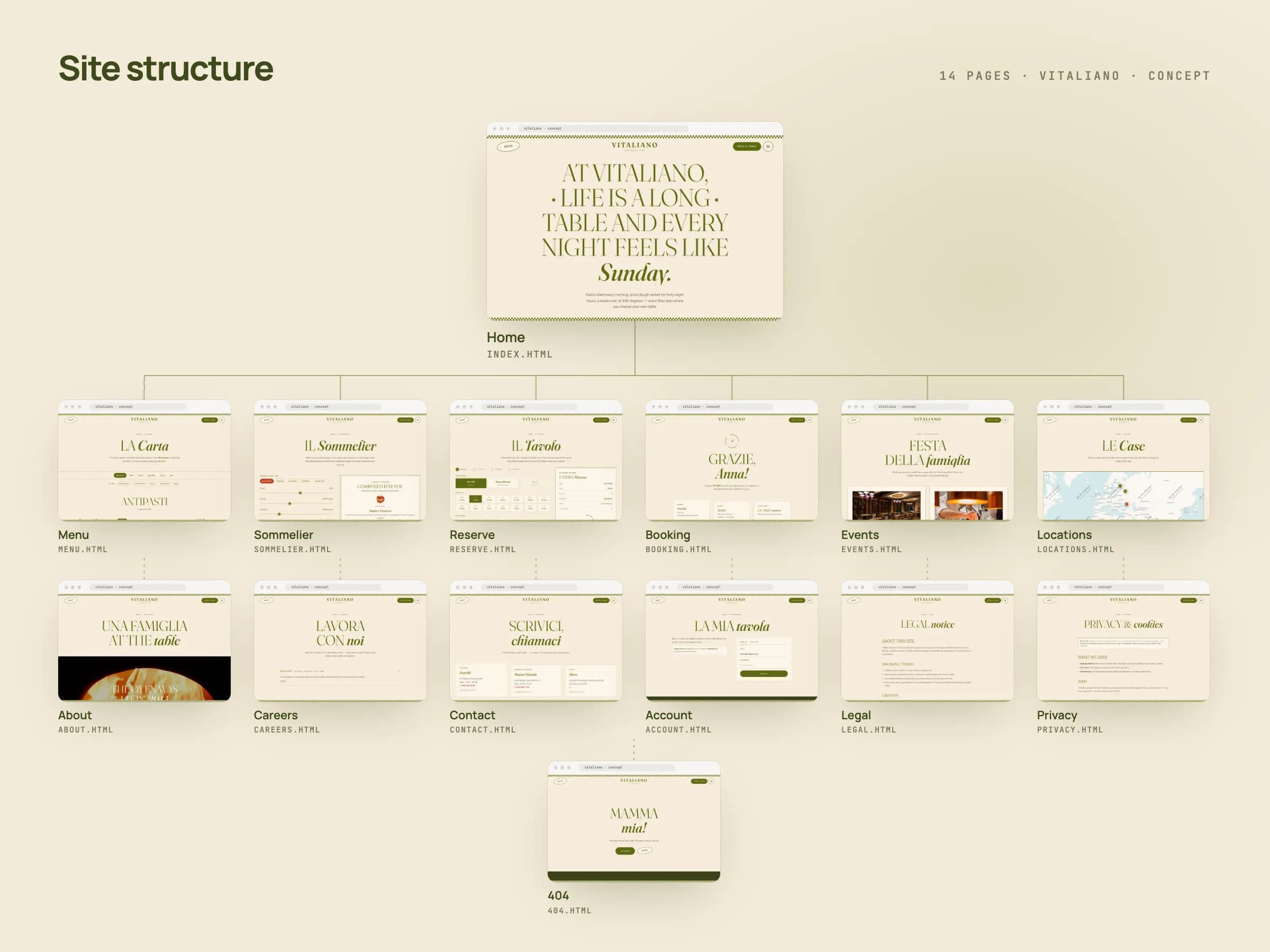
- pages, from La Carta to the booking confirmation
- 14
- priced dishes on the menu, plus 8 wines
- 34
- bookable tables on the floor plan of each of the 3 houses
- 20
- Lighthouse performance of the home page, mobile / desktop
- 70 / 93
Task
VITALIANO is a fictional Italian restaurant group with three houses, as the site calls its restaurants: Moscow, Saint Petersburg and Sochi, which is due to open in 2027. VITON13 built it as a concept to show what a restaurant site can do beyond a menu and a phone number. The site is in English, with the dishes named in Italian.
The site had to answer the questions a guest asks before dinner: what is on the menu and what it costs, what to drink with it, where each house is and where exactly they will sit. Booking had to work as choosing a seat, not as filling in a form.
What we did
14 pages: Home, La Carta (the menu), Il Sommelier, Il Tavolo (reservations), booking confirmation, private dining events, Le Case (the houses on a map), Chi siamo (about), careers, contact, a demo account with bookings, a legal notice, privacy and a 404 page. The menu lists 34 dishes and 8 wines with prices; as the cursor moves down the list, a photo of the dish follows it.
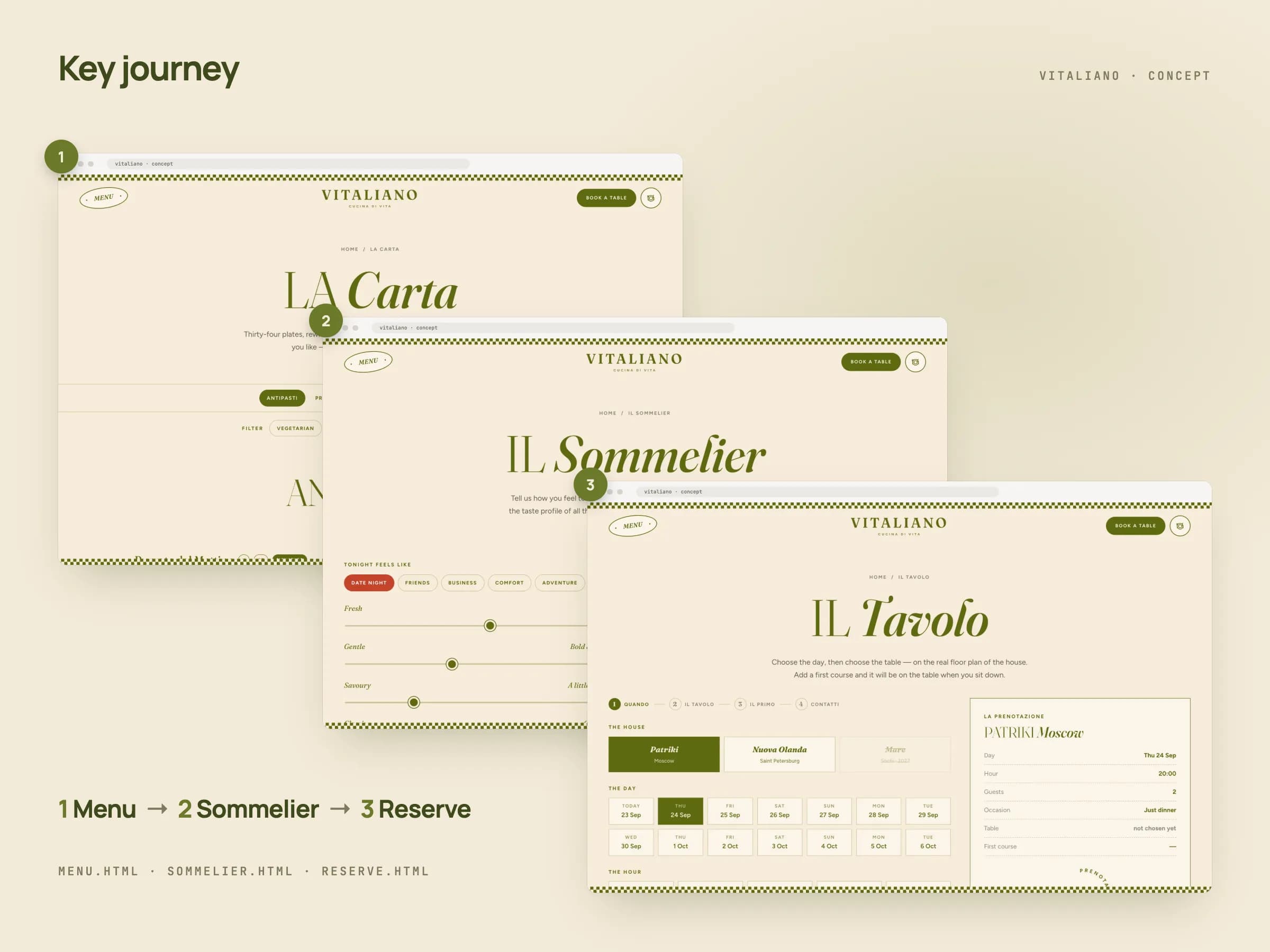
Il Tavolo draws a floor plan of each house with 20 tables: window two-tops, the main sala, a communal tavolata, a chef’s counter by the wood oven, a private room and a terrace. Availability changes with the house, date, hour and party size; hovering over a table shows what is special about it, and “Surprise me” picks the best free seat.
Il Sommelier gives every dish and wine a taste profile on four dimensions. The guest sets four sliders and a mood, and the site composes the closest antipasto, main, dessert and glass into a priced menu with a match percentage for each. Dishes chosen on the menu or in the sommelier become a pre-order that travels into the booking and is served when the guest sits down.
How it works
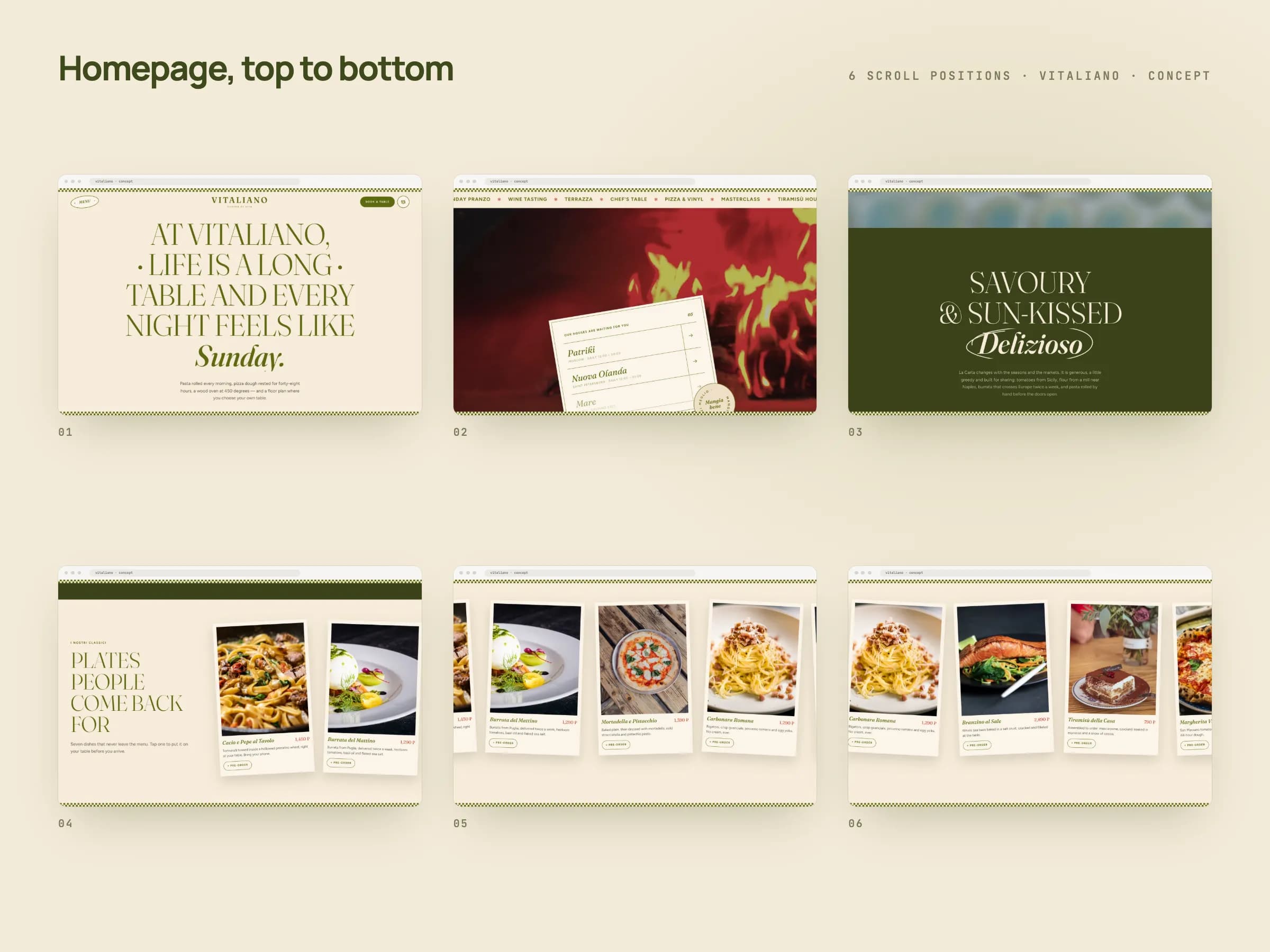
The key path runs Menu → Sommelier → Reserve: a guest reads La Carta, lets the sommelier build a dinner, takes that pre-order to Il Tavolo, picks a table and gets a confirmation that also appears in the demo account. Motion sets the pace: a preloader with a counter, olive curtain transitions between pages, headlines revealed line by line, parallax, a pinned horizontal gallery of signature dishes, a hand-drawn ellipse that draws itself, marquees that speed up with scrolling, magnetic stamp-style buttons and a custom cursor.
The site is plain HTML, CSS and JavaScript with no build step. The header, footer and overlays come from one shared script, so every page stays identical; GSAP with ScrollTrigger and Lenis handle animation and scrolling. Bookings and the account are demo state kept in the browser’s localStorage, and nothing is sent anywhere. Photos and video are licensed stock photography and video from Unsplash and Pexels, loaded by direct links from their CDNs.
What exists now
The concept exists as 14 working pages with 34 dishes, 8 wines, 3 houses and 20 tables on each floor plan. Lighthouse measured the home page on 22 September 2026. On mobile, with default throttling: performance 70, accessibility 94, best practices 77 and SEO 100, with LCP 5.0 s, CLS 0.015 and a 5.4 MB page in 31 requests. On desktop: performance 93, accessibility 94, best practices 77 and SEO 100, with LCP 1.0 s and CLS 0.025.
Checks across the 13 pages rendered in Chrome (the 404 page excluded) found a unique title and exactly one H1 on every page, the lang attribute set to en, layouts that fit a 390 px screen without horizontal scrolling, alt text on 100% of images and 0 broken internal links. Canonical tags, Open Graph tags and structured data are on 0 of 13 pages, and there is no sitemap.xml or robots.txt.
What this does not prove
VITALIANO is a concept built by VITON13 to show range, not a commissioned project. The restaurant group, its three houses, the people, dishes, prices and addresses are fictional. The site has no domain, no visitors, no search traffic and no bookings: every booking and pre-order is demo state that stays in the browser. Photos and video are licensed stock photography and video from Unsplash and Pexels.
The Lighthouse scores are lab measurements of the home page on one day, not field data from real guests, and a 100 SEO score covers the basics only. The case does not show how booking would work with a real reservation system, kitchen or payment, and it does not prove that the site would bring guests to a restaurant.
SEO review
On 22 September 2026 Lighthouse gave the home page SEO 100 on both mobile and desktop, with performance 70 on mobile and 93 on desktop; checks across 13 pages rendered in Chrome show the basics in place and the launch layer still missing.
Checked on September 22, 2026: 13 pages rendered in Chrome the way a search crawler sees them, plus Lighthouse 13 on the home page.
Lighthouse, home page
- Performance
- Mobile70Desktop93
- Accessibility
- Mobile94Desktop94
- Best practices
- Mobile77Desktop77
- SEO
- Mobile100Desktop100
On-page and technical checks
- Unique page titlesin place13/13
- Title length 30–65 charactersmissing6/13
- Meta descriptions 70–170 characterspartly10/13
- One H1 per pagein place13/13
- Page language declaredin placeen
- Mobile layout without sideways scrollin place390 px
- Images with alt textin place100%
- Broken internal linksin place0
- Canonical URLmissing0/13
- Open Graph title and imagemissing0/13
- Structured data (JSON-LD)missing0/13
- sitemap.xml and robots.txtmissing0/2
In place: a unique title and exactly one H1 on 13 of 13 pages, lang=en, every page fits a 390 px screen without horizontal scrolling, alt text on 100% of images and 0 broken internal links. Not yet right: only 6 of 13 titles are 30–65 characters long; partly done: 10 of 13 meta descriptions are 70–170 characters. Best practices is 77 on mobile and desktop because the Pexels video CDN sets third-party cookies.
Before launch: canonical tags and Open Graph tags with images on all 13 pages (0/13 now, failed); JSON-LD with a Restaurant for each house (address, openingHours, servesCuisine, acceptsReservations), Menu and MenuItem with prices, Event for private dining and BreadcrumbList (0/13 now, failed); sitemap.xml and robots.txt (neither exists); longer versions of the 7 short titles and the 3 short descriptions; self-hosted video instead of the Pexels CDN. Local SEO matters most for a restaurant: each house needs its own indexable page with its address and opening hours, while today all three share one Le Case page with a map. The 5.0 s mobile LCP also needs to come down.
Services this case shows
Describe the task on the service page; a written scope, timeline and price come back within one working day.
Discuss a similar projectMore cases
All cases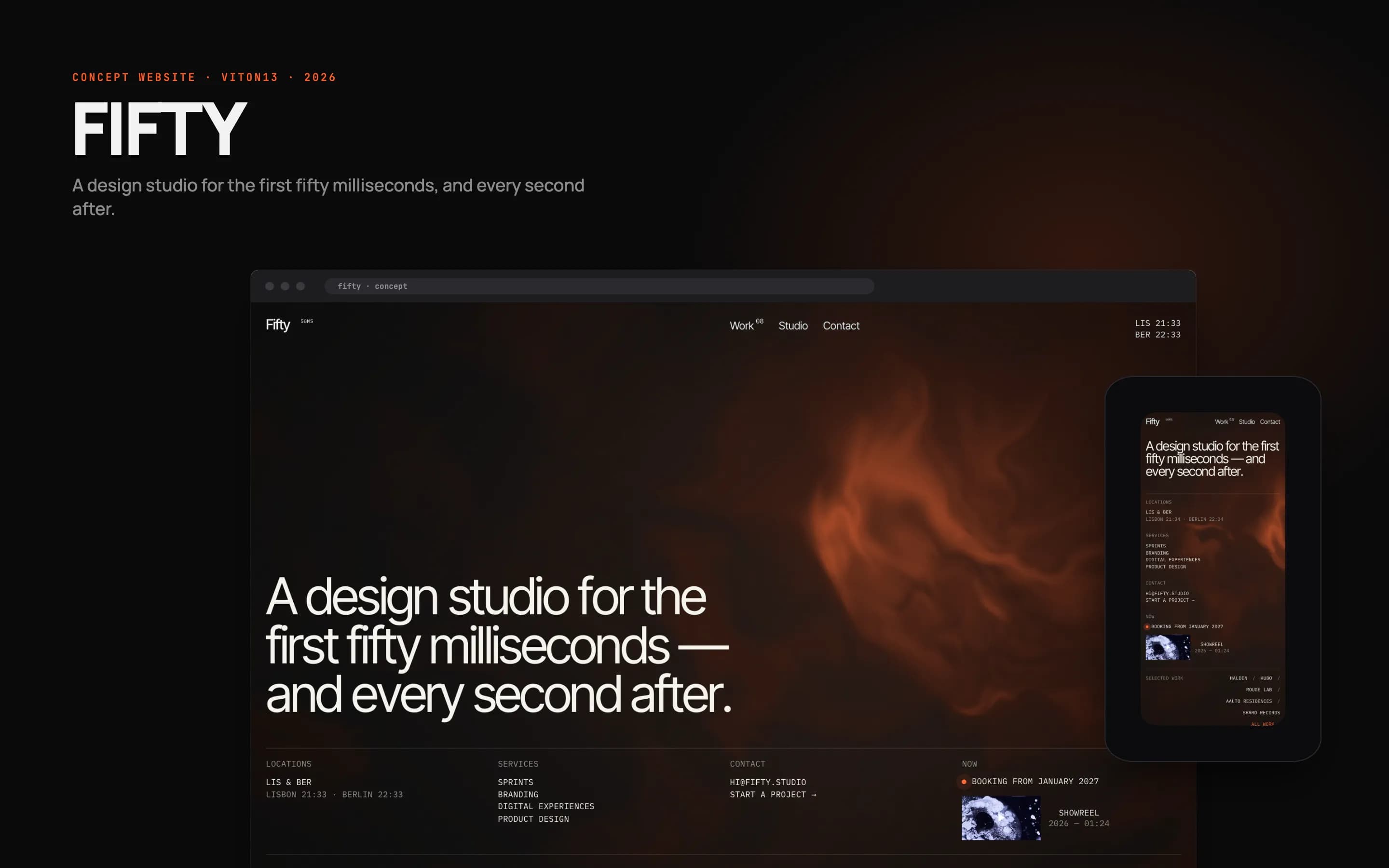
CONCEPTConcept — not a commissioned project
FIFTY
Concept studio site · 7 pages · English · 2026
A concept by VITON13 for a fictional digital design studio in Lisbon and Berlin, built on the idea that people judge a website in about fifty milliseconds. It is a compact business-card site: a live WebGL background, a work index with video previews and a brief builder on the contact page.
Read the case →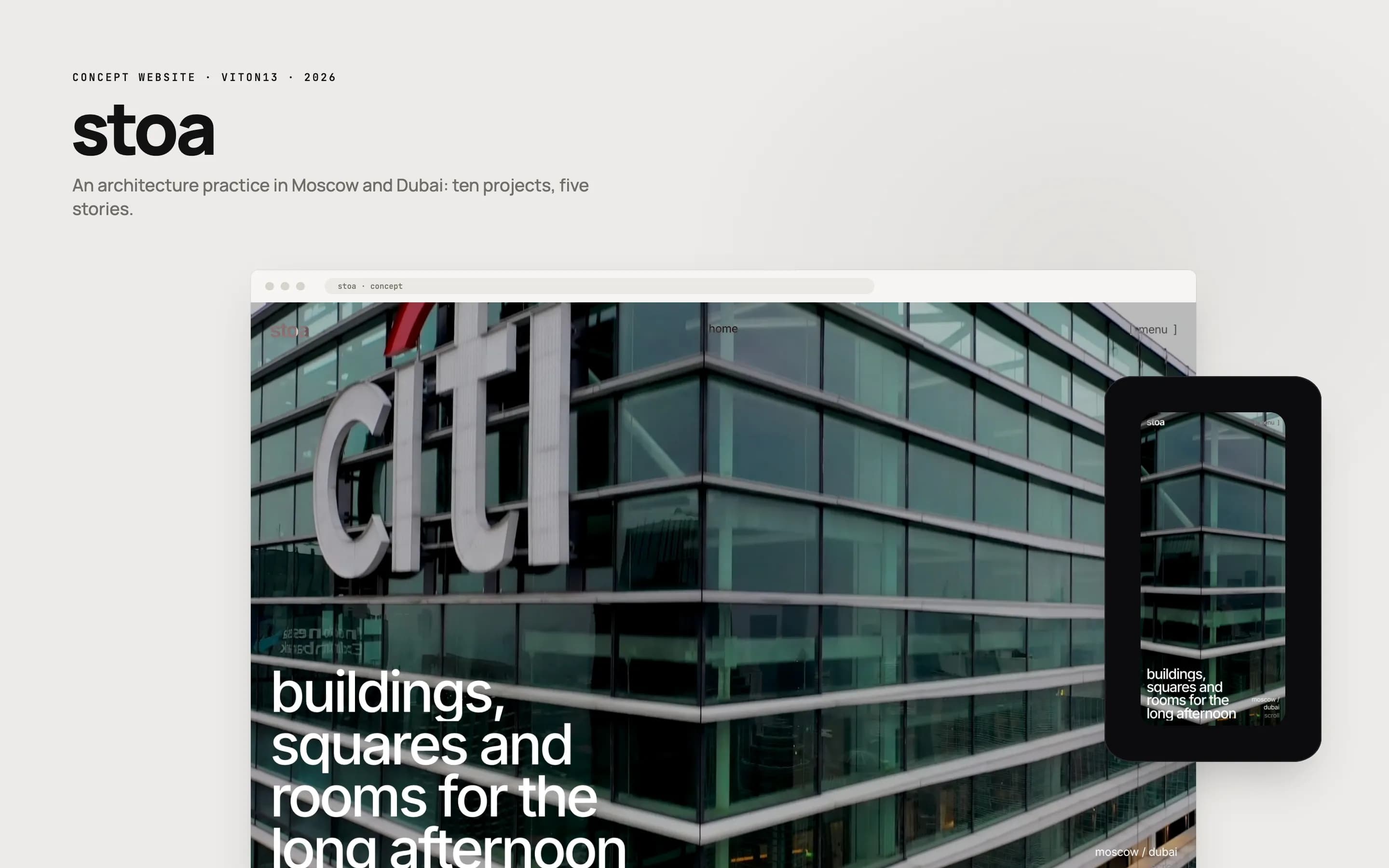
CONCEPTConcept — not a commissioned project
stoa
Concept · architecture practice · 10 pages · English · 2026
stoa is a fictional architecture practice with studios in Moscow and Dubai, and VITON13 built its site as a concept to show an editorial portfolio. Ten pages in lowercase English: a video hero, projects with filters, a journal, open roles and a dark contact map.
Read the case →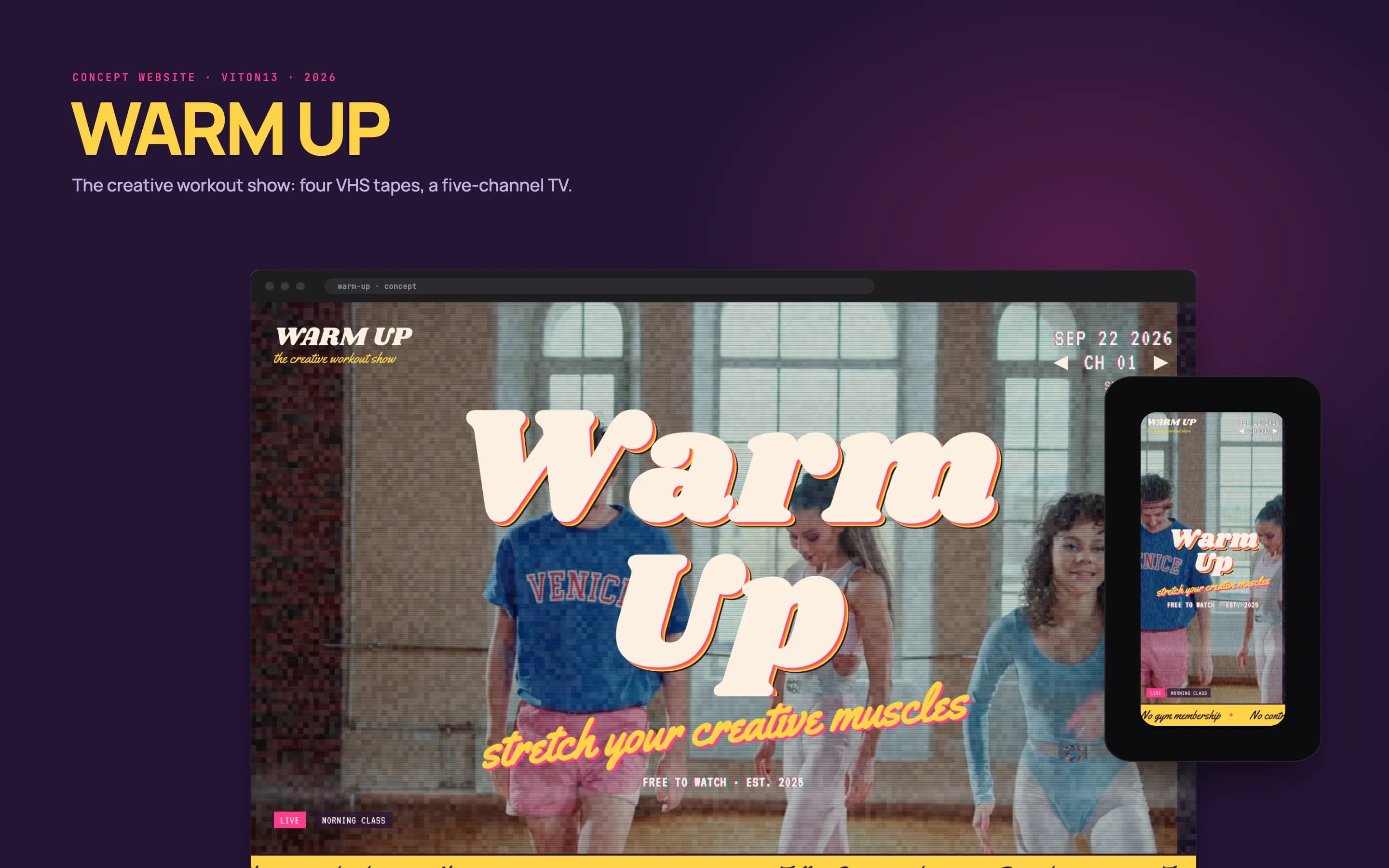
CONCEPTConcept — not a commissioned project
WARM UP
Concept · retro TV show · 7 pages · English · 2026
WARM UP is a fictional retro TV show that treats creative skills as muscles and presents its design guides as workout VHS tapes. VITON13 built its seven-page site as a concept: a VHS boot screen, a five-channel TV, 3D tape sleeves and a call-in hotline.
Read the case →