
Websites and development
How to check a web studio's portfolio before you hire: 12 questions (tested on our own 22 projects)
Check where each project comes from before judging how it looks. Ask whether it is CLIENT work, a CONCEPT built to show craft or the studio's INTERNAL product, then test one live client site yourself: PageSpeed Insights, the page source, and a dated Search Console screenshot behind any traffic claim. Of our 22 projects, one is client work.
What should every portfolio project be labelled: client, concept or internal?
Look past the visuals to provenance first: three kinds of work sit side by side in many studio portfolios, often unlabelled, and each proves something different.
| Label | What it is | What it proves | What it cannot prove | How to check it |
|---|---|---|---|---|
| CLIENT | Built for a business that commissioned it | It was paid for, approved and launched | That the studio caused the client's sales or traffic | Open the live site, find the studio's credit, ask for a reference |
| CONCEPT | A fictional brand made to show craft (spec work) | Design and front-end skill, testable in a lab | Work within a client's budget, content and deadline; any result | The case says “concept”; reverse image search finds stock sources |
| INTERNAL | The studio's own site, product or brand | The team can run a system in production | That a client would approve the same choices | Live under the studio's name; the Wayback Machine shows its age |
No label is a warning sign in itself. The warning sign is a portfolio where you cannot tell them apart: a fictional restaurant then passes for a paying client.
What does our own portfolio look like under these labels?
We labelled our own work first. On 24 September 2026 the portfolio held 22 projects: 21 works on the founder's site, tarasovvitalii.com, plus the site itself.
| Label | Count | Projects | What they let you judge |
|---|---|---|---|
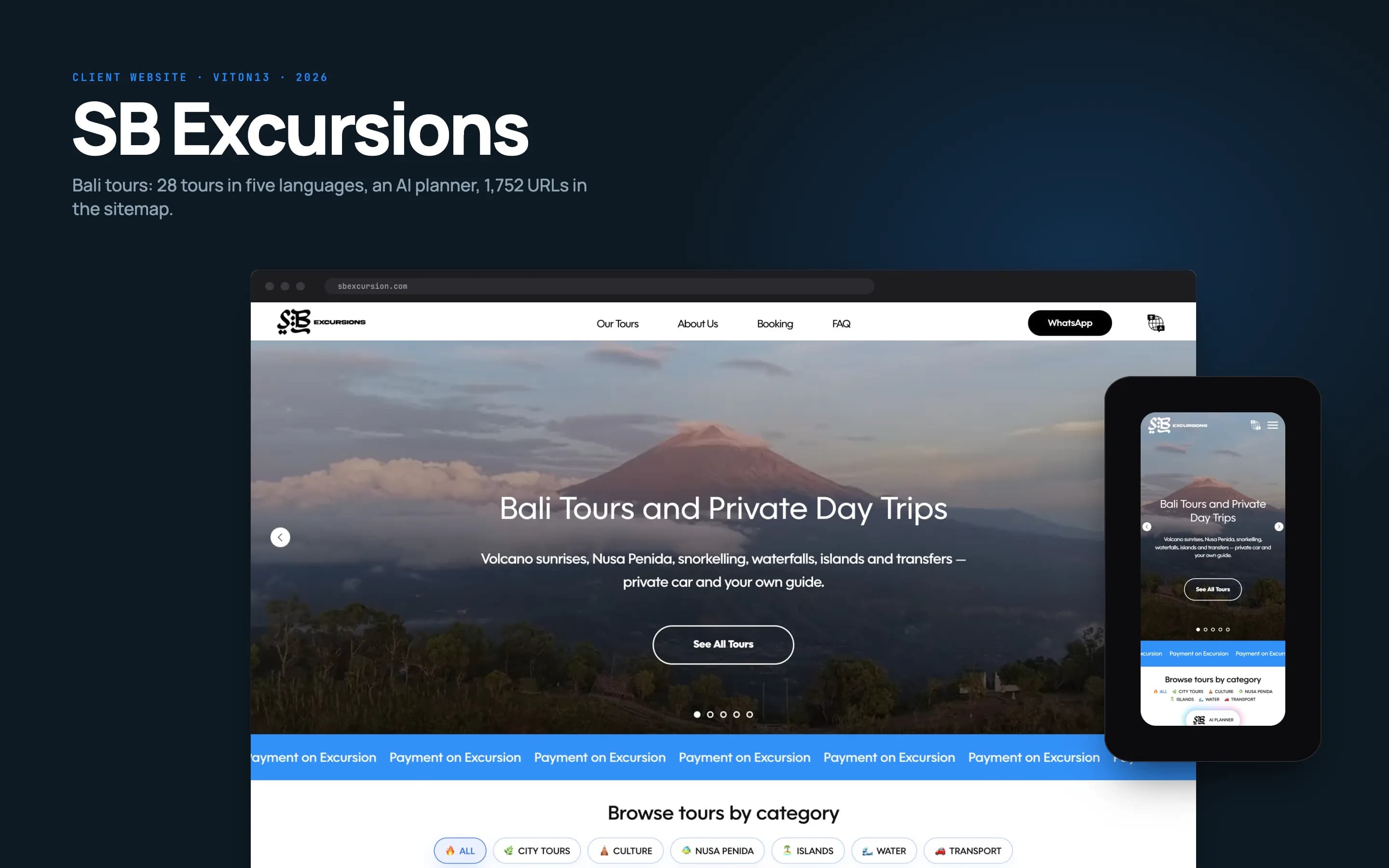
| CLIENT | 1 | SB Excursions, a Bali tours site in five languages | A launched client build with Search Console data |
| CONCEPT | 10 | Sites: ORIVA, VERIDA, VITALIANO, FIFTY, stoa, WARM UP, VITON13MEDICINE, HYPERSOLID. Brand concepts: VITON XIII BEAUTY, NUMBER ONE | Layout, motion, build and lab speed; no client or traffic |
| INTERNAL | 11 | viton13.com and its SEO clean-up, VIT MARKET, VJOURNAL, VITON ID, the VIT LIVE assistant, brand identities, brand films, Old Money, studio Reels, tarasovvitalii.com | Our own products in use, such as 7,215 URLs in viton13.com's seven live sitemaps on 19 September |
Read honestly: for proof that we can grow a client's search traffic you have one case, so weigh it as one. For proof that we can build a demanding front end you have eight concept sites and several live products to test. That is easier to judge than twenty-two logos.
Which 12 questions should you ask about any portfolio?
Ask them about the three projects closest to yours. One published rubric gives results 40% of the score, so count only results you have verified.
| # | Question | A good answer | Warning sign |
|---|---|---|---|
| 1 | Client work, concept or your own product? | A label on every project | Fictional brands among client logos |
| 2 | Where is it live today? | A URL that matches the screenshots | Screenshots only |
| 3 | What exactly did you do? | Named parts, and who did the rest | “Everything”, while the footer credits another agency |
| 4 | Who did it, and are they still with you? | Names and roles you will meet | Former staff or unnamed subcontractors |
| 5 | Where does each number come from? | Tool, property, dates and search type | A percentage with no period or tool |
| 6 | What was the baseline, and what else changed? | Equal before and after periods, season named | One “after” figure and a confident cause |
| 7 | Can I see the evidence? | A dated screenshot or view-only access, with consent | Every number is “confidential” |
| 8 | How does it perform on a phone? | Mobile scores with weak spots named | Desktop scores only, or an undated 100 |
| 9 | Photos, stock or AI images? | Stated for each project | Stock or AI passed off as the client's shoot |
| 10 | What did it cost, and how long did it take? | A range, and actual versus planned timeline | Only projects far above your budget |
| 11 | Can I talk to the client? | A reference call on a comparable project | Reviews only on the studio's own site |
| 12 | What does this project not prove? | Limits named unprompted | Every case is a success story |
Question 12 sorts studios fastest. Every VITON13 case has a “What this does not prove” section; ask other studios for the same.
How do you verify a live site yourself in 10 minutes?
You need a phone, a browser and five free tools: two minutes per step, on the live client project closest to yours.
- Open it on a phoneLoad the home page and one inner page over mobile data, open the menu and fill in a form without sending it. Heavy video headers show up here.
- Run PageSpeed InsightsPaste the URL into pagespeed.web.dev. Field data from real Chrome users over 28 days appears if traffic allows; “good” means LCP within 2.5 s, INP within 200 ms and CLS within 0.1. The lab score below is one simulated run (90–100 good, 50–89 needs improvement) and varies, so run it twice.
- Read the sourcePress Ctrl+U (Cmd+Option+U on a Mac) and search for a visible sentence. If it is missing, JavaScript draws the text, and not all bots run JavaScript. Search for the studio's name too: builders often leave a credit.
- Search the imagesRight-click the main image in Chrome and choose Search with Google Lens; stock matches are fine if the case says so. Check suspected AI images at contentcredentials.org/verify, though an empty result proves nothing: many sites strip metadata.
- Check the datesFind the domain's registration date in ICANN Lookup and the site's history in the Wayback Machine. A design archived before the studio says it built it needs explaining.
A lab score describes one page on one day: it reveals heavy pages, not whether a site sells.
What did this check find on our own sites?
On 22 September 2026 we ran Lighthouse on our client and concept home pages, mobile with default throttling and desktop.
| Project | Label | Mobile / desktop | Weak spot the case states |
|---|---|---|---|
| SB Excursions | CLIENT | 65 on mobile | LCP 7.8 s on phones |
| ORIVA | CONCEPT | 66 / 97 | 12.8 MB on a phone, LCP 7.3 s |
| VERIDA | CONCEPT | 69 / 94 | 16.7 MB on a phone, LCP 7.4 s |
| VITALIANO | CONCEPT | 70 / 93 | LCP 5.0 s on mobile |
| VITON13MEDICINE | CONCEPT | 75 / 99 | LCP 4.3 s despite a 0.5 MB page |
| stoa | CONCEPT | 88 / 99 | 13.4 MB on mobile, from a header video |
| WARM UP | CONCEPT | 88 / 73 | Desktop layout shift of 0.577 |
| FIFTY | CONCEPT | 89 / 100 | Pages with full-screen video not scored |
Two lessons apply to any portfolio. None of the eight reaches 90 on mobile, yet six of seven concepts score 93 or more on desktop: desktop tests flatter the work. All seven concepts also scored 100 for Lighthouse SEO without canonical URLs, Open Graph or structured data: that score checks basics, it is not an audit.
How should you read “we increased traffic by X%”?
A traffic claim has five parts: metric, tool, dates, baseline and evidence of cause. Clicks, sessions and impressions differ, so a claim that does not name one cannot be checked.
Take our own claim. In the SB Excursions owner's Search Console, web search, three months to 17 September 2026, the site averaged about 2.7 clicks a day before 7 August and about 26 from 14 August. (26 − 2.7) ÷ 2.7 ≈ 8.6, so “traffic up 860%” would be arithmetically true but misleading: a tiny baseline, a short period, clicks rather than bookings, and no way to separate our work from new language editions being indexed or the travel season. The case prints “×10” with both averages and calls the cause unproven.
When a studio quotes growth, ask for:
- A screenshot showing the property, dates and search type, or view-only access as a restricted Search Console user.
- Periods of equal length, plus the same weeks a year earlier.
- A dated list of site changes to match against each rise.
- The business number the traffic was meant to move, such as enquiries.
Are concept work, AI images and missing reviews warning signs?
Not by themselves; a concept dressed up as a client is. Our cases say “concept” up front and name sources: seven of our eight concept sites use licensed stock photos or video from Unsplash and Pexels, which a reverse image search should find.
AI images need the same honesty. The VITON XIII BEAUTY key visuals are all captioned as AI-generated, and the NUMBER ONE campaign visual spells the brand “NAMBER ONE”, a generation error its case discloses instead of showing the image. The GELO bottle visual carries Content Credentials signed for OpenAI, and its case says so.
In the US, the FTC's August 2024 final rule exposes fake testimonials, including AI-written ones, to civil penalties. Trust platforms the studio does not control, and a call with a past client. Our case pages quote no testimonials; these checks are our evidence.
What should the quote say once a portfolio passes?
A portfolio shows what a studio has done; the quote fixes what it will do for you. It should name:
- Deliverables by page type and device, and who supplies texts and images.
- Domain, hosting, analytics and Search Console in your company's name.
- A dated acceptance check, such as a Lighthouse run on the delivered templates.
- Review rounds, exclusions, post-launch terms, and how the studio may label your project in its portfolio.
For price ranges, see our small business website cost guide. If you are unsure you need a full site, read landing page vs website first.
How VITON13 does it
We build business websites and design corporate sites for companies that prefer to check the work. Choose AI-assisted (AI drafts, a developer directs and signs off) or human-led (a specialist builds, AI assists). Deliverables, inputs, review rounds and exclusions are fixed in writing first.
Business website development
- Price
- $113 AI-assisted or $173 human-led
- Timeline
- 3–5 working days
Corporate website design
- Price
- $113 AI-assisted or $173 human-led
- Timeline
- 7–12 working days
AI-assisted: AI drafts inside defined steps, a person directs and checks every result. Human-led: a specialist does the work and AI assists.
What is included
- 1 responsive build, checked on desktop and phone
- A page per agreed service, each leading to an enquiry
- Analytics setup with enquiry events
- Deployment on your company's domain and hosting
- 1 written completion note; build window 3–5 working days once materials are ready
Not included
- Texts, photos and translations, which you supply
- Domain, hosting, email and paid third-party services
- Booking, payments and site migration, quoted separately
- Ongoing SEO and any promise of traffic, rankings or sales
Revisions: 2 review rounds before launch; the exact number is confirmed in the written scope
Get an estimate in 1 working dayWritten estimate within 1 working day
Example
CLIENTClient project
SB Excursions, run through this guide's 12 questions
Our only client project, checked against the list. It is live at sbexcursion.com (question 2); VITON13 did its architecture, interface, build and search layer in five languages (question 3). The owner's Search Console, web search, three months to 17 September 2026: 1.08K clicks, 92.2K impressions, 1.2% CTR, average position 10.8 (question 5). Mobile Lighthouse performance: 65 (question 8).
What this does not prove
- That our work caused the rise in clicks after 7 August: language editions being indexed and the travel season fit the same dates.
- Anything about bookings or revenue: enquiries continue in WhatsApp, and the budget is not published.
- That we would repeat the result for another business or market: one case is a sample of one.
- That the site is fast: on phones its largest element takes 7.8 s to appear.
Read the case: SB Excursions: a Bali tours website in five languages, built to be found
Questions and answers
Is a portfolio of mostly concepts a reason to walk away?
No, if they are labelled and close to your project. Concepts show what a studio builds unconstrained, not how it handles your content, approvals and deadline. Ask for at least one live client or internal project, and start with a smaller first scope.
Can I ask to see a client's Search Console or analytics?
You can ask for evidence, but the data belongs to the client. Usually that means a screenshot showing property, dates and search type, or view-only access the client grants. A studio that shares nothing for any project asks you to trust its numbers.
Does a high Lighthouse score mean the site will rank or sell?
No. Lighthouse tests one page in a lab: performance reflects loading on a simulated device, and SEO checks basics such as titles. Rankings depend on content, links and competition; sales on the offer. Use it to spot heavy builds, not to predict results.
What if the studio says its strongest work is under NDA?
It happens. Ask for a walkthrough on a call with names removed, the company type and the scope, plus a reference who can confirm the project exists. If everything is under NDA, you are hiring on description alone, so keep the first job small.
Should I rule out a new studio with few client projects?
Not automatically. Labelled concepts and live internal products can show real skill. Reduce the risk instead: a smaller first scope, payment by milestone, accounts in your name from day one and a written acceptance check.
Are design awards and agency ratings a reliable signal?
They answer another question. Awards judge visuals, often of concepts, and some ratings rest on data agencies submit themselves. Ask how a rating verifies work: some reward a credit on the client's site or a case the client publishes. Then run your ten-minute check.
Sources
- Google — About PageSpeed Insights —
- web.dev — Web Vitals —
- Chrome for Developers — Lighthouse performance scoring —
- Google Search Central — JavaScript SEO basics —
- Search Console Help — Performance report —
- Search Console Help — Users and permissions —
- Google Search Help — Search with an image —
- Content Authenticity Initiative — Verify Content Credentials —
- ICANN Lookup —
- Internet Archive — Wayback Machine —
- RunetExpert — Web studio ranking criteria (in Russian) —
- FTC — Final rule banning fake reviews and testimonials —
- Design In DC — How to evaluate a web design agency portfolio —