
Websites and development
AI website builder or a web studio: when is a generated site enough, and when does it cost you?
An AI builder is enough for a simple brochure site you edit yourself, when looking like other sites is acceptable and nothing must connect to your tools. Hire a studio when the site is your sales channel or needs integrations, several languages or a distinct brand. VITON13 builds a landing page for $73 AI-assisted or $93 human-led.
What does an AI website builder actually make?
Two different products share the name. Site generators ask about your business and assemble pages from the platform's blocks, copy and pictures included; you edit and publish on their hosting. App builders write source code from a chat: pages, a database, sign-in. The first is a site on rent; the second is software that somebody has to look after.
| Site generators | AI app builders | |
|---|---|---|
| Examples | Wix AI, Durable, Hostinger AI Website Builder, Framer's AI agent | Lovable; Hostinger's agentic (vibe coding) mode |
| What you get | Pages made of the platform's blocks, with draft copy and images | Source code, a database, sign-in and forms |
| Leaving later | A Wix site has to keep running on Wix's servers, so leaving means a rebuild | Lovable's paid plans include code download and Git sync |
| Main risk | Looking like everyone else, and paying the plan for as long as the site lives | Unreviewed security, and code nobody on your side understands |
Durable advertises getting online in 30 seconds, and that is real progress. Yet no builder knows your prices, your past work or why a customer should pick you, and a sales page runs on exactly that.
When is an AI builder genuinely enough?
Plenty of businesses do not need a studio for their first site. A generated one is sensible when most of these are true:
- The site is a digital business card, and customers arrive through word of mouth, maps or social media rather than search.
- You will edit it yourself, and a monthly fee is easier to carry than a one-off invoice.
- One language, one city, and no booking, stock or payment system to connect.
- The brand can live with a template look for a year, because the offer is still being tested, not the design.
- The date matters more than the detail: an event, a pop-up, a test of demand.
Then spend the money on good photos and a clear offer, and come back to a studio when the site starts limiting sales.
Where do generated sites fall short?
The weak points are predictable, because the tool fills every gap with the most common answer.
- Sameness. Our research note on AI-generated websites lists the defaults a model reaches for without brand rules: centred heroes, blue-purple gradients, glass cards, bento grids, generic proof blocks. Visitors who saw ten such pages this week scroll past the eleventh.
- Invented specifics. Generated copy fills blanks with plausible years in business, awards or client counts; check or delete each one.
- Search. Google does not ban AI text, but it warns that generating many pages without adding value can breach its scaled content abuse policy, and it asks for accuracy in titles, descriptions, structured data and alt text too.
- Integrations. A CRM, booking calendar or stock feed the platform has no app for needs custom code, if the plan allows it.
- Exit. Wix's help centre says a Wix site must run on Wix's servers; the domain can move, the site cannot.
Is an AI app builder safe for logins, forms and payments?
Only once someone has checked it. In 2025 Veracode tested code from more than 100 language models: 45% of samples failed security tests with OWASP Top 10 flaws, and cross-site scripting went undefended in 86% of relevant samples. Bigger, newer models wrote more working code, not safer code.
Lovable scans at publish and offers a deeper scan for missing row-level security, open access rules, pasted API keys and vulnerable packages, yet its documentation leaves security to the owner and suggests a professional review for sensitive data. CVE-2025-48757, disclosed in May 2025, described Lovable projects whose database rules exposed names, emails and API keys.
What does each route cost over one and three years?
Builders charge rent; a studio charges once, plus hosting. List prices in US dollars, before tax, checked on 25 September 2026; the domain costs about the same everywhere, so it is left out.
| Route | Price as listed | First year | Three years | Watch for |
|---|---|---|---|---|
| Durable Launch | $25 a month, or $22 a month billed yearly | $264–$300 | $792–$900 | Your own domain starts on this plan; the free plan uses a durable.site address |
| Hostinger Premium | $2.99 a month with 48 months prepaid ($143.52) | $143.52 up front | $143.52, which covers four years | Renews at $10.99 a month |
| Framer Basic | $10 a month | $120 | $360 | 30 pages; extra languages are a paid add-on |
| Lovable Pro | $25 a month for 100 credits, or $250 a year | $250–$300 | $750–$900 | Heavy building burns credits faster |
| Wix Light | $17.77 a month billed yearly, USD shown for reference | $213.24 | $639.72 | Prices and currency vary by location; the free plan cannot use your own domain |
| VITON13 landing page | Build $73 AI-assisted or $93 human-led; design, if you need it, $73 AI-assisted or $93 human-led | One-off, plus hosting | No plan fee; hosting is billed by its provider | Copy and photos are yours; see the exclusions below |
Every builder row hides two more costs: your hours spent prompting, rewriting and checking, and the price after the promotion, which on Hostinger more than triples.
A one-page static site often fits a free hosting tier: Cloudflare Pages Free allows 500 builds a month.
Which five questions decide between a builder and a studio?
| Question | A builder is fine if… | A studio pays off if… |
|---|---|---|
| Is the site your sales channel? | Sales happen by phone, in person or through referrals | Ads or search send strangers who decide on the page itself |
| Does it have to connect to anything? | A contact form that lands in your inbox is all you need | Bookings, a CRM, stock, payments or a custom calculator |
| How many languages and markets? | One | Two or more, each with its own addresses and search settings |
| How distinctive must the brand look? | A clean template is acceptable for now | Design is part of what you sell, or your competitors already look generic |
| Who maintains it? | You, in the builder's editor | A developer or a studio on call, working on code you own |
Three or more answers on the right mean the builder will cost more in workarounds than it saves in fees. One or two: start on the builder, keep the domain in your name and plan the move.
Can you start with an AI draft and have a studio finish it?
Yes, and it is often the cheapest honest route. A generated draft is a useful brief: it shows the sections, tone and order you like. A studio keeps that thinking and replaces what the tool guessed.
- Keep: the section order, approved headlines and the page list.
- Replace: the stock layout with a design built from your brand, invented numbers with real ones, generic proof with your work.
- Add by hand: titles, descriptions, structured data, redirects and analytics events.
If the draft is code, say a Lovable project on GitHub, the question is rescue or rebuild. Our AI-generated code rescue ($73 AI-assisted or $93 human-led, 5–8 working days) reproduces what fails, protects critical routes and replaces unsafe parts step by step. A draft inside Wix has no code to rescue, so the page is rebuilt from its content and keeps your domain.
What should you have ready before choosing either route?
- One sentence on who the site is for and what a visitor should do next.
- Real facts: prices, service area, hours and three pieces of proof.
- Photos you own or licensed; label generated images a customer could mistake for real work.
- The domain registered in your own name.
- The inbox or CRM where leads should arrive, and the person who answers them.
When not to order from us: with no offer, photos or clear customer yet, the cheapest builder plan is the right tool for finding out. A studio cannot design around facts that do not exist.
How VITON13 does it
We build one conversion page in 5–8 working days from an approved design: yours, our Launch Landing design ($73 AI-assisted or $93 human-led, 3–5 working days) or your AI draft reworked into one. Pick AI-assisted, where AI drafts and a developer checks and signs off, or human-led. Send the draft link or a short brief, and a fixed scope with its final price comes back in writing within one working day.
Landing page development
- Price
- $73 AI-assisted or $93 human-led
- Timeline
- 5–8 working days
Launch Landing
- Price
- $73 AI-assisted or $93 human-led
- Timeline
- 3–5 working days
AI-generated code rescue
- Price
- $73 AI-assisted or $93 human-led
- Timeline
- 5–8 working days
AI-assisted: AI drafts inside defined steps, a person directs and checks every result. Human-led: a specialist does the work and AI assists.
What is included
- 1 page of up to 8 sections, built from the approved design
- Mobile and desktop layouts, every section checked on both
- 1 lead form with a thank-you state, delivered to your email or CRM
- Up to 5 analytics events in GA4 or Yandex Metrica, each fired once to prove it records
- 1 deployment on your domain with SSL, with a crawlable page and a written publishing handoff
Not included
- The page design itself, unless you add the Launch Landing design package
- Copywriting, photography and translations
- Ad campaign setup and ad budget
- The domain, paid hosting after the first deployment and paid third-party tools
Revisions: 2 review rounds on the delivered page, recorded in the written scope
Get an estimate in 1 working dayWritten estimate within 1 working day
Example
CONCEPTConcept — not a commissioned project
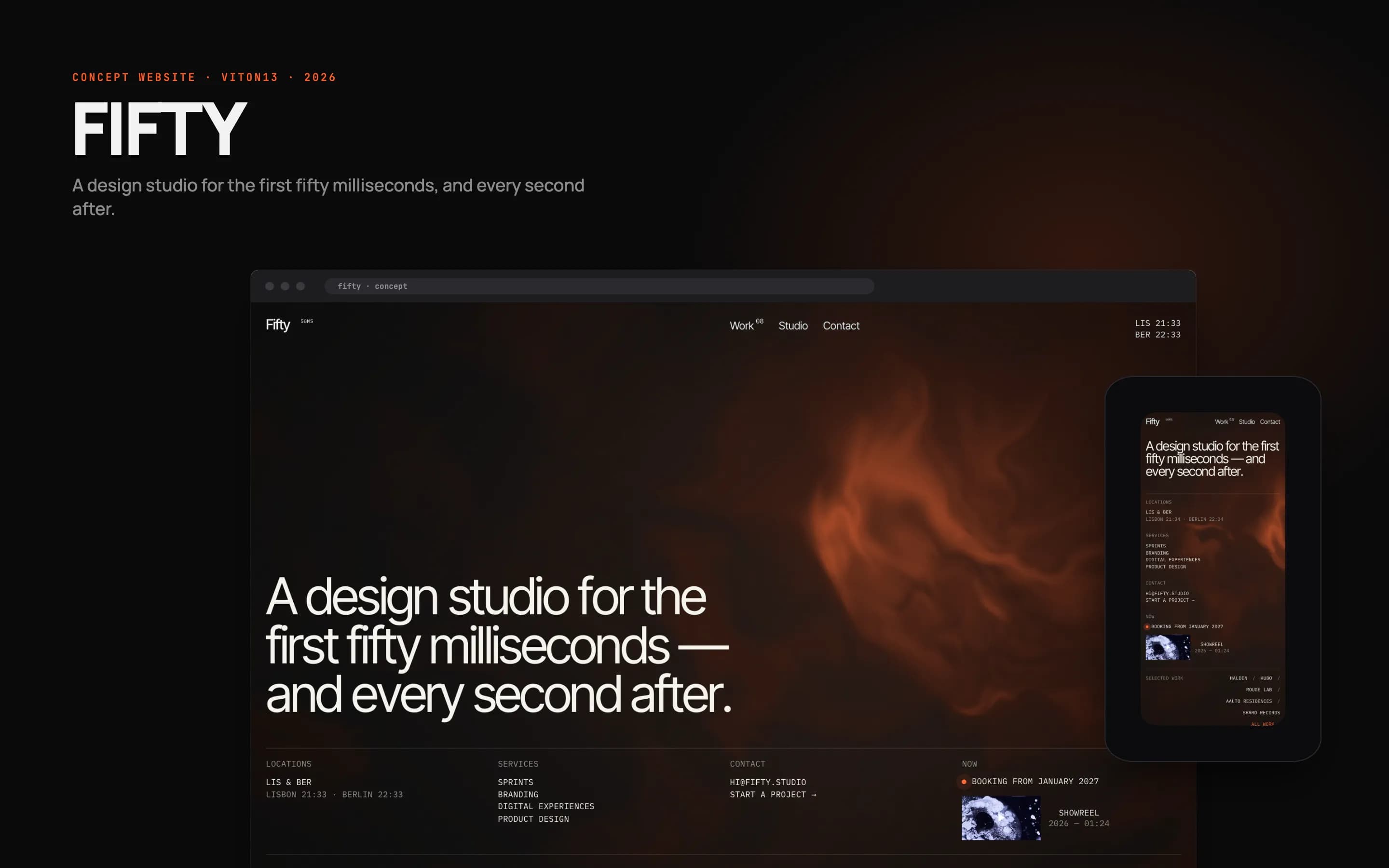
FIFTY: a concept studio site built for the first fifty milliseconds
FIFTY is a VITON13 concept for a fictional design studio in Lisbon and Berlin, built on the idea that a site must make its point before anyone reads it: 7 pages, 8 projects and a WebGL shader written for it. On 22 September 2026 Lighthouse scored its home page 89 on mobile and 100 on desktop, at 2.1 MB. The same check found no canonical tags, Open Graph or structured data on its 6 rendered pages and no sitemap, while Durable's free plan lists structured data and a sitemap as standard. Hand-built design needs that layer finished on purpose.
What this does not prove
- FIFTY is a concept: the studio, its people, projects and addresses are fictional, and the site has no domain, visitors or enquiries.
- The Lighthouse scores are lab tests of the home page on one day, not real-visitor data; the project pages were not scored.
- It was never compared with a generated site, so it does not show that hand-built design converts better.
- Its photos and video are licensed stock from Unsplash and Pexels, not a studio's own work.
Read the case: FIFTY: a concept site for a design studio built around the first fifty milliseconds
Questions and answers
Will Google penalise a site written with AI?
Not for being written with AI. Google holds AI content to the same Search Essentials as any other; the trouble starts when many pages are generated without value for readers, which can breach its scaled content abuse policy. Check every generated title, description and alt text for accuracy, and delete any claim you cannot back up.
Who owns a site made with an AI builder?
You own your text, and the domain if it is in your name. The site is different: a Wix site must stay on Wix's servers, while Lovable's paid plans let you download the code. With VITON13, the agreed rights and editable files pass to you under the project terms after payment.
How long does a studio take compared with a builder?
A builder produces a draft the same day, but a publishable site takes as long as your copy, photos and checks. Our landing page build takes 5–8 working days from an approved design, and the Launch Landing design takes 3–5 working days before it. On either route the usual delay is content, not code.
What if the AI-assisted version gets something wrong?
AI drafts, and a developer checks and signs off before anything reaches you. The page then goes to a preview address, you test it on your own phone and send corrections, and two review rounds are included. Anything outside the written scope, such as a new feature, is estimated separately before work continues.
How do payment and cancellation work?
You first receive a written scope, timeline, final price and payment route, and nothing is charged before you confirm. You can cancel free of charge before approving the scope. Once work starts, completed work is charged and the unstarted remainder is refunded.
Sources
- Durable — Pricing —
- Durable — Home page —
- Wix — AI Website Builder —
- Wix Help Center — Exporting or embedding your Wix site elsewhere —
- Wix — Plans —
- Hostinger — AI Website Builder —
- Framer — Pricing —
- Lovable Docs — Subscription plans —
- Lovable Docs — Security —
- Matt Palmer — CVE-2025-48757 disclosure —
- Veracode — 2025 GenAI Code Security Report —
- Google Search Central — Using generative AI content on your website —
- Cloudflare Pages — Limits —
- VITON13 Research — Why most AI-generated websites look the same —