
Marketing, SEO and AI search
How does a local service business get recommended by ChatGPT, Gemini and Google AI Mode?
Asked for a plumber or a dentist nearby, an AI assistant largely draws on map and listing data: your Google Business Profile, your Bing, Apple and Yandex listings, review sites and your service pages. To be recommended, make those sources agree on who you are, where you work and what you charge, then earn reviews that describe the job.
Where do AI assistants get their answer to a “near me” question?
“Who can fix a leaking boiler near me tonight?” is not answered from a model's memory. The assistant estimates where the person is, queries place data and the web, and writes a shortlist. Most of that place data sits in a few databases you can claim at no cost.
| Assistant | Local facts come from | Listing you control |
|---|---|---|
| Google AI Mode, AI Overviews, Ask Maps (Gemini in Google Maps) | Google's index and Maps; Ask Maps reads 300 million+ places and reviews from 500 million+ contributors | Google Business Profile |
| ChatGPT search | The web, plus listing providers that get an approximate location; Yelp reviews, ratings and photos under a licence reported on 23 July 2026 | Your Yelp page and other directories |
| Microsoft Copilot | Bing search and Maps; deeper Copilot integration announced | Bing Places, which imports a Google profile |
| Siri and Apple Maps | Apple's own place data | Apple Business (free), shown in Maps, Siri and Spotlight |
| Alice AI and the Yandex Maps AI chat | Yandex Search and Maps; the chat reads place descriptions and user reviews | Yandex Business |
So the listing is what gets recommended, and your website is where the assistant confirms what a listing leaves out: the exact service, the price, the streets you cover.
Why does an assistant name a competitor instead of you?
Google ranks local results on relevance, distance and prominence (how well known a business is, reviews and links included), and says a better local ranking cannot be bought. Answers built on map data inherit that logic and need words to match: “emergency” or “open on Sunday” can only match text in a category, a service description or a review. The usual gaps:
- A broad primary category (“Contractor”) where a precise one fits (“Roofing contractor”).
- A service listed on the website but missing from the listing.
- Blank or stale hours, so “open now” questions skip you.
- Few or old reviews that never name the work done.
- A service page that is not indexed; the technical SEO checklist guide covers that.
Distance should not be faked: Google's guidelines reject unstaffed virtual offices and keep a service area within about two hours' drive of the base.
Which business facts must match on every listing?
Assistants compare sources. If your site shows one phone number and two directories another, the model may prefer a rival whose details agree. Keep this audit as a sheet and repeat it after any change.
| Fact | Where to check | Typical mismatch | Fix |
|---|---|---|---|
| Business name | Signage, site, every listing | Keywords added: “Smith Plumbing – 24/7 Emergency Plumber Leeds” | The name on your signage; Google bans taglines |
| Address or service area | Contact page, markup, listings | A home address shown for a mobile business | Hide it if customers never visit; list real areas |
| Phone | Site, listings, ads | A call-tracking number as the main line | One local number everywhere |
| Categories | Every listing | Five loose categories | As few and as specific as possible |
| Hours and holidays | Listings, site, booking tool | Summer hours never switched back | Update everything the same day |
| Services and “from” prices | Listing, service pages | Listing and price page disagree | One dated price list |
Claim listings you never created and correct them, or ask the platform to remove duplicates: a forgotten one with an old address keeps feeding the wrong fact to every system that reads it.
How do you earn reviews and mentions an assistant can use?
Google says more reviews and positive ratings can help local ranking. Reviews are also text that assistants summarise: in BrightLocal's 2026 survey of 1,002 US adults, 45% had used an AI tool for local recommendations, up from 6% a year earlier, and 82% read AI-written review summaries. “Replaced the pump the same evening in Chorlton” gives an assistant a service, a speed and a place; “great service!” gives it nothing.
- Ask every customer when the job is done, with a direct link, and do not choose who gets asked.
- Suggest what to mention (service, area, speed), never what to say about quality.
- Reply to each review with facts, including what changed after a complaint.
- Earn true local mentions: a supplier's installer list, a club you sponsor, local news.
Google's Maps policy bans incentives for reviews and asking only happy customers. The US FTC rule of August 2024 bans fake and AI-generated reviews and undisclosed insider reviews, with civil penalties. And do not mark up your own reviews: Google recommends review markup only on sites that review other businesses.
What should a service page say so an assistant can quote it?
Open each service page with the facts a person checks before calling:
- What you do and for whom: “boiler repair for homes, most makes”.
- Where: the districts you cover, written out, not only drawn on a map.
- When: hours, emergency cover, the usual wait for a visit.
- How much: a dated “from” price, and what pushes it up.
- What happens next: a call, a message or a booking form.
Write one page per real service, not one per town: Google's spam policies call city pages that funnel visitors to one page doorway abuse. An area page needs facts true for that area, such as response times or jobs done there.
Mark the page up as LocalBusiness or a subtype such as Plumber, using only what the page shows. Markup wins no recommendation by itself; it removes doubt about which business the page describes.
How do you check each month whether AI recommends you?
Local answers depend on where the question is asked: ChatGPT, for one, may use an approximate location from the IP address unless the user shares a precise one.
- Write 10–12 local prompts“[service] near me”, “[service] in [district] open on Sunday”, “how much is [service] in [town]”, plus one in each language your customers speak.
- Pin the locationAsk from inside your area or name the district, in a fresh session. Note date and device.
- Cover five assistantsChatGPT, Gemini, Google AI Mode, Copilot, and Alice AI for Russian-speaking buyers.
- Log the whole shortlistWere you named, in what position, beside which rivals, and which source did the assistant show?
- Fix the source, then waitA wrong fact usually traces back to one listing. Correct it, date the change and repeat next month; compare months, not single answers.
Keep calls and website clicks from your Business Profile beside the log, and ask new customers how they found you.
What does it cost: do it yourself, local SEO or GEO work?
Most of this costs time, not money. Pay when you cannot spare the hours or cannot explain what three monthly tests show.
| Route | Cost | What you get | Choose it when |
|---|---|---|---|
| Do it yourself | Your time; listings are free | Claimed listings, audit sheet, prompt log | One location, a site you can edit |
| Citation software | BrightLocal Citation Builder: from $2 per citation | Directory listings created or corrected | Dozens of directories to clean up |
| VITON13 Search Snapshot | $33 AI-assisted or $53 human-led, 1–2 working days | Your main searches next to three rivals, on one page | You cannot tell where the gap is |
| VITON13 Local SEO | $53 AI-assisted or $73 human-led, 3–5 working days | Location evidence audit, local page and profile plan, review controls | Listings disagree, or you serve several areas |
| VITON13 GEO Optimisation | $93 AI-assisted or $113 human-led, 7–12 working days | Baseline, up to 5 pages reworked, profiles checked, re-run after 30 days | The basics hold, yet assistants name rivals |
For one location in a quiet market, AI-assisted is enough: AI drafts, a specialist edits and checks. Choose human-led for clinics, law firms, a name shared with another business or several locations: it adds an expert interview and checks twice as many profiles.
When should a local business not pay for AI visibility yet?
- The listing is unverified, suspended or duplicated: fixing that is free and comes first.
- The website is not indexed: start with a technical SEO audit.
- Prices or service area are not settled: no page can state what the business has not decided.
- You have a handful of reviews: spend a month asking every customer first.
Walk away from sellers who promise a slot in ChatGPT's answer, sell review bundles or rent a virtual address to “rank” in another city. None of these systems sells an organic recommendation.
How VITON13 does it
For a local business we run GEO Optimisation with a local brief: questions in your customers' words, runs made for your service area, and a profile check of the listings assistants read in your market. It costs $93 AI-assisted or $113 human-led and takes 7–12 working days. Send the request form: a written estimate with the exact scope arrives within one working day, and nothing starts until you approve it.
GEO Optimisation
- Price
- $93 AI-assisted or $113 human-led
- Timeline
- 7–12 working days
AI-assisted: AI drafts inside defined steps, a person directs and checks every result. Human-led: a specialist does the work and AI assists.
What is included
- A 40-check baseline: 10 local questions in 4 assistants agreed in the scope, with who was named and which source was shown
- Up to 5 key pages reworked to open with the answer and state area, hours and a dated price, with 5–8 FAQ answers
- Structured data on those pages where it applies: Organization (as LocalBusiness for a local firm), Service, FAQPage, BreadcrumbList
- 5 external profiles checked against your site (10 in the human-led option), with a list of corrections
- robots.txt recommendations for the crawlers behind these assistants
- The same 10 questions asked again 30 days after go-live, compared row by row
Not included
- Pages beyond the 5 reworked ones
- Collecting reviews for you, paid placements, link building or PR
- Profiles we cannot get access to, and any listing or directory fees
- Any promise that an assistant will name or cite you
Revisions: 2 rounds on the page copy and 1 on the structured data
Get an estimate in 1 working dayWritten estimate within 1 working day
Example
CLIENTClient project
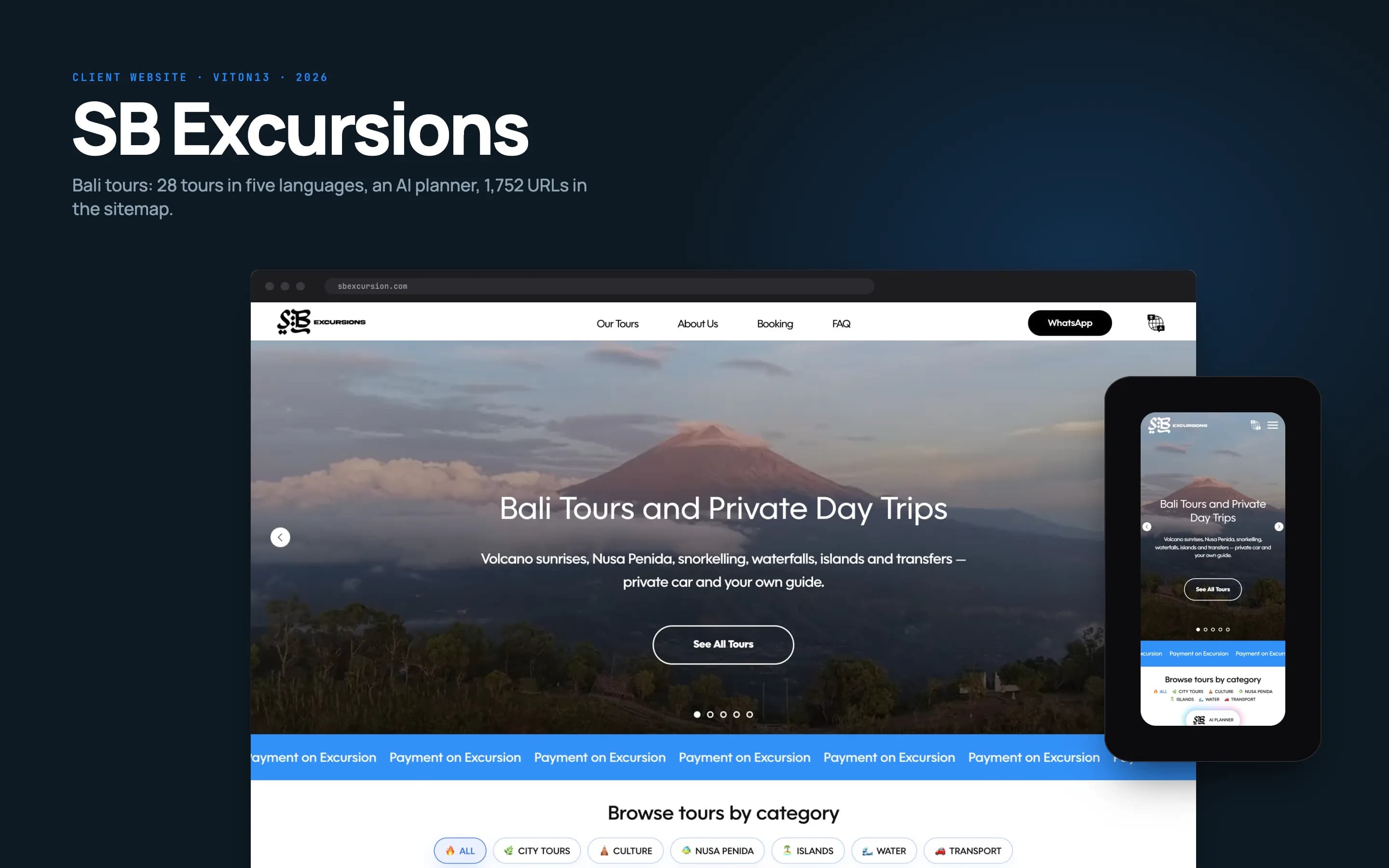
SB Excursions: a Bali tour operator's site that states its facts plainly
SB Excursions runs private tours in Bali, a local service travellers compare before messaging anyone. We designed and built its five-language site. Every tour card repeats duration, pickup, route and price, and titles give the practical answer, such as “Ubud Tour: 10 Hours, Hotel Pickup, $65 per Car + Tickets”. Pages carry TravelAgency, TouristTrip and FAQPage markup, and robots.txt lets GPTBot, ClaudeBot and PerplexityBot in. The owner's Search Console reports 1.08K clicks and 92.2K impressions over the quarter ending 17 September 2026, at an average position of 10.8.
What this does not prove
- That any assistant recommends SB Excursions: no AI answers or mentions were measured for this site.
- Anything about map listings or reviews: the case covers the website, not the operator's listings.
- Bookings: enquiries continue in WhatsApp, and Search Console counts only visits from Google Search.
- High rankings: at an average position of 10.8, plenty of searches still land on the second page.
Read the case: SB Excursions: a Bali tours website in five languages, built to be found
Questions and answers
Do I still need a website if my Business Profile is complete?
Yes, for anything beyond the simplest question. A profile holds hours, a phone and a category; an assistant asked about a price, a specific service or a district needs a page that states it. A short site with one clear page per service is enough for most small firms.
How long before assistants start naming my business?
There is no reliable date. Listing edits pass each platform's own review, and every assistant refreshes its sources on its own schedule, so one prompt can return different shortlists a week apart. Run the same local prompts monthly: a pattern across two or three months is the signal, not a single answer.
Can I pay to be recommended by ChatGPT or Google?
Not in the organic answer. Google says a better local ranking cannot be requested or bought, and paid placements are labelled as ads. Be wary of anyone selling a place in an AI recommendation: at best they are selling ordinary listing work under a new name.
What should I do if an assistant shows wrong hours or an old address?
Open the source the answer shows, or ask the assistant where the fact came from. It is usually one stale listing, or a directory that copied it. Correct that listing, remove duplicates, update your site the same day and repeat the prompt a few weeks later.
What if the AI-drafted copy on my pages gets something wrong?
In the AI-assisted option, AI writes the first draft and a specialist edits every page and validates the markup before you see it. You then approve the copy, with two rounds of changes on the text and one on the structured data. Only facts you confirm, such as prices, areas and hours, go live.
Who owns the pages, and can the price change later?
The pages are yours: they go live on your site or are handed over ready to paste, and your listings stay in your own accounts. Price and scope are fixed in the written estimate before work starts; anything added later is quoted separately, with your agreement.
Sources
- Google — How to improve your local ranking —
- Google — Guidelines for representing your business —
- Google — Optimizing for generative AI features —
- Google — LocalBusiness structured data —
- Google — Spam policies —
- Google Maps — Prohibited and restricted content —
- Google — Ask Maps —
- OpenAI Help — Searching the web with ChatGPT —
- Yahoo Finance — Yelp–OpenAI licensing deal —
- Bing — The new Bing Places for Business —
- Apple Business —
- Yandex — Alice AI launch (in Russian) —
- Yandex — AI chat in Yandex Maps (in Russian) —
- US FTC — Rule on fake reviews and testimonials —
- BrightLocal — Local Consumer Review Survey 2026 —
- BrightLocal — Pricing —