
Marketing, SEO and AI search
Marketing strategy for a company: what it is, what it includes, an example and what it costs
A marketing strategy is a written set of choices: which customers to win first, what to promise them, which channels and budget carry the promise, how progress is measured and what you stop doing. Expert Market puts the average one-off UK strategy project at £2,500, and VITON13 builds one from $93.

What is a marketing strategy, in plain words?
A marketing strategy is a short list of decisions made before the budget goes out: the goal for the year, the customers you go after first, the promise you make them, the channels that carry it and what each channel may spend. Just as important is what you rule out. A strategy that excludes nothing is a wish list.
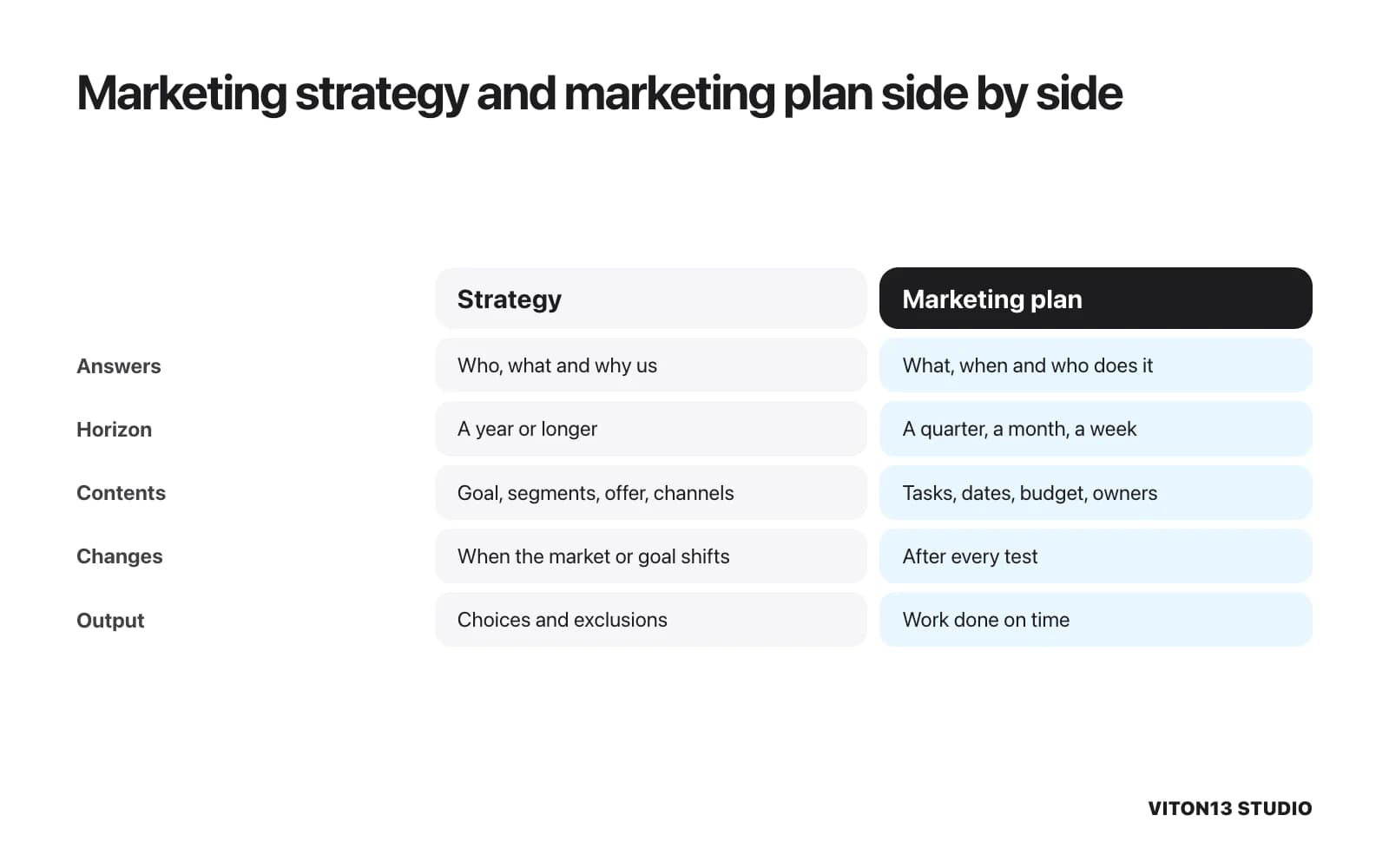
The US Small Business Administration says most marketing plans cover the target market, competitive advantage, sales plan, goals, an action plan, the budget and how results are measured. The strategy is the first half of that list, the choices; the plan is the second half, the dated tasks that carry them out.
What does a marketing strategy include?
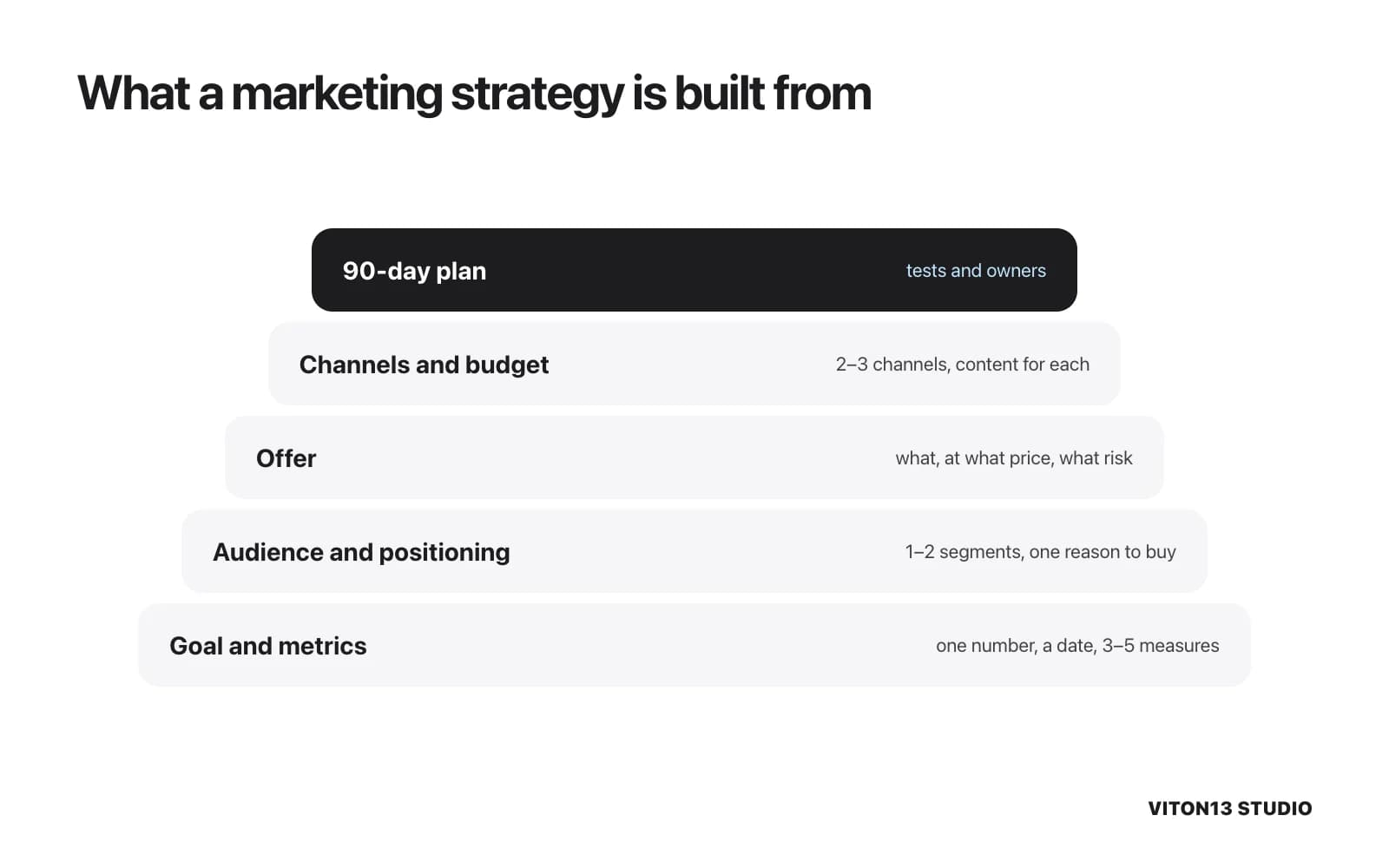
Seven parts cover almost any small or mid-sized business. Decide them in this order, because each depends on the answer before it.
| Part | Question it answers | Finished when |
|---|---|---|
| Goals and metrics | What should we achieve this year? | There is a number, a date and 3–5 measures checked monthly |
| Audience | Who buys, and why now? | One or two segments are described by their need and where they look |
| Positioning | Why us over the alternative? | The difference can be proved and a rival could not claim it |
| Offer | What, on what terms, at what price? | The buyer’s first step has a clear price and a low risk |
| Channels and budget | Where do we reach buyers, and for how much? | Each channel has a role, a cap and a rule for switching it off |
| Content | What do we say at each step? | Topics and formats are set a month ahead |
| 90-day plan and measurement | What now, and how will we know it worked? | Tasks have owners and dates; tests have a pass mark |
Marketing strategy example: a small coffee roaster
Imagine a small roaster in Leeds that sells beans in its café and on a marketplace. Most orders are one-off, and the owner wants steady income without opening a second site.
| Part | Decision |
|---|---|
| Goal | From 40 to 250 active subscriptions in 12 months, beans every two weeks |
| Metrics | New subscriptions a month, cancellations, cost per subscriber, margin per order |
| Audience | Home brewers who already buy fresh coffee; then offices of up to 30 staff |
| Positioning | Beans arrive within three days of roasting, roast date on every bag |
| Offer | 30% off the first delivery, free switching, one-click pause; a trial week for offices |
| Channels and budget | £1,500 a month: Google search ads, Google Business Profile, email to past customers, a QR leaflet in every bag |
| What we stop | Marketplace discount promotions and the second café, this year |
| 90-day plan | Month 1: subscription page. Month 2: ads live, five offices on trial. Month 3: review and switch off the weakest channel |
| Measurement | A promo code per channel, UTM tags, one sheet updated every Monday |
“What we stop” is the row that turns a to-do list into a strategy: without it the roaster would keep doing a little of everything and never learn which channel brings subscribers.
How can you tell whether your business already has a strategy?
Self-check
Does your business have a marketing strategy?
Tick what is true today, not what you plan to make true.
ticked 0 of 8
Your result: No strategy yet, only activities. Start with the first two steps below: a goal in numbers and one main segment.
How do you create a marketing strategy in five steps?
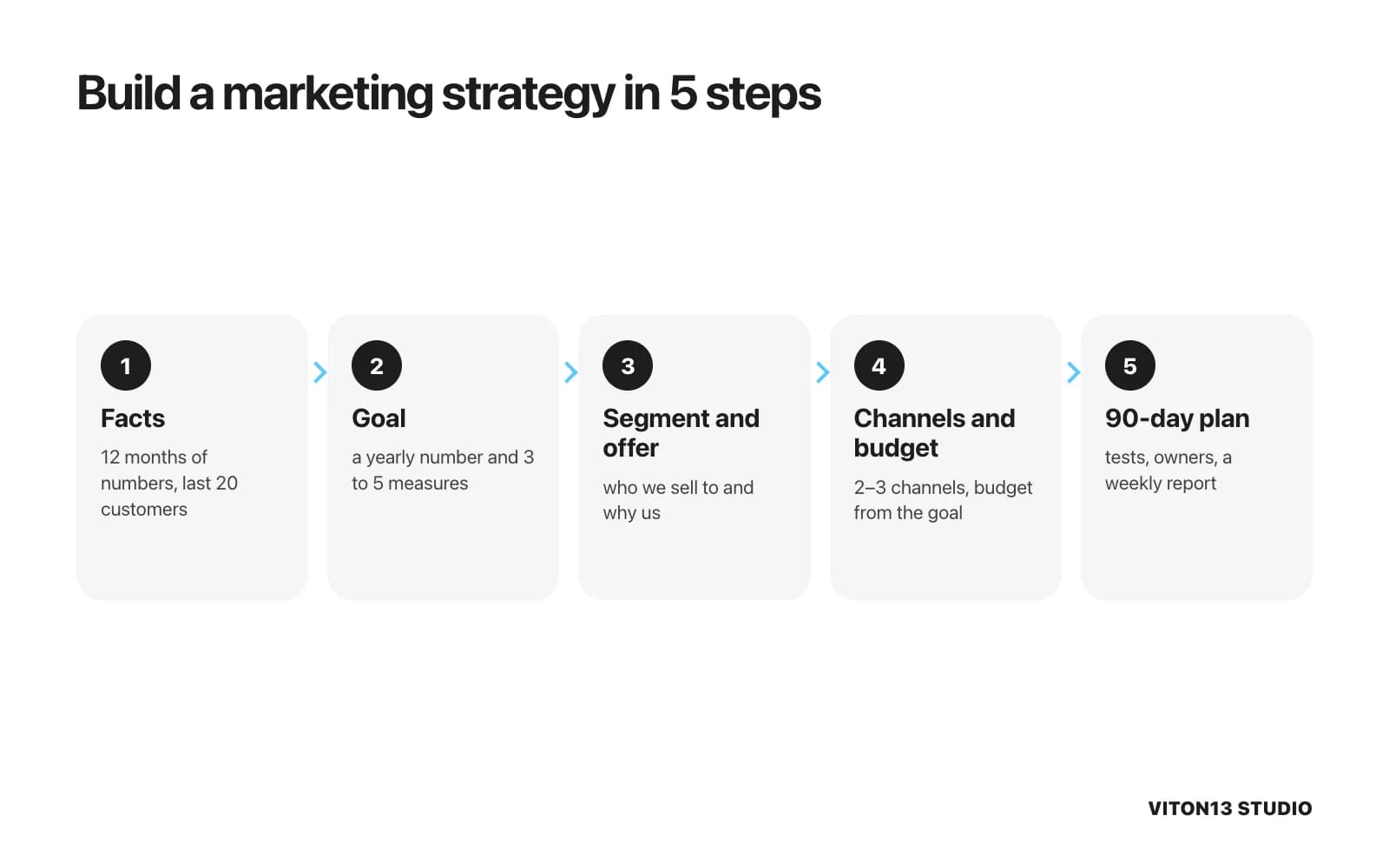
A small business can write its own strategy in a few working days if the numbers are to hand. Give each step a written answer before moving on.
- Gather the factsTwelve months of revenue and enquiries, where your last 20 customers came from, the prices and promises of 3–5 competitors.
- Set the goalOne number for the year and 3–5 measures: specific, measurable, achievable and dated.
- Choose the segment and offerOne or two segments, one reason to choose you, a first step with a clear price, and a note of who you will not serve.
- Assign channels and budgetTwo or three channels with a role and a cap each. Budget equals customers needed times the cost per customer your margin can bear.
- Plan the next 90 daysWeekly tasks with owners, tests with pass marks, one shared sheet. After 90 days cut what failed and back what worked.
Check each channel’s rules before relying on it. The ICO says you must not send marketing emails or texts to individuals without specific consent, apart from a soft opt-in for past customers who bought something similar and were offered an opt-out every time.
How much of your revenue should go on marketing?
Gartner’s 2026 CMO Spend Survey, published on 11 May 2026, puts marketing budgets at 7.8% of company revenue, up from 7.7%; it polled 401 marketing leaders in North America, the UK and Europe, mostly at companies with over $1 billion in revenue. The CMO Survey’s 2026 edition, answered by 308 US companies, reports 9.0%.
Those are big-company benchmarks. A small firm does better to work upwards, as the roaster did: customers needed, what one may cost without losing the margin, and which channels deliver at that price. If the result comes to 30% of revenue, revisit the goal or the offer before you spend.
How much does a marketing strategy cost?
The price follows the research inside: a document built on the owner’s beliefs costs a fraction of one backed by customer interviews and competitor analysis. Figures published as of 16 October 2026:
| Who | Published figure | Notes |
|---|---|---|
| Freelance marketing consultant, YunoJuno | £418 a day on average | 2026 benchmark from platform bookings |
| UK agencies, Expert Market averages (March 2025) | £2,500 per one-off strategy project; £700 a day | No published method |
| Independent US consultant, OuterBox (September 2026) | $75–$250 an hour; projects such as a channel roadmap $5,000 to $50,000+ | The agency’s planning ranges |
| Agencies reviewed on Clutch (September 2026) | Typical digital marketing project $10,000–$49,999 | Usually strategy plus delivery |
| ELPODIUM, international agency (vc.ru, May 2026) | €3,500 | Up to 10 customer interviews; delivery extra |
| VITON13 | $93 AI-assisted or $113 human-led | Three outputs in 7–12 working days |
Ask every supplier: what will you research yourselves, what do I get besides the document, and who carries out the plan at what price? Delivery is often priced separately, so budget for both.
How long does a marketing strategy take, and how long does it last?
Time grows with the research. ELPODIUM estimates two to four days for a freelancer’s 10–15 page document and quotes two to three weeks for its own strategy, plus a month of question-and-answer support. VITON13 delivers in 7–12 working days once the brief is approved.
Write the strategy for a year and the plan for a quarter; the SBA advises maintaining a marketing plan at least annually. Look at the numbers weekly, review the plan every 90 days and revisit the strategy yearly or when the market shifts.
What does a marketing strategy cost with VITON13?
The strategy is ticked. Add research if you lack data, positioning if customers cannot tell you from rivals, or an audit if marketing already runs and nobody knows what works. Totals add starting prices in both modes, without ad spend.
Cost calculator
Build the strategy you need
Tick the work you need before the plan goes live.
Your estimate
- AI-assisted
- from $93
- Human-led
- from $113
- Timeline
- 7–12 working days
stages can overlap; the written estimate fixes the dates
Get a written estimate in 1 working dayToday’s starting prices of VITON13 packages; the written proposal fixes scope and price before work begins.
Competitor research takes 3–5 working days, positioning 5–8 working days and the strategy 7–12 working days.
How VITON13 builds a marketing strategy
We start from the decision the strategy must support and from evidence: your brief, current materials, the access the work needs, one recent sale or campaign, and the person entitled to make the commercial call. The opening review weighs segment priority, offer clarity, the job of each channel and how much demand your sales team can really handle. We then build three outputs in turn and agree the choices with you at each handover, not only at the end. AI-assisted: AI makes the first pass over market and competitors; a specialist checks every figure and writes the conclusions. Human-led: a marketer leads and AI assists. If audience, offer and sales are already proven, we propose a one-channel sprint instead and record it before you approve anything.
Marketing strategy
- Price
- $93 AI-assisted or $113 human-led
- Timeline
- 7–12 working days
Competitor and demand research
- Price
- $53 AI-assisted or $73 human-led
- Timeline
- 3–5 working days
Brand positioning
- Price
- $73 AI-assisted or $93 human-led
- Timeline
- 5–8 working days
AI-assisted: AI drafts inside defined steps, a person directs and checks every result. Human-led: a specialist does the work and AI assists.
What is included
- Market diagnosis: segment priority and the sales capacity available to follow up demand
- Offer and audience map: who to reach first and what to promise them
- 90-day channel plan: ranked choices, explicit exclusions, tests and one owner per decision
- Delivery: 7–12 working days after the brief is approved
Not included
- Ad spend, tool subscriptions and other external costs
- Running ads, producing content or SEO, quoted separately
- Legal review of advertising, emails and consent
- Any promise of sales, leads or rankings
Revisions: 2 revision rounds on the deliverables
Get an estimate in 1 working dayWritten estimate within 1 working day
Example
PILOTPilot in progress
No published strategy case yet
VITON13 has not yet published a client marketing strategy with results, so this guide invents no clients or growth figures. The coffee roaster is an illustration: the business is made up and its goal, budget and cost per subscriber are assumptions.
What this does not prove
- It does not show how many subscribers a real roaster would win; that depends on product, price, town and team.
- Working the budget out from the goal shows a method, not the market cost of a coffee subscriber.
Questions and answers
Does a small business need a marketing strategy?
Yes, once you spend money in more than one channel. One page is enough: a goal, one or two segments, an offer, two or three channels, a budget and a 90-day plan. Length is optional; choices and written exclusions are not.
How long should a marketing strategy document be?
Long enough to hold the decisions. ELPODIUM describes a freelancer’s document as 10–15 pages and a basic agency’s as 30–60 slides. Length says nothing about quality: look for numbers, exclusions and named owners.
Can AI write a marketing strategy?
It can draft one, gathering competitor overviews, segment options and a plan template quickly. It does not know your margin, your customers’ objections or your team’s capacity, so a person responsible for the result must check every figure and conclusion.
What is the difference between strategy and tactics?
Strategy decides who to sell to, what to sell and where not to go. Tactics are single actions: an advert, a post, a promotion, an email. Tactics change weekly with test results; the strategy changes yearly or when the market, product or goal changes.
What if the strategy has not worked after 90 days?
Find what failed first. No enquiries from a channel means changing the channel; enquiries without sales point to the offer or the sales process. Rewrite the whole strategy only if the choice of segment proves wrong.
Sources
- Gartner, 2026 CMO Spend Survey —
- The CMO Survey, Highlights and Insights Report 2026 —
- U.S. Small Business Administration, Marketing and sales —
- ICO, Electronic mail marketing (PECR) —
- YunoJuno, Marketing consultant contractor rates 2026 —
- Expert Market, Digital marketing costs in the UK —
- OuterBox, Marketing consultant cost: fees, rates and retainers —
- Clutch, Digital marketing pricing guide —
- vc.ru, ELPODIUM: a marketing strategy for 5,000 roubles or 5,000 euros —