
CONCEPTConcept — not a commissioned project
ROKO: a satirical launch site where one real-time 3D stone tells the story
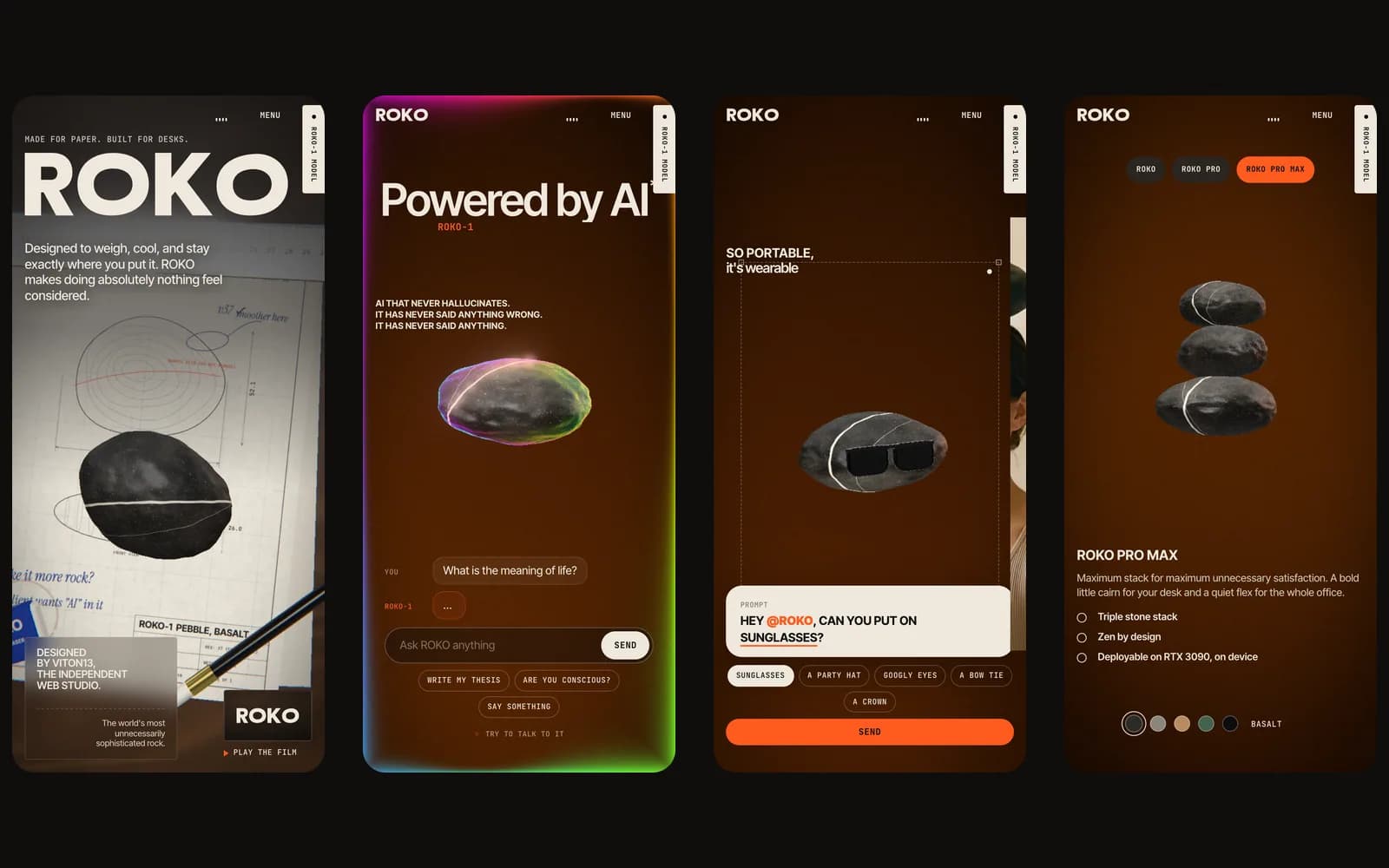
ROKO is a fictional product: a river pebble launched like an AI device, “Powered by AI*”, where the footnote reads “Ancient Igneous”. VITON13 built its launch site as a concept to show range: one real-time 3D stone carries the whole scroll story, from a desk flat-lay to a pendant, a thermal camera and a cairn, and the last screen turns the joke into the studio’s pitch.
Open the live project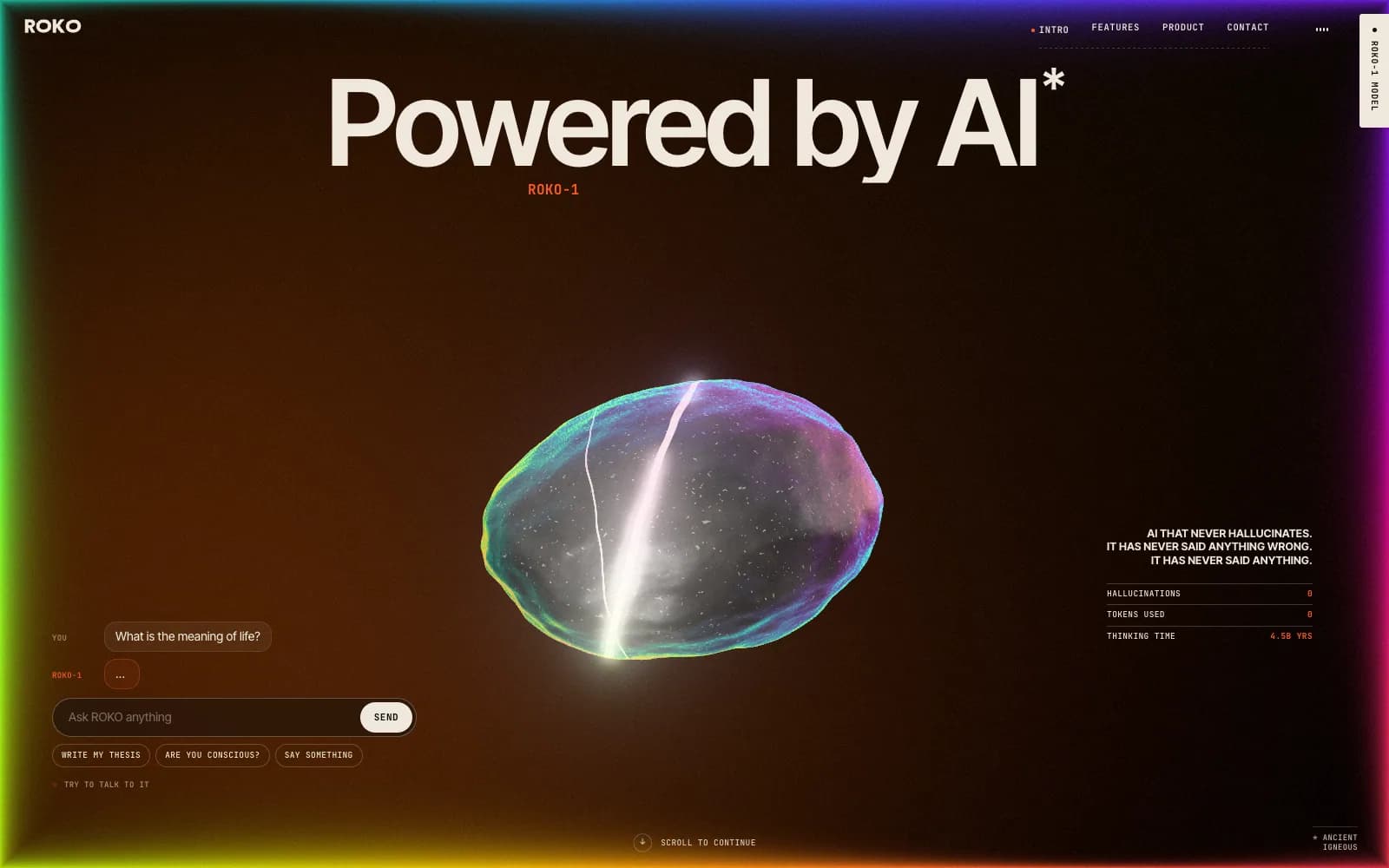
- scroll sections, and one real-time 3D stone travels through all of them
- 12
- photos and films generated with our own render of the stone as the reference (11 photos, 3 films)
- 14
- downloaded 3D models or stock photos: the stone and the props are generated in code
- 0
- main script gzipped (0.71 MB raw), three.js included
- 0.19 MB
Task
Launch sites for AI hardware have become a genre of their own: one glossy object, a scroll story, big promises. VITON13 builds concept sites to show its range in genres where it has no client project to point to yet, and ROKO is the one with a joke in it. The product is a river pebble launched like an AI device; the footnote to “Powered by AI*” reads “Ancient Igneous”.
The brief we set ourselves was to make a deliberately useless product feel like a flagship launch: premium materials, real interactions and jokes that land for people who follow AI news. The structure and the logic follow Lusion’s oryzo.ai, where one 3D object carries the whole page; the product, the copy, the 3D and every image are ours.
What we did
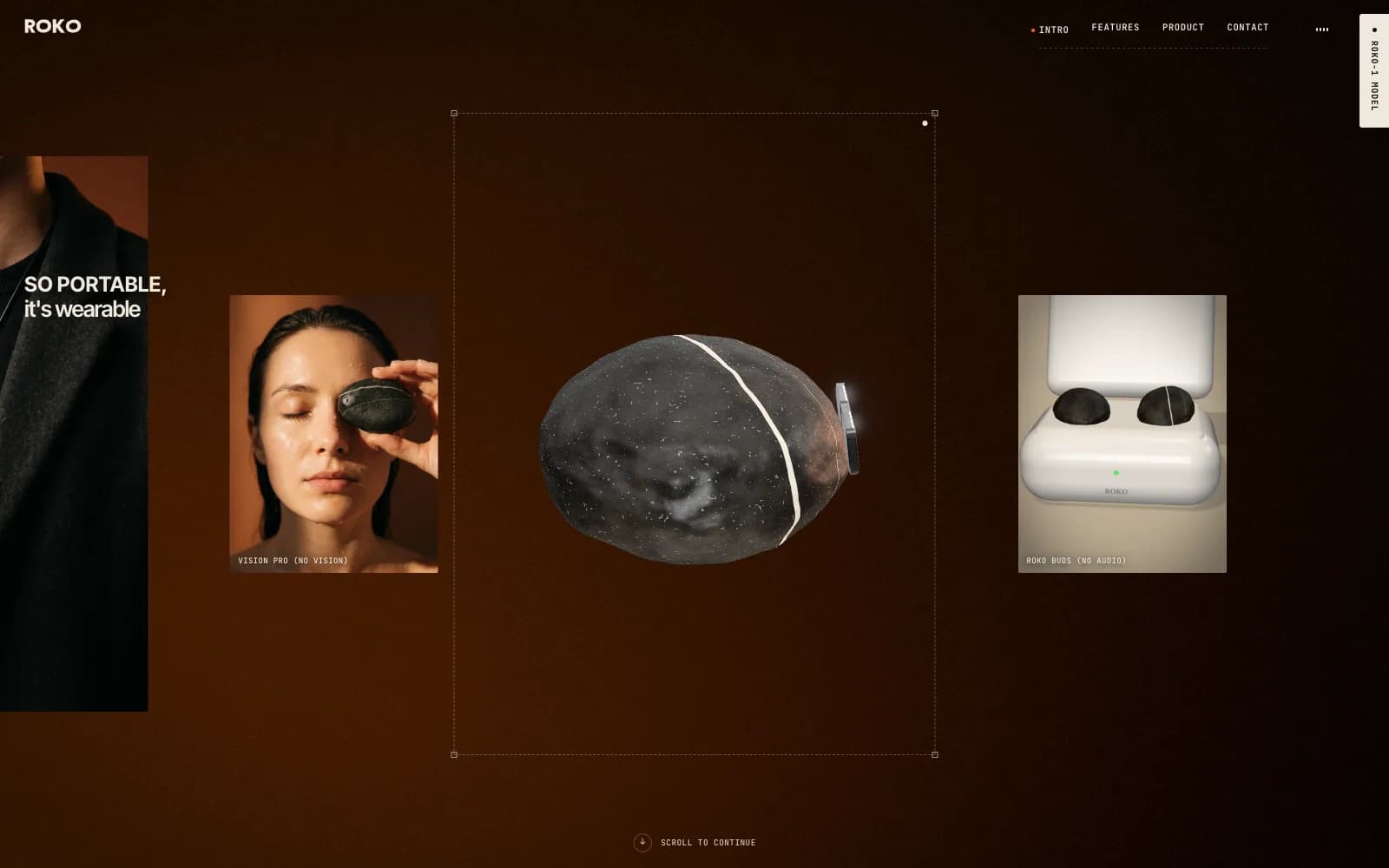
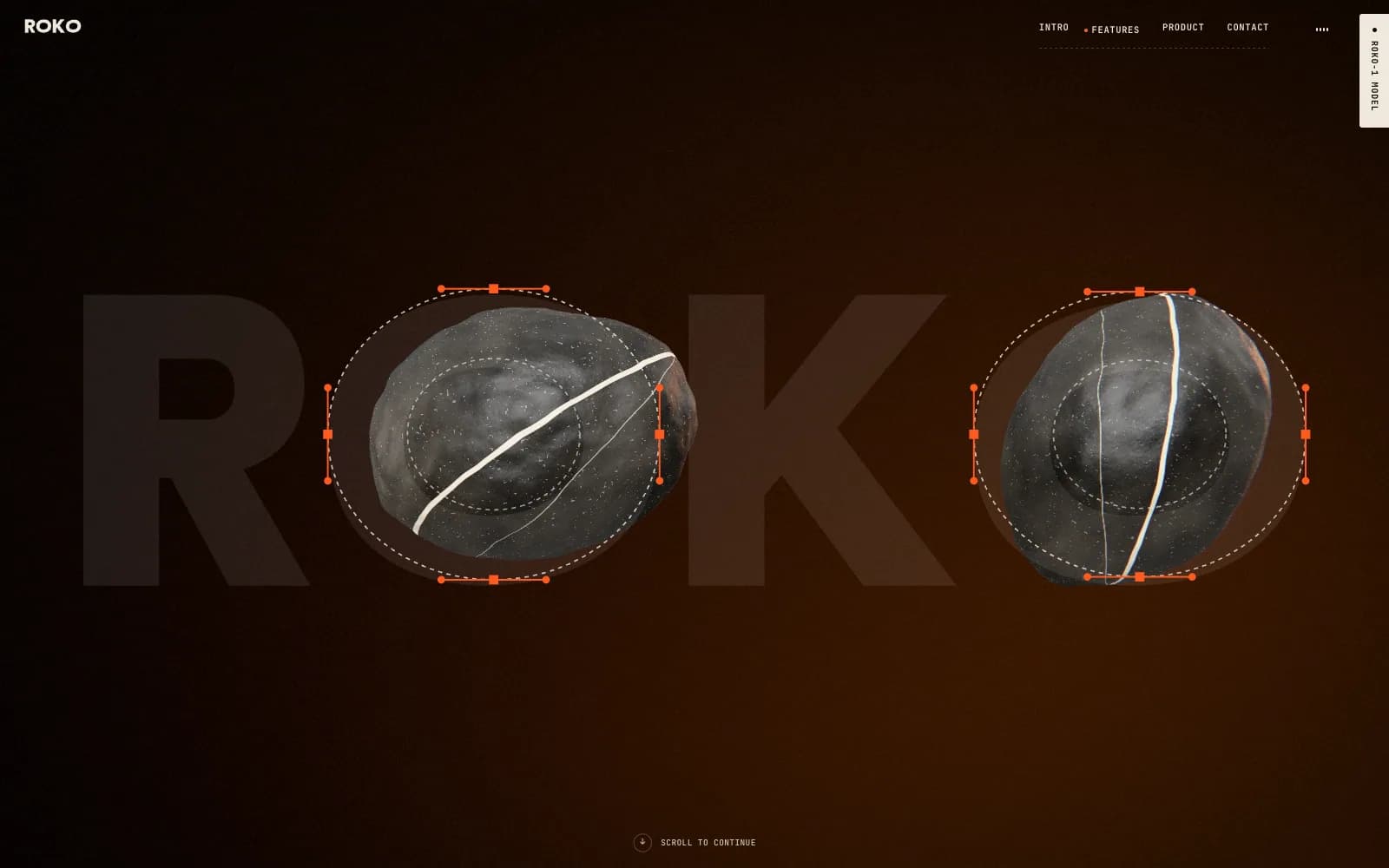
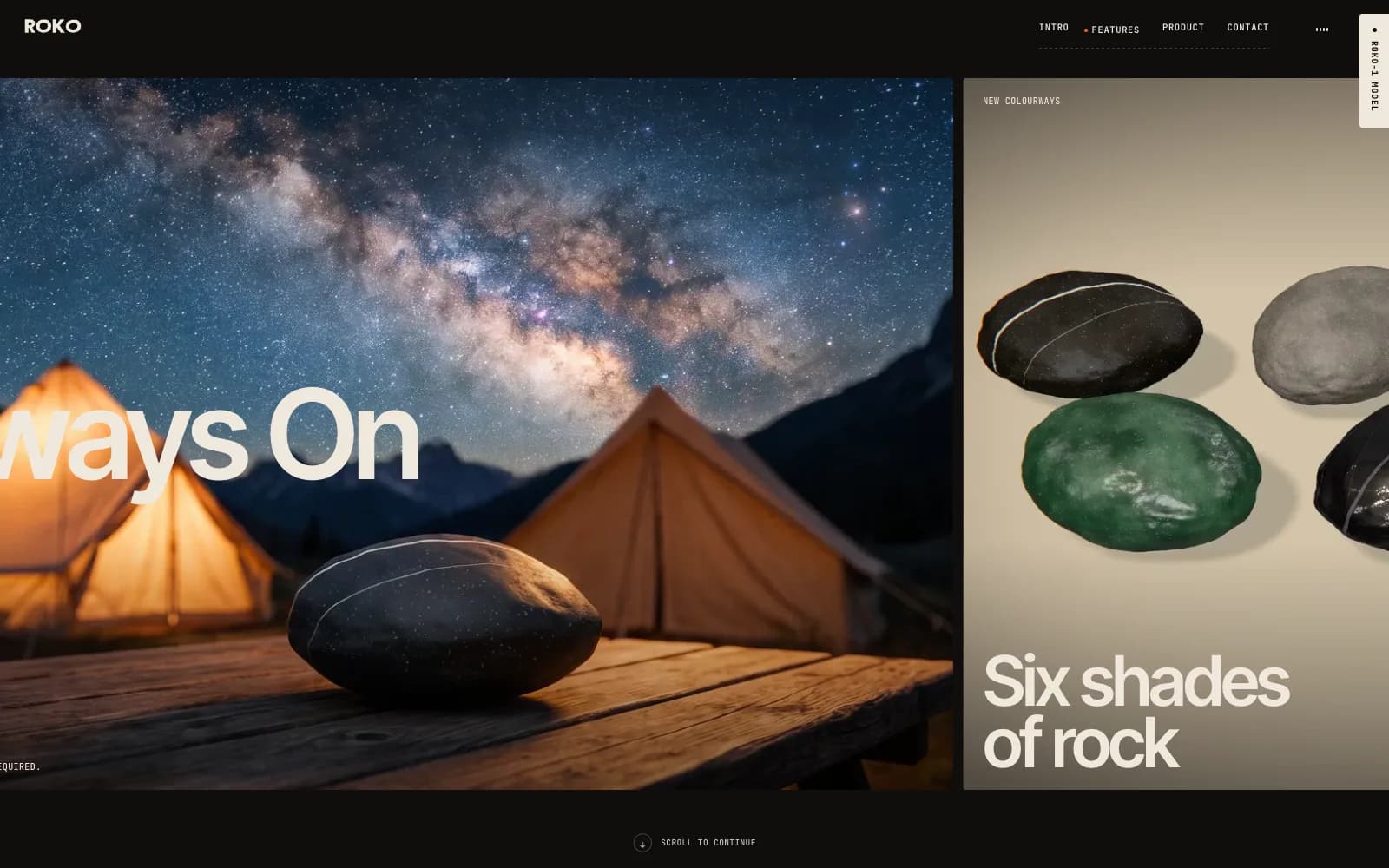
One English page with 12 sections: a flat-lay hero on a walnut desk, an AI section, a wearable section, features, “under-rock encryption”, a macro loupe, sustainability, reviews, a social strip, three product tiers in five colourways, “open weights” and a footer. Between sections the same stone rises off the desk, hangs as a pendant, pins papers in the wind, lands in the O’s of the wordmark and stacks into a cairn.
Every section has something to do. A chat where ROKO thinks for 4.5 billion years and answers “…”; a prompt that puts sunglasses, a party hat, googly eyes, a bow tie or a crown on the live stone; temperature buttons for a thermal model; a polarised-light loupe; a 24-second film played in real time; synthesized sound; and a real .obj download of the “open weights”. The last screen turns to the reader: if a studio can sell a rock, imagine what it can do for a brand.
How it works
The stone is generated in code. Seeded noise erodes an egg-shaped ellipsoid, five seeds are stored as morph targets, and a patched physical material adds speckle, a white quartz vein, micro-bump, a thermal “ironbow” mode with isotherms and an iridescent AI rim. A scene director gives every section a pose — stone, props, light and background — and blends one section’s exit into the next one’s entry over a screen of scroll, so the pebble stays one object from the hero to the footer.
The desk, the technical drawing, the props and nine product shots are rendered from the same scene. The photos with people and three six-second films were generated through CometAPI (Nano Banana Pro for stills, Veo 3.1 fast for video) with our own render of the pebble as the product reference, so the stone in every photo is this one. Photos, films and fonts load as the visitor reaches them; the page is marked noindex, nofollow.
What exists now
The site is live at tarasovvitalii.com/demos/roko/ as one page with 12 sections, 20 images and 3 films, built on 28 September 2026. The main script, three.js included, is 0.71 MB, or 0.19 MB gzipped; the whole build is 6.6 MB, 2.9 MB of it films that load only when reached. The same day we clicked through every interaction in headless Chrome at 1440 × 900 and on a 390 px phone screen, with a clean console.
On the live address the same day Lighthouse gave performance 43 on mobile and 64 on desktop (medians of three runs), with best practices at 100 and accessibility at 92; the page transfers 0.55 MB on load, and the photos and films follow as the visitor scrolls. The phone score is held back by long main-thread tasks at start-up (total blocking time 3.6 s) and a late largest paint, the hero text, at 4.2 s.
What this does not prove
ROKO is a concept VITON13 built to show range, not a commissioned project. The product, its reviews, press and prices are satire: nothing is for sale, and the site has no client, no domain of its own, no users, no traffic and no enquiries. The people in the photos and films are generated, not real customers, and the copy is in English only.
Frame rates were spot-checked on one machine in headless Chrome (about 100 fps in the AI section, 58 fps in the wearable strip), not measured across devices, and they say nothing about older phones. Lighthouse measures loading, not how smoothly the 3D scene runs. The demo is kept out of search on purpose, so it has no search results to show.
SEO review
Measured on the live address on 28 September 2026. Lighthouse 13.5.0 (three runs per device, medians, on a MacBook at a load average of about 3) gave performance 43 on mobile (LCP 4.2 s, TBT 3.6 s, 0.55 MB) and 64 on desktop (LCP 0.4 s), with best practices at 100 and accessibility at 92 on both. SEO is 66 because the demo is marked noindex, nofollow in the page and in the server header: it is a concept, and the page meant for search is its case on the portfolio.
Checked on 28 September 2026: 1 pages rendered in Chrome the way a search crawler sees them, plus Lighthouse 13 on the home page.
Lighthouse, home page
- Performance
- Mobile43Desktop64
- Accessibility
- Mobile92Desktop92
- Best practices
- Mobile100Desktop100
- SEO
- Mobile66Desktop66
On-page and technical checks
- Unique page titlesin place1/1
- Title length 30–65 charactersmissing0/1
- Meta descriptions 70–170 charactersin place1/1
- One H1 per pagein place1/1
- Page language declaredin placeen
- Mobile layout without sideways scrollin place390 px
- Images with alt textpartly12/26
- Broken internal linksin place0
- Canonical URLmissing0/1
- Open Graph title and imagein place1/1
- Structured data (JSON-LD)missing0/1
- sitemap.xml and robots.txtpartly1/2
Checked on the one page, rendered in headless Chrome at 390 px. In place: a title, a description of 120 characters, one H1, the language declared (en), no sideways scroll at 390 px, 0 broken links among 8 targets, and og:title with an absolute Open Graph image. Partly: 12 of the 26 images carry alt text and the other 14 are marked decorative with an empty alt, and Lighthouse flags colour contrast, heading order and small tap targets. Missing: the title runs to 74 characters, and there is no canonical URL and no JSON-LD. robots.txt sits at the domain root; the demo is kept out of sitemap.xml on purpose, while its portfolio case is listed in four languages.
If ROKO were a real launch: open the page to search with a title of 30–65 characters, a canonical URL and Product and Organization JSON-LD; describe the product photos that carry meaning instead of marking them decorative; and fix the contrast, heading order and tap targets Lighthouse lists. On a phone the score is held back by long main-thread tasks at start-up and by the largest paint at 4.2 s: starting the 3D scene after the hero text has painted, and loading the film and the photo strip only on approach, are the next steps for speed.
Services this case shows
Describe the task on the service page; a written scope, timeline and price come back within one working day.
Discuss a similar projectMore cases
All cases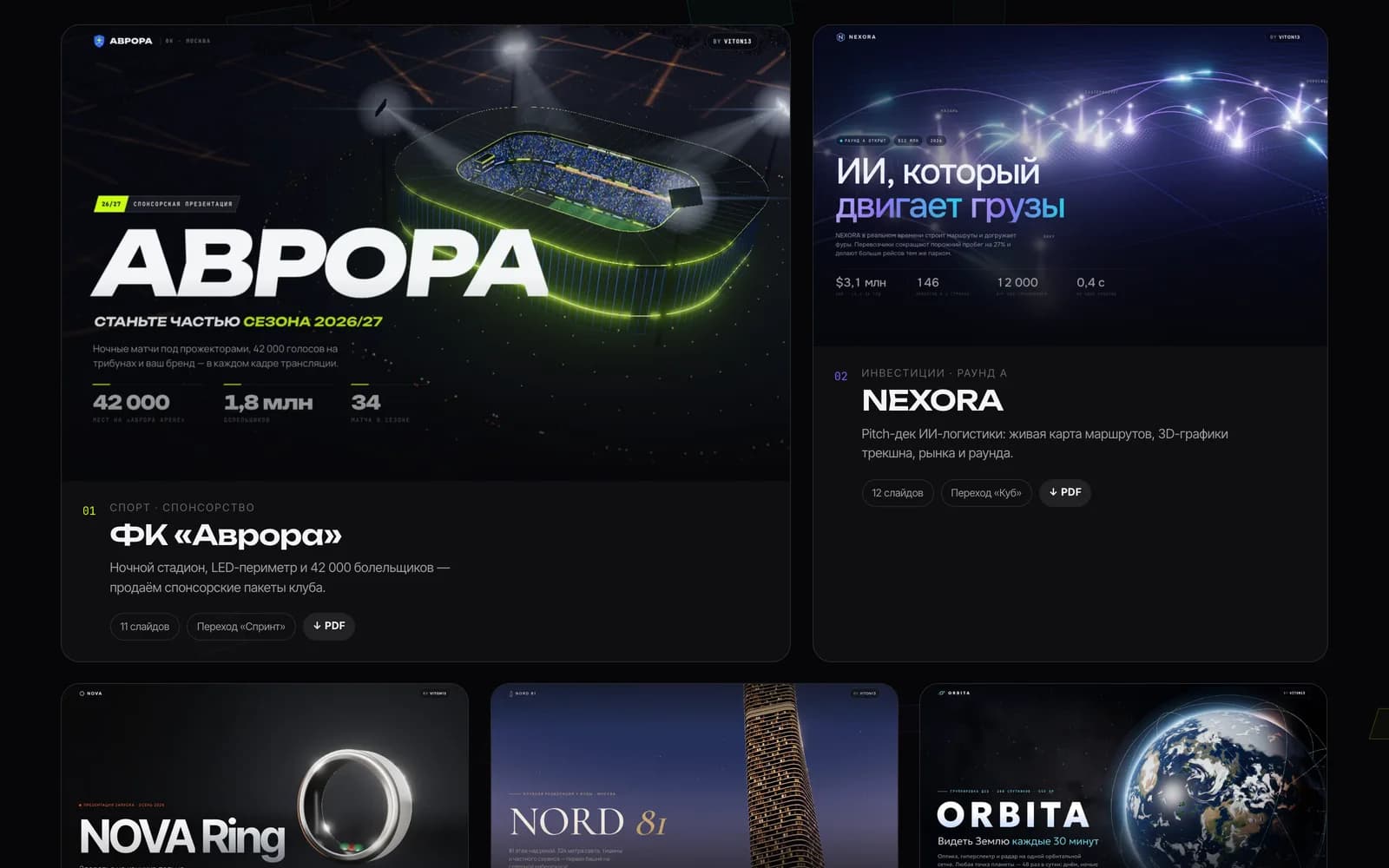
CONCEPTConcept — not a commissioned project
3D presentations
Concept presentations · 7 decks · Russian · 2026
Seven presentation concepts that open from a link: a sponsorship package, a Series A pitch, a product launch, a residential tower, a space company, a festival and a clinic. Every deck is HTML slides over a live three.js scene, and every slide flies the camera to its own shot; one engine adds keyboard and swipe control, a 3D overview of all slides and a PDF for email.
Read the case →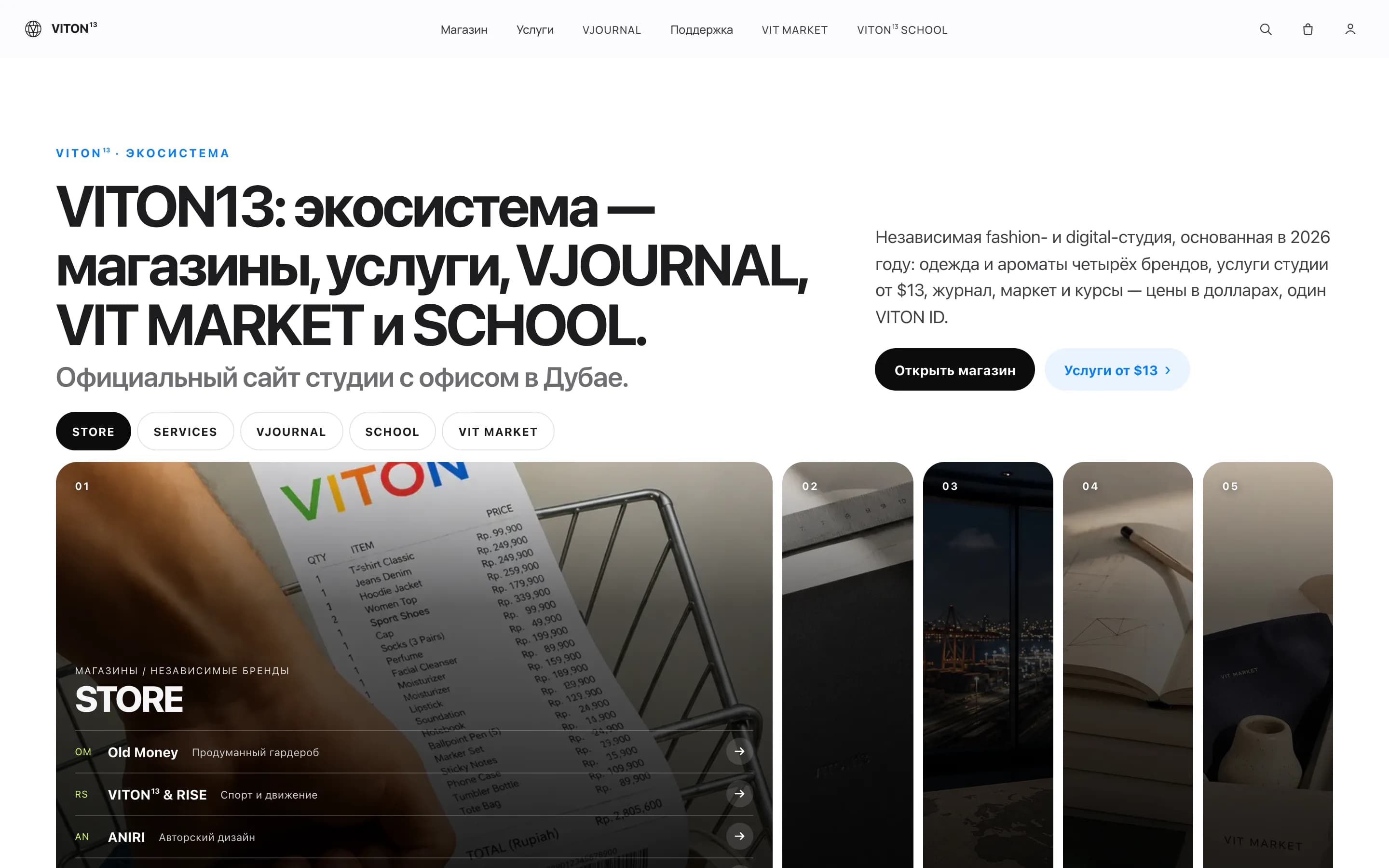
INTERNALOur own product
viton13.com
Next.js 16 · 5 languages · 7 hosts · 2026
VITON13’s own website: one Next.js application serves the main domain and six section subdomains in English, Russian, Spanish, French and Hindi. Before a release goes live, a crawl checks its internal routes.
Read the case →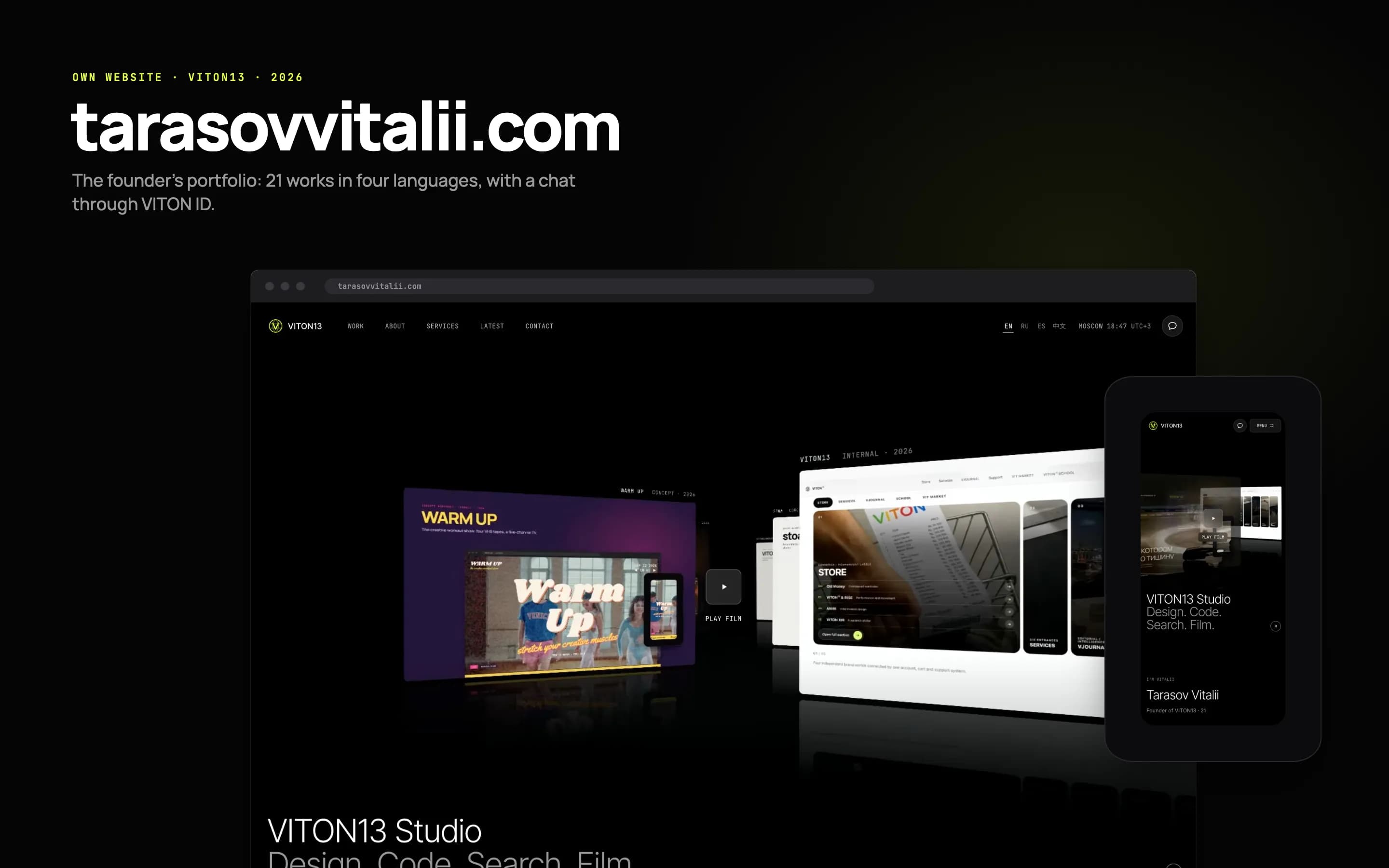
INTERNALOur own product
tarasovvitalii.com
Own website · 4 languages · 21 works · 2026
The personal website of Vitalii Tarasov, the founder of VITON13, designed and built by the studio and live since 23 September 2026. It shows 21 works, each labelled client, own product or concept, in English, Russian, Spanish and Chinese, lets visitors write to him through VITON ID and opens on a showreel drawn frame by frame in code, 47.6 seconds in full.
Read the case →