
Websites and development
Framer, Webflow or custom Next.js: which should you choose for a brand website in 2026?
Pick Framer if a designer builds and edits a marketing site of a few dozen pages and launch speed matters most. Pick Webflow if a content team publishes weekly and needs a large CMS. Pick custom Next.js for accounts, integrations, many languages or code you can host anywhere, and budget for development and upkeep instead of platform rent.
What is the real difference between Framer, Webflow and custom Next.js?
Framer and Webflow are hosted visual builders: you design on a canvas, publish, and pay the platform every month to run the site. A custom Next.js site is code that a developer writes, kept in your repository and run on hosting you choose.
| Question | Framer | Webflow | Custom Next.js |
|---|---|---|---|
| Built by | A designer, on a canvas | A designer or Webflow specialist | A developer, in code |
| Edited by | Content editors, $10 a month each | Limited seats, $15 a month each | Editors in a connected CMS |
| CMS on the main paid plan | 10 collections, 2,500 items | 40 collections, 20,000 items | Set by your CMS |
| Extra languages | $20 a month per locale | Localize from $9 a month | In code, no per-language fee |
| Motion | Built-in effects, React code components | Interactions built on GSAP | Any library, GSAP and three.js included |
| Exit | No HTML export | HTML and CSS export; the CMS stays | The code is yours; any Node.js host |
Who will edit the site after launch, and what can they change?
Settle this first. Brand sites are edited by people who did not design them: a marketer adding a case, an assistant changing a price.
- Framer: content editors, $10 a month each, update the CMS, translations and page text without the design tools; a full editor costs $20.
- Webflow: a Limited seat edits content or assembles approved components; a Full seat that can change the design costs $39 a month billed yearly.
- Next.js: there is no editor until one is added. Copy sits in files a developer changes, or in a headless CMS, a separate admin panel the site reads from.
So we agree the editable parts up front: news, cases and prices in the CMS, the layout in code. Our CMS integration costs $73 AI-assisted or $93 human-led and is accepted when a non-technical editor creates, schedules, corrects and rolls back a real entry.
Which one handles motion, 3D and interaction best?
Design-led sites are often bought for their motion: scroll reveals, pinned scenes, a film in the hero, sometimes 3D. All three can do it; the ceiling and the page weight differ.
- Framer: effects, page transitions and scroll animation are set on the canvas; for the rest, developers write React code components, compatible with React 18, in Framer’s editor.
- Webflow: Interactions run on GSAP, which Webflow owns and has made free for everyone, including once-paid plugins such as SplitText and ScrollSmoother.
- Next.js: any library, from GSAP to three.js and custom WebGL, inside a speed budget you set, with motion switched off for visitors who ask for less.
A platform gives you ready tools on someone else’s runtime; code gives you nothing ready and every kilobyte to cut. Our founder’s portfolio (the example below) is hand-coded without Next.js: its GSAP motion stops under reduced-motion settings, and on 24 September 2026 Lighthouse scored its home page 99 for mobile performance.
Where do page and CMS limits start to bite?
Limits rarely matter at launch. They bite in year two, once the blog or the case library has grown.
| Plan, a month billed yearly | Pages | Collections | CMS items | Past the limit |
|---|---|---|---|---|
| Framer Basic, $10 | 30 | 2 | 1,000 | Move to Pro |
| Framer Pro, $30 | 150 | 10 | 2,500 | $20 per 100 pages, $20 per 10,000 items |
| Webflow Basic, $15 | 300 static | None | None | Move to Premium |
| Webflow Premium, $25 | 300 static | 40 | 20,000 | Team, $2,500 a month on an annual contract |
| Custom Next.js | No cap | Your CMS | Your CMS | Hosting usage |
Two posts a week make about 312 entries in three years, fine on any plan with a CMS. A catalogue or a directory of branches reaches 2,500 far sooner, and on Framer Basic posts plus cases already use both collections.
What do the plans cost over three years?
The table assumes one site, one owner seat and, where stated, one extra language.
| Set-up | Plan and add-ons | Per month | 36 months |
|---|---|---|---|
| Framer, small site | Basic, one language | $10 | $360 |
| Framer, marketing site | Pro plus one locale | $50 | $1,800 |
| Webflow, no CMS | Basic plus Localize Essential | $24 | $864 |
| Webflow, with CMS | Premium plus Localize Essential | $34 | $1,224 |
| Custom Next.js | Vercel Pro, one developer seat | $20 | $720 |
Rent is the smaller line. The build pays a designer on Framer, a designer or Webflow specialist on Webflow, and a developer plus a designer on Next.js. Afterwards the platforms bill monthly, while Next.js needs someone to update dependencies. Either way the money goes to people, just different ones.
How much SEO and language control does each give you?
All three serve HTML that crawlers read. What separates them is redirects, language URLs and which tags you may change.
- Framer: built-in SEO, redirects from Pro up, translated URL paths per locale; lang and hreflang are set automatically and cannot be edited in the interface.
- Webflow: canonical tags, sitemap, robots.txt, schema markup and 301 redirects; translated URLs only with Localize Advanced, from $29 a month.
- Next.js: sub-path routing such as /fr/products, or a domain per language; hreflang, sitemaps and every status code are written in code and do exactly what is specified, nothing more.
How hard is it to leave each platform?
Ask before launch, while the answer is cheap.
- Framer: no HTML export for self-hosting, because sites depend on its rendering, image optimisation and delivery network (help centre, 15 September 2026). Leaving means a rebuild.
- Webflow: HTML and CSS export with a paid workspace plan such as Core, $19 a month billed yearly; CMS items and pages are not exported, so a blog moves through the CMS API or by hand.
- Next.js: repository and hosting account in your name; a Node.js server or Docker runs every feature, a static export fewer. The lock-in left is to people, eased by a clean repository and a handover note.
Every move changes URLs. Google advises server-side permanent redirects from each old URL, kept as long as possible and generally for at least a year.
When are Framer or Webflow smarter choices than custom code?
We sell custom builds, yet the honest answer is often a platform.
| Situation | Sensible choice | Why |
|---|---|---|
| Portfolio under 30 pages, edited by its designer | Framer Basic | Fastest to a live address |
| Designer-led site that needs staging and redirects | Framer Pro | Branching without a developer |
| Weekly publishing in one or two languages | Webflow Premium | 20,000 items and editor seats |
| Four or more languages with translated URLs | Custom Next.js | No per-language fee |
| Accounts, bookings, a CRM or payments | Custom Next.js | Server code and your own database |
| Heavy 3D under a strict speed budget | Custom Next.js | You choose every file that loads |
When not to order from us: a few pages, one language, a designer already in Framer and nothing that needs a server. Launch there, keep the domain in your name and the copy outside the platform; our estimate would say the same.
What does a custom Next.js site cost with VITON13?
Every package has a fixed price in two modes: AI-assisted, where AI drafts and a specialist directs and signs off, or human-led, where the specialist builds and AI helps.
| Package | Price | Timeline | What you get |
|---|---|---|---|
| Corporate website design | $113 AI-assisted or $173 human-led | 7–12 working days | Sitemap up to 20 pages, 6 templates, prototype, Figma handover |
| Next.js website | $73 AI-assisted or $93 human-led | 5–8 working days | 5 templates, SEO set-up, preview deploys, 2 languages |
| Launch Site | $113 AI-assisted or $173 human-led | 3–5 working days | Build with CMS or data wiring, server, domain, SSL, launch checks |
| CMS integration | $73 AI-assisted or $93 human-led | 5–8 working days | Content model, editor workflow, connection to the site |
The Next.js package builds a design that already exists; Launch Site suits pages, CMS and launch in one order. With Figma layouts or a Framer prototype in hand, skip the design line.
How VITON13 does it
We turn approved layouts, from Figma or a Framer prototype, into a Next.js site you own, with motion kept inside a speed budget. Send the brief through the order form; the package, the fixed price and the dates arrive in writing within one working day.
Next.js website development
- Price
- $73 AI-assisted or $93 human-led
- Timeline
- 5–8 working days
Launch Site
- Price
- $113 AI-assisted or $173 human-led
- Timeline
- 3–5 working days
AI-assisted: AI drafts inside defined steps, a person directs and checks every result. Human-led: a specialist does the work and AI assists.
What is included
- 5 page templates from your approved layouts
- 1 SEO set-up: sitemap, canonical tags, hreflang and metadata per template
- 1 deployment pipeline with a preview address for every change
- 2 languages wired in, with your texts
- The repository and pipeline handed over, with access in your name
Not included
- Design: a separate package, or your own layouts
- Copy and translations
- Hosting, domain and third-party subscriptions
- Redirect mapping beyond the old site’s main templates
Revisions: 2 revision rounds on the deliverables, fixed in the written scope
Get an estimate in 1 working dayWritten estimate within 1 working day
Example
INTERNALOur own product
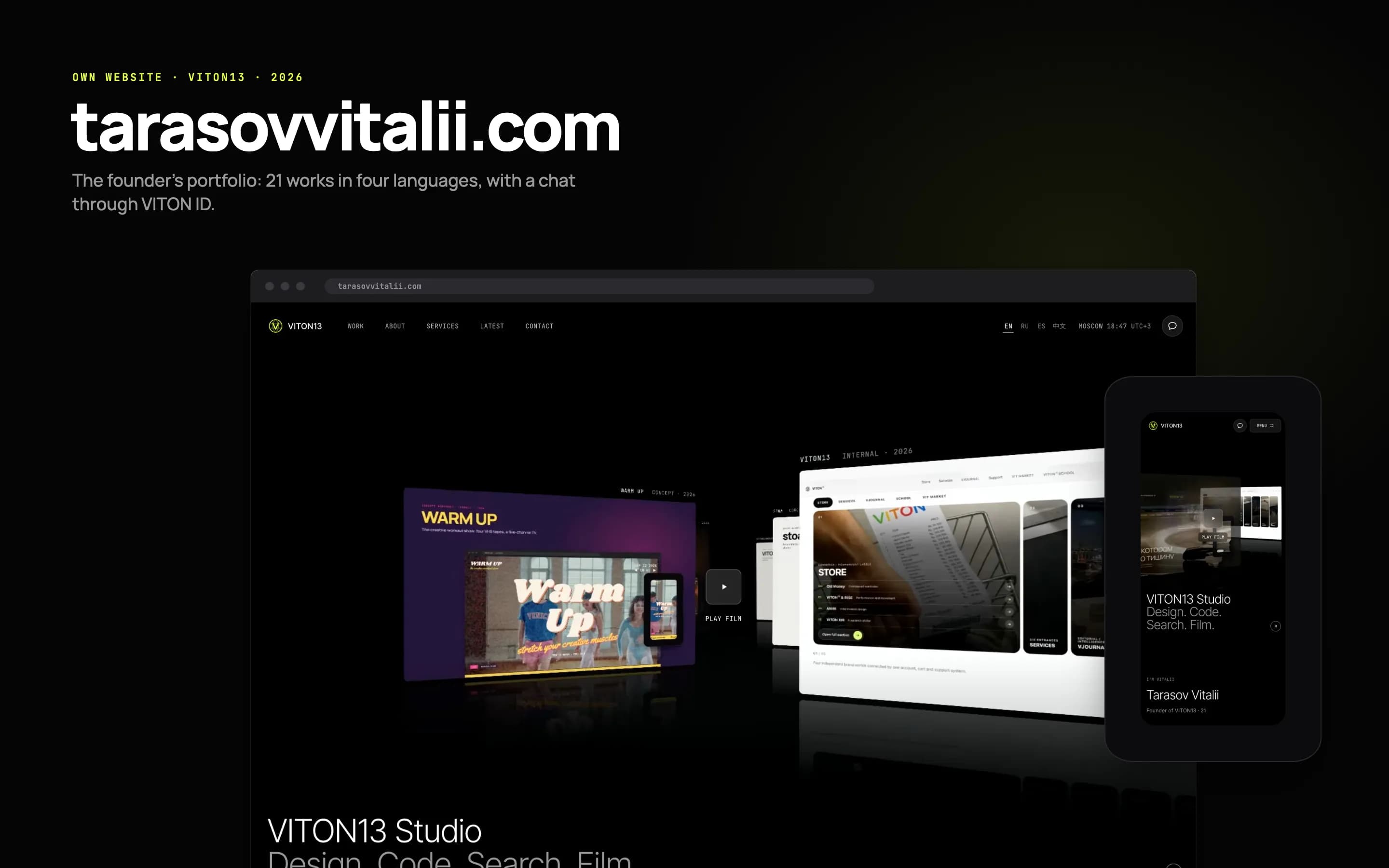
tarasovvitalii.com: a hand-coded, design-led portfolio in four languages
Our founder’s portfolio, live since 23 September 2026, was designed and hand-coded by VITON13: a Node static generator pre-renders every page, and motion runs on GSAP with ScrollTrigger and Lenis. It has four language editions, 108 sitemap pages linked by hreflang and a chat through VITON ID. On 24 September 2026 Lighthouse gave the home page 99 for mobile performance, with LCP at 2.0 s.
What this does not prove
- It is our own site, not client work, and it does not use Next.js.
- The scores are lab tests of one page on one day; a second desktop run gave 95.
- It is too new for traffic, ranking or enquiry data.
- We did not build the same design in Framer or Webflow, so it compares nothing directly.
Questions and answers
Can you move my Framer or Webflow site to Next.js without losing rankings?
Nobody can honestly promise that. We list every live URL, rebuild the pages, set permanent redirects and compare a crawl before and after. Framer pages cannot be exported, so we work from the live site and your files; Webflow CMS content comes across through its API. The move is priced as website migration, $53 AI-assisted or $73 human-led.
Can my designer keep working in Figma or Framer?
Yes. We build from approved layouts, Figma files or a Framer prototype, and match type, spacing and motion on a preview address you check on your own devices. After launch, texts are edited in the CMS; a layout change is a developer task, quoted like any other.
Who owns the code, the domain and the accounts?
You do. Register the repository, hosting, domain and Search Console to your business; we hand over the repository and the deployment pipeline at the end. Agreed rights and editable files pass to you once the project is paid; fonts and stock images keep their own licences.
What happens if AI-drafted code is wrong?
In AI-assisted mode AI drafts components and a developer reviews, tests and signs off each change, and nothing goes live before you have seen it on the preview. Anything that departs from the approved layouts is corrected in the revision rounds. Human-led, the same package costs $93.
How does payment work, and can I cancel?
You first get the written scope with the timeline, the final price and the payment route, and nothing is charged before you confirm it. Cancelling is free until you approve the scope. After work starts, completed work is charged and the unstarted part is refunded.
How long does the whole project take?
Design takes 7–12 working days and the Next.js build 5–8 working days, one after the other, plus the time you need to approve layouts and supply texts. If the design already exists, the project starts at the build.
Sources
- Framer — Pricing —
- Framer Help — Can I export my website to HTML and self-host it? —
- Framer Help — Localized page paths —
- Framer Help — Language attribute —
- Framer Developers — Code components —
- Webflow — Plans and pricing —
- GSAP — Pricing —
- Vercel — Pricing —
- Next.js — Deploying —
- Next.js — Internationalization —
- Google Search Central — Site moves with URL changes —