
Websites and development
How much does SaaS development cost? MVP, v1 and the bills that start after launch
Published 2026 price guides put a SaaS MVP at roughly $10,000–$60,000 and a full platform at $150,000–$500,000 or more, because they count different scope. Tenants, subscription billing and permissions set SaaS apart from an ordinary web app. VITON13 builds SaaS platforms from $213.
How much does SaaS development cost?
Every guide prints a range, and the ranges disagree. The table sets three 2026 price lists beside the studio's starting prices. The vendors sell the work they price, so read them as opinions, not a market average.
| Source | MVP or first release | Mid-size product | Full platform |
|---|---|---|---|
| Netguru (Poland), updated 21 Jul 2026 | $25,000–$50,000 for a basic app | $50,000–$150,000 | $150,000–$500,000 |
| MarsDevs (India), updated 26 Jun 2026 | $25,000–$60,000, 6–10 weeks | $60,000–$150,000, 3–6 months | $150,000–$500,000+ |
| RaftLabs (India) | $10,000–$20,000, 6–8 weeks | $20,000–$60,000, 12–14 weeks | $120,000+ for AI or enterprise builds |
| VITON13 | $73 AI-assisted or $93 human-led for a one-journey web app MVP | From $213 AI-assisted or $313 human-led | Estimated from the brief |
The spread has three causes. Vendors call different things an MVP, from a micro-tool with sign-in and billing to a multi-role product with admin screens and integrations. Teams in India price below teams in Poland or the US. And some prices leave out design, testing or project management. For custom software of every kind, Clutch reports reviewed projects most often cost $10,000–$49,999 and average about $132,480 over roughly 13 months, so the lower rows are the useful ones for a first version.
What does SaaS add to the bill that an ordinary web app does not?
One system sold to many customers needs work that a single-company app skips: keeping customers' data apart, deciding who may do what, charging on a schedule and showing the owner what happens. Two vendors price these lines.
| Line | MarsDevs | RaftLabs | What moves it |
|---|---|---|---|
| Multi-tenant architecture | Adds $5,000–$15,000, depending on isolation | $8,000–$25,000 | How strictly data must be separated |
| Sign-in, roles and permissions | $3,000–$10,000; a provider $3,000–$5,000, custom SSO and MFA $8,000–$15,000 | Sign-in $800–$2,000; role-based access $2,000–$4,500 | Number of roles; SSO for enterprise buyers |
| Subscription billing | $3,000–$5,000 for 2–3 fixed plans; $8,000–$15,000 for metered usage | $2,500–$5,000 | Trials, plan changes, invoices, tax |
| Admin screens | Inside the frontend line | $1,500–$4,000 | What support can fix alone |
| Analytics and reports | Not priced separately | $4,000–$10,000 | What the owner must see |
| Privacy layer | Legal documents $3,000–$10,000 | GDPR or HIPAA layer $5,000–$15,000 | Markets served and kinds of personal data |
Microsoft's architecture guide draws the key distinction: a tenant is a customer organisation, and many users of one company form one tenant. It treats isolation as a spectrum from shared everything to shared nothing, and calls the choice commercial as well as technical. Sharing is cheaper, but one fault can reach every tenant and a heavy tenant can slow the rest. MarsDevs says it has rebuilt multi-tenancy that clients got wrong, at more than the original build, so settle this line before the first screen.
What does subscription billing involve, and what do payment fees cost?
Taking a card once is a checkout. A subscription is a lifecycle the product follows for months, and an estimate should name each part:
- Plans and entitlements: what each plan unlocks and how the product enforces it.
- Trials, upgrades, downgrades and cancellations, with the proration rules written down.
- Failed payments: retries, customer emails and what access the account keeps meanwhile.
- Invoices and receipts, plus sales tax or VAT for each customer's country.
- Provider events, handled so product and provider agree on who has paid.
- Refunds, disputes and an admin screen for support to correct an account.
Fees are a share of revenue, so they grow when the product works. Stripe's pricing page, shown for Latvia, lists 1.5% + €0.25 for standard European cards, 0.7% of billing volume for Stripe Billing, and 3.5% on top of card fees for Managed Payments, its merchant-of-record service that covers sales tax and VAT. Paddle, a merchant of record, lists 5% + 50¢ per checkout transaction with tax compliance included. On a $49 plan that is $2.95 a month, or 6%. Stripe's European card fee on a €49 plan is about €1 before the Billing fee, but tax registration and filing then stay with you unless you add Managed Payments.
Freelancer, studio, in-house or AI-assisted: who should build it?
| Route | Published figures | Fits | Watch for |
|---|---|---|---|
| Freelancer | RaftLabs lists $15–$60 an hour | One module, or an MVP you can check yourself | Continuity; design and testing are extra jobs |
| Agency, by country (Clutch) | $25–$49 an hour in India, Ukraine, Spain, Mexico; $50–$99 in the US and Poland; $100–$149 in Canada and Australia | A full team for a defined scope | Bands are declared, not invoiced |
| Agency, blended team (MarsDevs) | US and Canada $100–$180; Western Europe $80–$150; Eastern Europe $40–$80; India $15–$30 | Comparing regions | A vendor's own table |
| In-house | US developers earn a median $135,980 a year in wages (BLS, May 2025); MarsDevs puts a senior US engineer above $150,000 with benefits | Continuous work after launch | Months to hire |
| AI-assisted build | MarsDevs says AI tools speed development 30–40% but struggle with multi-tenancy, billing logic and security | Routine screens and tests | Every change needs a reviewer |
| VITON13 | From $213 AI-assisted or $313 human-led | Roles, plans and billing in one scoped build | The estimate follows the brief |
Clutch's US band is about half of MarsDevs's: one counts bands firms choose themselves, small shops included, the other blended team rates. Ask how many hours each team expects: a low rate with many hours costs more than a high rate with few.
What does a SaaS cost to run after launch?
| Line | Published figure | Who says so |
|---|---|---|
| Maintenance and fixes | 15–25% of the build price per year; about 20% in Netguru's guide | MarsDevs; Netguru |
| Hosting | $50–$200 a month before launch; $200–$500 at 100–1,000 users; $500–$2,000 at 1,000–10,000; $2,000–$10,000+ beyond | MarsDevs, a vendor estimate |
| Monitoring, email, support tools | Monitoring $0–$100 a month early on, email $20–$50, support tools $50–$500 | MarsDevs |
| Payment fees | A share of each charge: see the billing section | Stripe and Paddle pricing pages |
| Penetration test | $5,000–$25,000 per assessment | MarsDevs |
| All running costs | $2,000–$8,000 a month | RaftLabs |
Do you need GDPR or SOC 2 work before you launch?
GDPR comes first, because it applies from the first customer record. When customers load personal data of people in the EU into your product, you usually act as their processor. The regulation's text on EUR-Lex requires a contract with the controller (Article 28), security suited to the risk, with encryption, restorability and regular testing as examples (Article 32), and telling the controller without undue delay about a breach, which the controller reports within 72 hours where required (Article 33).
SOC 2 is different: not a law but a report by an independent CPA firm. The AICPA describes SOC reports as assurance reports that CPAs provide, and its 2026 notices warn about promises of fast, easy reports. Enterprise buyers may ask for one. MarsDevs prices a first SOC 2 at $20,000–$60,000, then $10,000–$25,000 a year; test that against a CPA's quote.
Should you build, buy or use no-code?
RaftLabs, an agency, puts no-code at $0–$5,000 up front and $50–$500 a month with a ceiling around 5,000–10,000 users, and white-label templates at $5,000–$15,000; treat that as one agency's opinion. Settle the route before anyone is paid:
- Does an existing product cover most of the job for the people who would pay? Then configure it and build only what is missing.
- Can you name one paying customer type and one job? If not, test demand with a landing page, pre-orders or a manual service first.
- Is your logic standard? No-code suits standard plans and screens; custom pricing rules, data models or integrations point to code.
- Will customers demand separate data or SSO? That moves you to the higher tenancy and sign-in lines.
- Do you sell to EU customers or large companies? Budget the processor contract and ask early about SOC 2.
- Can you fund twelve months of running costs as well as the build? If not, cut scope before you start.
- Who looks after the product after launch: a hire, a retainer or you?
How VITON13 builds a SaaS platform
We begin with one recurring business problem, the person who will accept the result, a normal case and a failed one, and the current stack. The build covers tenant boundaries, plans and permissions, and billing with usage analytics, and it is accepted when one role journey runs end to end with real states, permissions and recovery. If it cannot be tested safely we propose discovery, a pilot or a smaller boundary first, and if an existing product does the job we say so. AI-assisted: AI drafts models, screens and tests and an engineer reviews every change. Human-led: an engineer leads design and build and AI assists. The estimate follows the brief: user roles, integrations and platforms.
SaaS platform development
- Price
- $213 AI-assisted or $313 human-led
- Timeline
- 15–30 working days
The final price is fixed in writing after a short scope review.
Web app MVP
- Price
- $73 AI-assisted or $93 human-led
- Timeline
- 5–8 working days
Subscription platform development
- Price
- $213 AI-assisted or $313 human-led
- Timeline
- 15–30 working days
The final price is fixed in writing after a short scope review.
AI-assisted: AI drafts inside defined steps, a person directs and checks every result. Human-led: a specialist does the work and AI assists.
What is included
- Multi-tenant architecture for the customer model you agree
- Plans and permissions: what each plan and role may do
- Billing and usage analytics
- Acceptance on one end-to-end role journey
- Delivery: 15–30 working days after the brief is approved
Not included
- Hosting, domain and third-party fees, including payment-provider and tax fees, paid by you
- Legal advice, audits and compliance certification
- Marketing and ad spend
Revisions: 2 revision rounds per stage
Get an estimate in 1 working dayWritten estimate within 1 working day
Example
CONCEPTConcept — not a commissioned project
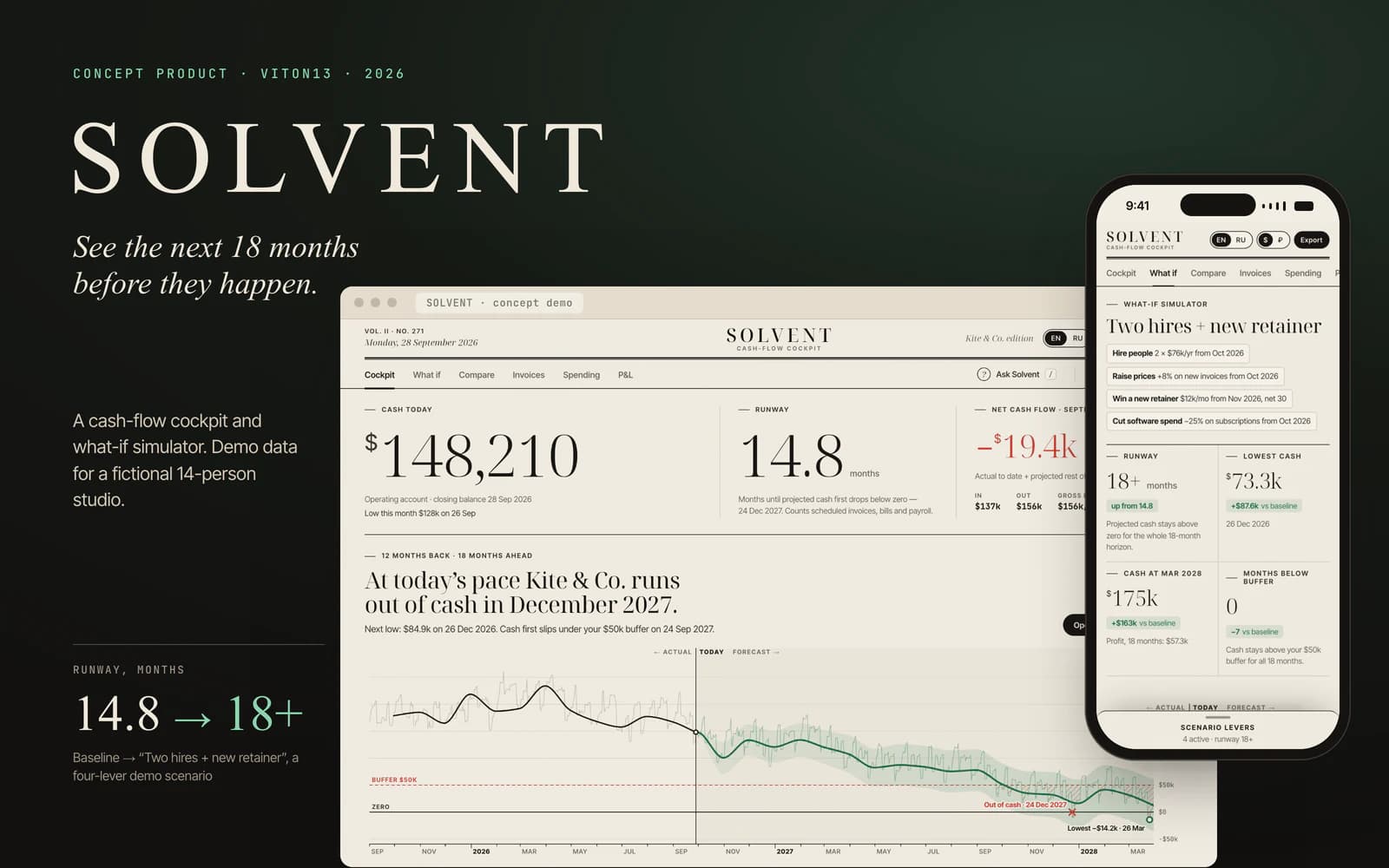
SOLVENT: a finished-looking product and the SaaS layers it does not have
SOLVENT is a cash-flow cockpit and scenario simulator VITON13 built as a concept on the invented books of a 14-person studio. It has a what-if simulator with eight levers, nine presets and an 18-month forecast, and all 1,927 of its automated checks passed on 28 September 2026. The case file says a production version would still need bank feeds, an accounting integration, accounts and roles, and encrypted storage. Accounts and roles are one of the SaaS lines priced above; a product sold to many customers would add tenants and billing.
What this does not prove
- It is a concept with invented data: no client, users or revenue, so it shows nothing about demand or churn.
- It has no accounts, tenants or billing, so it says nothing about their cost; the prices here come from the sources.
- The checks show the maths matches its own definitions, not that a forecast would be right for a real business.
Read the case: SOLVENT: a concept cash-flow cockpit and what-if simulator for a small business
Questions and answers
How long does it take to build a SaaS product?
MarsDevs puts an MVP at 6–10 weeks, a standard platform at 3–6 months and an enterprise build at 6–12 months or more; RaftLabs says 6–8 weeks for an MVP and 12–14 for a fuller product. VITON13's SaaS platform page shows 15–30 working days after the brief is approved.
What does each extra customer cost to serve?
Less than the build, but not nothing. MarsDevs's hosting estimates rise from $200–$500 a month at 100–1,000 users to $2,000–$10,000 or more beyond 10,000, every charge pays a payment fee, and MarsDevs lists $100–$1,000 a month for the model calls behind an AI chatbot, a bill that grows with customers, not with build hours.
Is a micro-SaaS cheaper to build?
Yes, because it does one job. MarsDevs prices a single-feature tool at $15,000–$30,000 in 4–6 weeks, and Netguru says a scaled-down communication product can land at $10,000–$25,000. The saving comes from fewer roles, plans and integrations, not from skipping billing.
How do I compare two SaaS quotes?
Rewrite both in the same lines: tenants, roles, billing, admin, analytics, integrations, testing and release. A line missing from one quote is your first question. Then compare expected hours times rate, and ask what the price includes for revisions.
Does the AI-assisted price make the SaaS worse?
No, it changes who writes the first draft. VITON13 prices both modes, from $213 AI-assisted and from $313 human-led. MarsDevs reports that AI tools struggle with tenancy, billing and security, so in both modes an engineer reviews every change on those lines.
What does VITON13 need from me to start?
One normal example, one failed example, the current stack, any access limits and the person who will accept the result. That exposes the unknowns without pretending the specification is finished. The estimate then follows user roles, integrations and platforms, from $213.
Sources
- Netguru, SaaS Development Costs: A Comprehensive Breakdown —
- MarsDevs, Cost to Build SaaS in 2026 —
- RaftLabs, SaaS App Development Cost in 2026 —
- Clutch, Software Development Pricing by Location —
- US Bureau of Labor Statistics, Occupational Outlook Handbook: Software Developers —
- Microsoft Learn, Tenancy models for a multitenant solution —
- Stripe, Pricing —
- Paddle, Pricing —
- EUR-Lex, Regulation (EU) 2016/679 (GDPR) —
- AICPA & CIMA, System and Organization Controls: SOC Suite of Services —