
Marketplaces
Marketplace SEO in 2026: how Amazon, Wildberries and Ozon rank listings, what to fill in and what it costs
Marketplace SEO means making a listing match the words shoppers type and then win against the other matches. Ozon publishes its weights: text relevance counts for 20–40%, sales for 15–25% and reviews for 5–10%. Amazon tells sellers to use buying-intent keywords and keep titles to 80 characters. VITON13 optimises Wildberries and Ozon cards from $73.

What is marketplace SEO, and how is it different from website SEO?
Marketplace SEO fits a listing to the platform's own search box: the words shoppers type, the fields the platform reads and the reasons one listing outranks another. It covers keywords, title, attributes, description, category and a before-and-after check in the platform's reports.
Unlike a search engine for websites, a marketplace earns on orders, so it sorts products by how likely they are to sell. Ozon says its search picks promising products by price, quality and delivery speed, and Amazon notes that listing quality and account health can contribute to rankings. Words get a listing into the race; sales, price, delivery and reviews decide where it finishes. SEO for your own shop in Google is a separate job.
How do marketplace search engines rank listings?
Every large marketplace first finds products that contain the query words, then sorts them by the chance of a purchase. Amazon uses search terms for lexical matching and does not publish its formula; Wildberries and Ozon publish far more, which makes them a useful map.
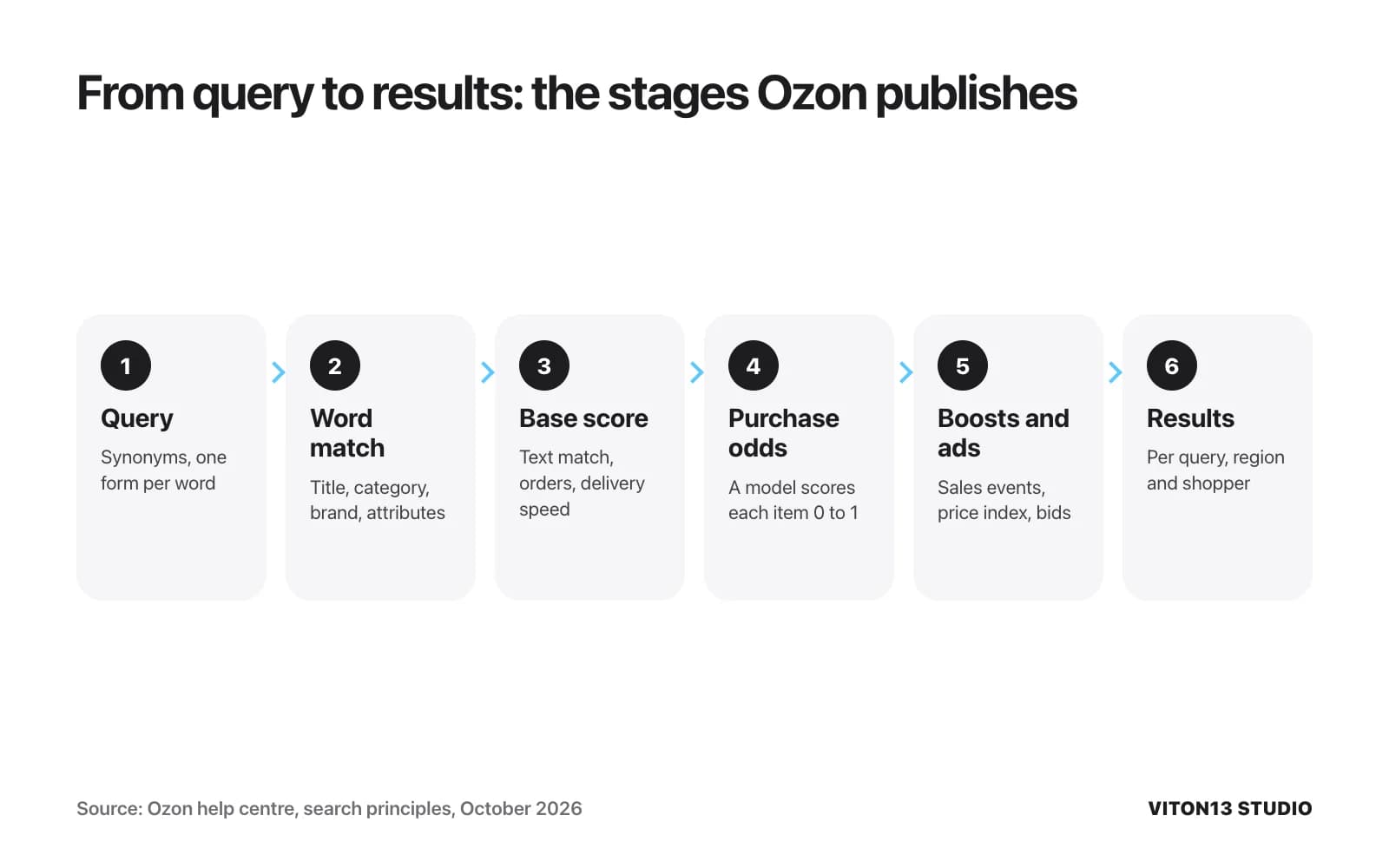
Wildberries names delivery time, sales, promotions, card quality, rating and reviews as its main organic factors, and its search also weighs conversion. Ozon describes five stages, from cleaning up the query to adding ads, shown below.
| Factor group | Weight | What it measures |
|---|---|---|
| Text relevance | 20–40% | Query words against title, description, attributes |
| Product sales | 15–25% | Conversion and orders over a period |
| Popularity for the query | 10–15% | Impressions, basket adds, favourites |
| Personalisation | 10–15% | The shopper's own purchases and interests |
| Price | 5–15% | Price changes, price against the query average |
| Delivery | 5–15% | Speed of delivery to the shopper |
| Reviews | 5–10% | Rating and number of reviews |
Where do you find the keywords shoppers actually use?
Take keywords from the marketplace itself: inside a marketplace shoppers type short phrases with size, colour and use. Amazon suggests mining its search-box suggestions and competitor listings; the rest comes from platform reports.
| Tool | What it shows | Access |
|---|---|---|
| Amazon Product Opportunity Explorer | Top search terms and search volume trends | Seller Central |
| Amazon Search Query Performance | Queries leading to your brand: impressions, clicks, cart adds | Brand Registry, which Amazon calls free |
| Wildberries search queries report | All platform queries: frequency and trend | Free; per-query funnel with Jam |
| Ozon search visibility | Who searched and saw the product, position, conversion | Full data with Premium Plus or Pro |
Group keywords by meaning (product type, use, material, size, season) and give each group one listing, so two of your listings never split the same impressions.
How do you optimise a listing for marketplace search, step by step?
- Collect the category's queriesPull them from platform reports and suggestions; drop other brands and words that do not describe your product.
- Give each query group one listingKeep colour and size variants of one model together rather than copying text into near-identical listings.
- Fill in attributes firstFilters read attributes, not prose. Wildberries shows only cards with the colour filled for “red dress”, and Ozon's content rating gives 30 of 100 points once over 70% of search attributes are filled.
- Write the title in shoppers' wordsLead with the product type, brand and the key detail people search for. Amazon allows 200 characters and recommends 80 or fewer.
- Write the description for a personUse plain sentences on features, use and care. Amazon warns that keyword stuffing can hurt rankings, and Wildberries docks quality points for strings of search phrases.
- Add back-end terms, then checkOn Amazon, put synonyms and variants in the generic keyword field, in lowercase, without brand names or words like “best”. A new Ozon product appears in minutes; if it is missing after 20, check the indexing errors report.
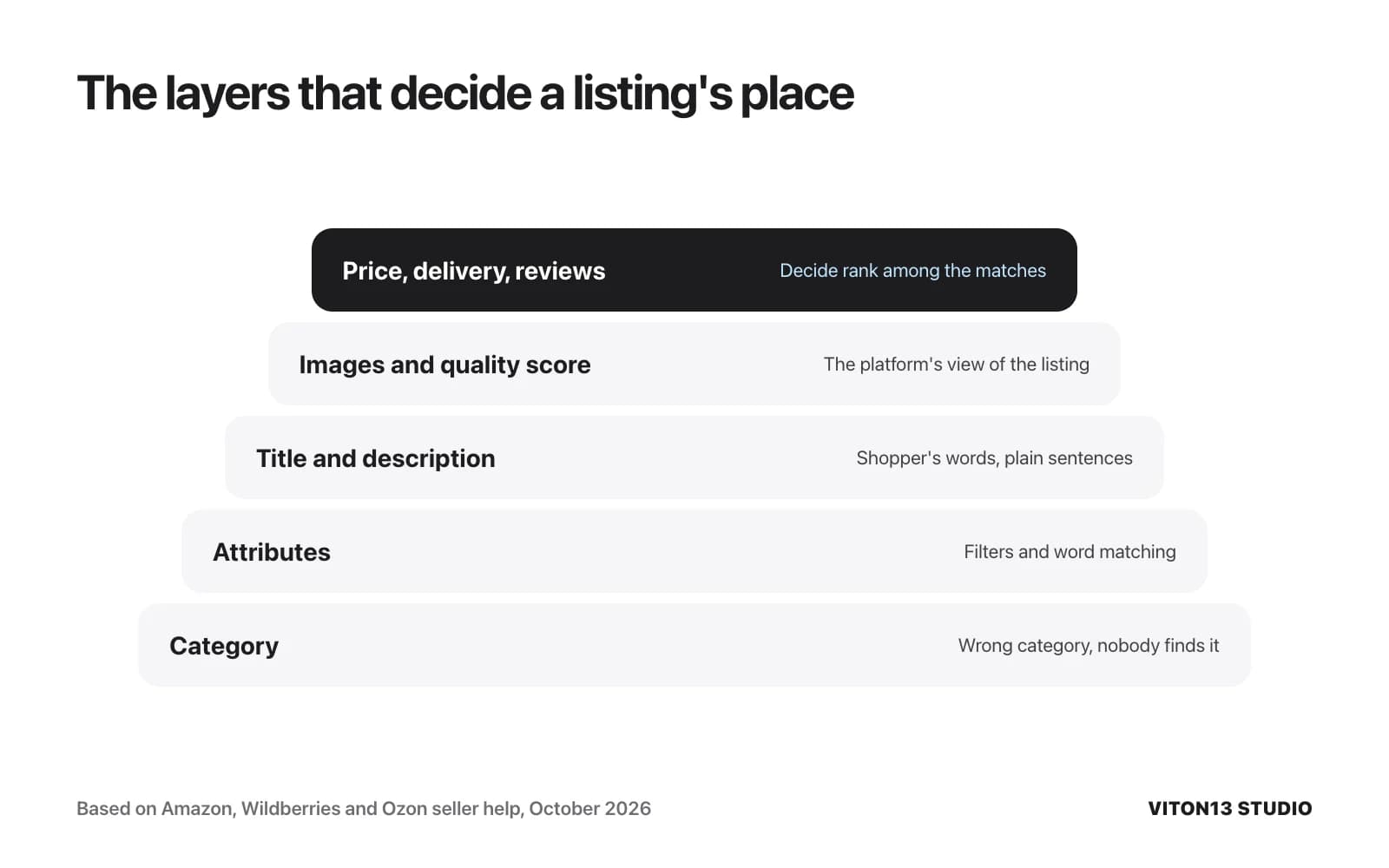
Check the category first: Amazon's code of conduct requires the correct category, and a misfiled product drops out of the filters shoppers use.
Self-check
Is your listing ready for marketplace search?
Tick what is already true for a listing or a group of them.
ticked 0 of 8
Your result: Not ready: the platform will match the listing to random words or none. Start with the category, filter attributes and a real query export.
How do you know marketplace SEO worked, and how long does it take?
Measure in platform reports, not by searching from your phone: Ozon notes that shoppers in one city at the same moment see different results. Record the numbers before changing anything and compare the same metrics after a pause.
- Amazon's Search Query Performance shows impressions, clicks and cart adds for queries leading to your brand, and Manage Your Experiments A/B tests titles, images and descriptions.
- Wildberries reports a median position, counted only where shoppers opened the card or added it to the basket.
- Ozon's visibility report shows who saw the product, its position and conversion to order, with a delay of one to two days.
Indexing is fast, but rank moves only as orders, basket adds and clicks build up, so take the second measurement weeks later and in a comparable season.
Is organic SEO or paid promotion better on a marketplace?
You rarely choose one: platforms layer ads on top of the organic score. On Wildberries a promoted position is the organic weight times the bid weight, and its help says paid promotion only adds to the organic position. Ozon sums an organic part and an ad part that depends on the bid and on the chance of a click and an order.
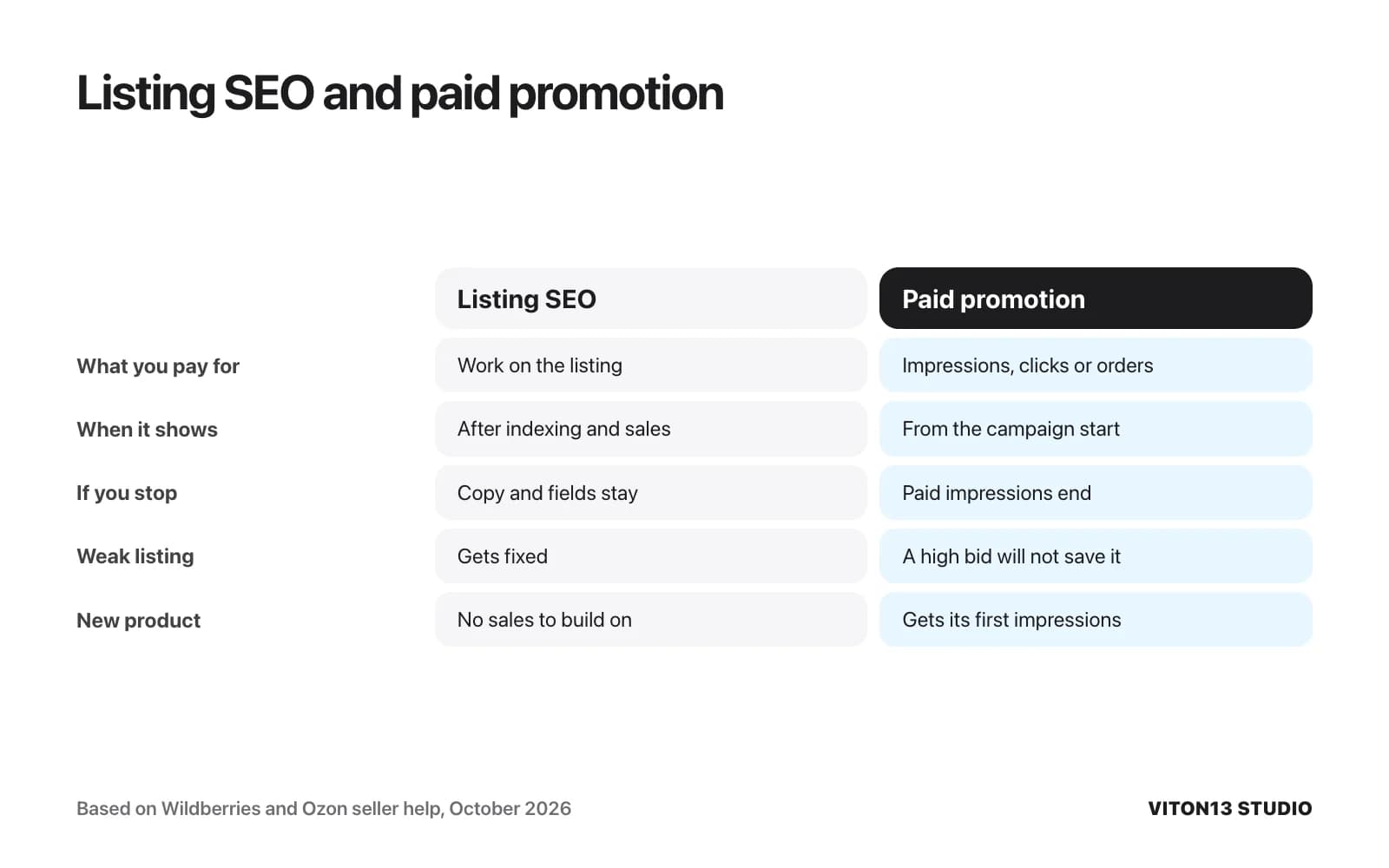
For new products Wildberries suggests a single-bid campaign that gathers 5,000–7,000 impressions to learn which phrases shoppers use, ready-made SEO material, and warns that weak cards may not reach the top even with a high bid. Budgets and bids are in our marketplace advertising guide.
Do fake orders and paid reviews still work, and what are the penalties?
Self-purchases, bots and paid reviews fake the signals that search rewards, and platforms both discount them and punish them.
- Amazon's code of conduct treats non-authentic or self-paid orders, bot traffic and incentivised searches as manipulation.
- The same code bans paying or giving free products for reviews and reviewing your own products; breaches can cost listings, payments and selling privileges.
- Amazon says it proactively blocked hundreds of millions of suspected fake reviews in 2025.
- Wildberries normally ignores a seller's own order in the rating, and Ozon warns that bots which view but never buy push a listing down.
In the United States, the FTC rule announced in August 2024 bans fake reviews, reviews bought on condition of a set sentiment and undisclosed insider reviews, and allows civil penalties for knowing violators.
How much does marketplace SEO cost?
The price depends on who does the work and what is included. These are published prices as of 16 October 2026.
| Option | Price | What you get |
|---|---|---|
| Do it yourself | Your time plus tools: Amazon Brand Registry is free; Wildberries Jam from 22,990 roubles per 30 days; Ozon Premium Plus 34,990 roubles a month | Reports; the analysis and copy are yours |
| Upwork freelancer | Typically $30–$65 an hour in the US, $15–$41 in the UK | Titles, bullets, back-end terms |
| Russian agency on Workspace, for Wildberries and Ozon | Declared ranges of 25,000–100,000 roubles; a manager's hour about 2,400 roubles | Often monthly management |
| VITON13: card SEO | $73 AI-assisted or $93 human-led | Query map, 20 cards, attribute check, 2 measurements; 5–8 working days |
| VITON13: listing optimisation | $53 AI-assisted or $73 human-led | Audit and new copy for live cards; 3–5 working days |
Compare scope rather than the headline figure: where keywords come from, how many listings, attributes and a baseline. Copy without a keyword map is cheaper, but it guesses the shopper's words instead of measuring them.
Cost calculator
Build the work your cards need
Tick what your Wildberries and Ozon cards need.
Your estimate
- AI-assisted
- from $73
- Human-led
- from $93
- Timeline
- 5–8 working days
stages can overlap; the written estimate fixes the dates
Get a written estimate in 1 working dayToday's starting prices of VITON13 packages; the written proposal fixes scope and price before work begins.
How VITON13 does card SEO
Our card SEO package covers Wildberries and Ozon. We map the queries buyers type in your category, group them by product type, use, material and size, and place them in the title, attributes and description of 20 cards, filling empty fields and fixing values that contradict the photos. We usually pick products with stock and margin and the fewest impressions, or you name them. Impressions and positions are recorded before the change and again after a pause.
Marketplace SEO
- Price
- $73 AI-assisted or $93 human-led
- Timeline
- 5–8 working days
Marketplace listing optimisation
- Price
- $53 AI-assisted or $73 human-led
- Timeline
- 3–5 working days
Marketplace product card design
- Price
- $73 AI-assisted or $93 human-led
- Timeline
- 3–5 working days
AI-assisted: AI drafts inside defined steps, a person directs and checks every result. Human-led: a specialist does the work and AI assists.
What is included
- 1 map of the queries buyers use in your category
- 20 cards rewritten: title, attributes and description
- Attribute completeness check on all 20 cards
- 2 measurements of impressions and positions: before the change and after it
Not included
- No promise of positions: ranking also weighs price, stock and sales
- Advertising and its budget
- Amazon, Mercado Libre and other marketplaces; the package covers Wildberries and Ozon
- Your own online store's SEO and photo or slide design, which are separate services
Revisions: 2 revision rounds on the deliverables
Get an estimate in 1 working dayWritten estimate within 1 working day
Example
PILOTPilot in progress
No published card SEO case yet
VITON13 has not published a card SEO case with a client's figures, so this guide invents no results. Marketplace work runs as a pilot direction: a specialist at the pilot price in exchange for before-and-after figures and a review.
What this does not prove
- Ozon's factor weights describe its general model; your category and region will differ.
- Freelancer and agency prices are snapshots on one date, not a market average.
Questions and answers
What is marketplace SEO in simple terms?
It is getting a product found in a marketplace's own search: collecting the words shoppers type, putting them where the platform reads them, keeping the listing in the right category and checking position and clicks in the platform's reports.
How long should an Amazon product title be?
Amazon's limit is 200 characters, and its seller blog recommends 80 or fewer. Put the product type, brand and key detail first; further keywords belong in bullet points, the description and the back-end search terms field.
Can a product rank without advertising?
Yes. Wildberries' seller help says a card can hold a high position and get orders from organic traffic alone. A brand-new product without sales has little to rank on, which is why ads often bring its first impressions and queries.
Is buying your own products to rank higher allowed?
No. Amazon's code of conduct names orders you paid for or refunded externally as sales rank manipulation, risking listings, payments and selling privileges. Wildberries normally ignores a seller's own orders in the rating, and Ozon says bot views without purchases push a listing down.
How long does marketplace SEO take to show results?
Indexing is fast: Ozon says a new product appears within minutes and its visibility data lags by one to two days. Rank moves as orders, basket adds and clicks build up, so compare with your baseline after several weeks.
Does VITON13 optimise Amazon listings?
Our marketplace SEO package is built for Wildberries and Ozon cards: a category query map, 20 rewritten cards, an attribute check and two measurements. The method in this guide applies to Amazon too, but that work is not part of this package.
Sources
- Amazon: seller code of conduct —
- Amazon: use search terms effectively —
- Sell on Amazon: how to boost listings —
- Sell on Amazon: Amazon SEO —
- Amazon: Trustworthy Shopping report —
- FTC: rule banning fake reviews —
- Wildberries: search and promotion FAQ —
- Wildberries: card quality rating —
- Wildberries: search queries report —
- Wildberries: your products in search —
- Wildberries: Jam prices —
- Wildberries: tariff options —
- Ozon: how search works —
- Ozon: search visibility —
- Ozon: content rating —
- Ozon: seller fees and subscriptions —
- Upwork: listing optimisation, US —
- Upwork: listing optimisation, UK —
- Workspace: marketplace SEO agencies —