
Design
Website redesign cost in 2026: refresh, restructure or rebuild, and when AI shortens it
Innowise's August 2026 guide prices a basic redesign at $10,000–$25,000, a mid-range one at $30,000–$80,000 and a high-end one at $100,000 or more. The level of change, not the new look, sets the price. At VITON13, a UX audit that settles the level costs $53 AI-assisted or $73 human-led; corporate website design costs $113 AI-assisted or $173 human-led.
What does each level of website redesign cost in 2026?
“Redesign” names three different jobs, and most tenfold gaps between quotes come from pricing different jobs under one word. Name the level first, then compare numbers. The ranges below come from agencies that sell redesigns: their price logic, not audited averages.
| Level | What changes | What stays | Published market range | VITON13 route |
|---|---|---|---|---|
| 1. Visual refresh | Colours, type, imagery, spacing and components on the existing pages | Structure, URLs, platform and most of the copy | Innowise basic redesign $10,000–$25,000 (50–150 hours); Flowout landing-page refresh $2,500–$8,000 | Conversion-focused web design, $93 AI-assisted or $113 human-led, for the pages that lose enquiries |
| 2. Structural redesign | Navigation, page templates, key journeys and the content model | The domain and usually the platform; some URLs change | Innowise mid-range $30,000–$80,000; Flowout full redesign of up to 15 pages $15,000–$40,000 | Corporate website design, $113 AI-assisted or $173 human-led: up to 20 pages mapped, 6 templates |
| 3. Rebuild on a new platform | All of the above plus the CMS or codebase, content migration and redirects | The domain and the content worth keeping | Innowise high-end $100,000–$200,000+; Flowout 20+ pages $35,000–$90,000+ | Corporate website design, then business website development (from $113) and website migration (from $53) |
WebFX, which also sells redesigns, splits the market by who does the work: $5,000–$75,000 with an agency, $3,000–$10,000 with a freelancer and $800–$5,000 in-house.
Which evidence tells you the level you need?
Judge the current site by what it does, not by how old it looks. All of this evidence exists before anyone opens a design tool.
| What you notice | Evidence to pull | Level it usually points to |
|---|---|---|
| The site looks dated, but enquiries are steady | Enquiries per month over the last 12 months | Level 1, or no redesign yet |
| Visitors arrive, few of them get in touch | Drop-off by step on the enquiry path; a UX audit of that path | Level 1 on the pages that leak |
| People cannot find services; the menu grew item by item | Site-search terms, exit pages, clicks on navigation | Level 2 |
| Every text change needs a developer; the theme or plugins are out of support | CMS limits and the update history | Level 3 |
| Pages are slow on phones | Core Web Vitals field data: LCP above 2.5 s, INP above 200 ms or CLS above 0.1 at the 75th percentile | Speed work first; level 3 only if the platform is the cause |
| New services, markets or languages do not fit | The content model: which page types are missing | Level 2 or 3 |
A weak score is not yet a verdict. Our case page for SB Excursions, a CLIENT site we built, lists its open items: a mobile performance score of 65 with a 7.8-second largest contentful paint, and accessibility at 87 because of contrast, link names and tap targets. That is a to-do list for the existing templates, not a reason to draw new ones.
Why start with a UX audit instead of a redesign brief?
A redesign brief assumes the answer. An audit asks the question first: where does the site lose people, and is the cause the layout, the content or the offer? VITON13's UX audit follows one key journey, usually the path to an enquiry, across up to 10 screens on phone and desktop. It ranks up to 15 issues by the evidence behind them and ends in a backlog your team can work through. It costs $53 AI-assisted or $73 human-led and takes 3–5 working days.
The audit lands in one of three places, and two cost less than a redesign. Issues on a few pages: fix those pages. Issues with navigation and missing page types: level 2. Issues that trace back to the platform: level 3, with the backlog as part of its brief. Tests with recruited users are not included; the audit works from analytics, heuristics and any recordings you share.
How do you keep search traffic through a redesign?
Search risk rises with the level: a refresh that keeps every address changes little, while a rebuild often changes every URL pattern. Google's site-move guidance is direct: map old URLs to new ones, use server-side permanent redirects, keep them for at least a year, and expect rankings to fluctuate while the site is recrawled — for a medium-sized site that can take a few weeks or more.
- Export every URL that matters: the sitemap, top pages in Search Console, landing pages in analytics and pages other sites link to.
- Mark each one keep, merge or retire, and give every kept or merged page exactly one new address.
- Carry over titles, descriptions, headings, structured data and hreflang for each kept page, not only its look.
- Set 301 or 308 redirects on the server, without chains, and point internal links straight at the new addresses.
- Submit the new sitemap, then compare clicks and indexed pages in Search Console for equal periods before and after launch.
This work has its own price. Flowout lists a CMS migration with no redesign at $8,000–$30,000, covering URL mapping, redirects and metadata. At VITON13 it is a separate order, website migration without SEO loss, from $53 AI-assisted or $73 human-led over 3–5 working days: a migration map, the redirect set and a check after launch.
What does AI change in a redesign, and what does it not?
Masterly, a design agency that sells this way of working, wrote in August 2026 that teams designing in Figma and letting coding agents do the build deliver a marketing-site redesign for roughly $5,000–$20,000 in 2–4 weeks, against $15,000–$60,000 at agencies working the older way. Treat it as a vendor's claim, not a measured average.
AI is quick at the parts that repeat: layout variants, component code, responsive states, a first redirect map drafted from a crawl export. It does not decide which pages to cut, write your positioning, gather texts from five departments or get the final yes. Those steps set the calendar at every level.
That is why VITON13 prices each package in two modes. For corporate website design, AI-assisted costs $113: AI takes over repetitive production and a designer directs and reviews every template. Human-led costs $173: a designer leads the process, the decisions and the delivery, with AI as a helper. Both share the published window of 7–12 working days. Choose human-led when the brand is still taking shape or the site supports high-stakes decisions.
Why can two quotes for the same site differ fivefold?
- Templates, not pages: 40 pages built from 6 templates cost less than 15 pages with a layout each.
- Content: rewriting and new photography often cost more than the design; a quote that expects you to supply them is lower for that reason alone.
- Migration volume: thousands of URLs, several languages or a long blog archive mean a bigger redirect map and more checking.
- Integrations: CRM forms, booking, payments and analytics events all need rework when templates change.
- Approvals: each extra approver adds a review cycle, so name one person who signs off.
When one quote is far below the others, look for the line it leaves out. It is usually content or migration.
Which lines in a redesign quote should worry you?
- No URL inventory and no redirect map, or “SEO included” without a named deliverable.
- A fixed launch date with no deadline for your texts and images.
- A platform change with no content export plan and no way back.
- Design files, code or accounts that stay with the supplier after launch.
- No baseline of enquiries, rankings and speed before launch, so nobody can tell whether the redesign helped.
- Promises of more traffic or higher rankings: no supplier controls either.
When should you not redesign at all?
Skip the redesign, or postpone it, in these cases:
- Enquiries hold steady and the only complaint is taste. New imagery on the home page and one key template may do.
- The real problem is traffic. New templates do not bring visitors who never arrive.
- The faults fit on a short list. VITON13's Site Fix Pack covers up to five agreed fixes on a live site for $33 AI-assisted or $53 human-led, in 1–2 working days.
- A new name or identity is on the way. Settle it first, or you will pay for two redesigns.
- Your texts are not written. Screens designed around dummy copy fall apart once the real words arrive.
What should you send with a redesign request?
- Read access to analytics and Search Console, or exports covering the last 12 months.
- The pages that bring enquiries or sales, and the ones you consider untouchable.
- Your brand files: logo, colours, fonts and any guidelines.
- Every connected service: CRM, booking, payments, chat and tracking.
- Who writes the texts, who approves the design and the reason behind any deadline.
How VITON13 does it
A redesign with us begins with its level. If the evidence is thin, start with the UX audit; if the level is already clear, order corporate website design straight away. Pick AI-assisted or human-led, send your brief and receive a written scope with the price and dates on the next working day. Production starts only once you approve it.
UX audit
- Price
- $53 AI-assisted or $73 human-led
- Timeline
- 3–5 working days
Corporate website design
- Price
- $113 AI-assisted or $173 human-led
- Timeline
- 7–12 working days
AI-assisted: AI drafts inside defined steps, a person directs and checks every result. Human-led: a specialist does the work and AI assists.
What is included
- A read of your current site, services and audiences before any screen is drawn
- Information architecture: sitemap and navigation for up to 20 pages
- 6 page templates, each for desktop and mobile
- 1 responsive UI kit: grid, type, colours and components
- 1 clickable prototype of the main journey, from the home page to an enquiry
- Developer handover in Figma with sizes, states and spacing
- Delivery window: 7–12 working days once the brief and texts are ready
Not included
- Building the site: business website development is a separate order
- URL mapping and redirects: website migration is a separate order
- Copywriting, translations, photography and illustration
- A new logo or brand identity
- The UX audit, unless you order it first
Revisions: 2 revision rounds on the deliverables; the number is confirmed in the written scope
Get an estimate in 1 working dayWritten estimate within 1 working day
Example
CONCEPTConcept — not a commissioned project
VITALIANO: a finished-looking concept site and the search layer it still lacks
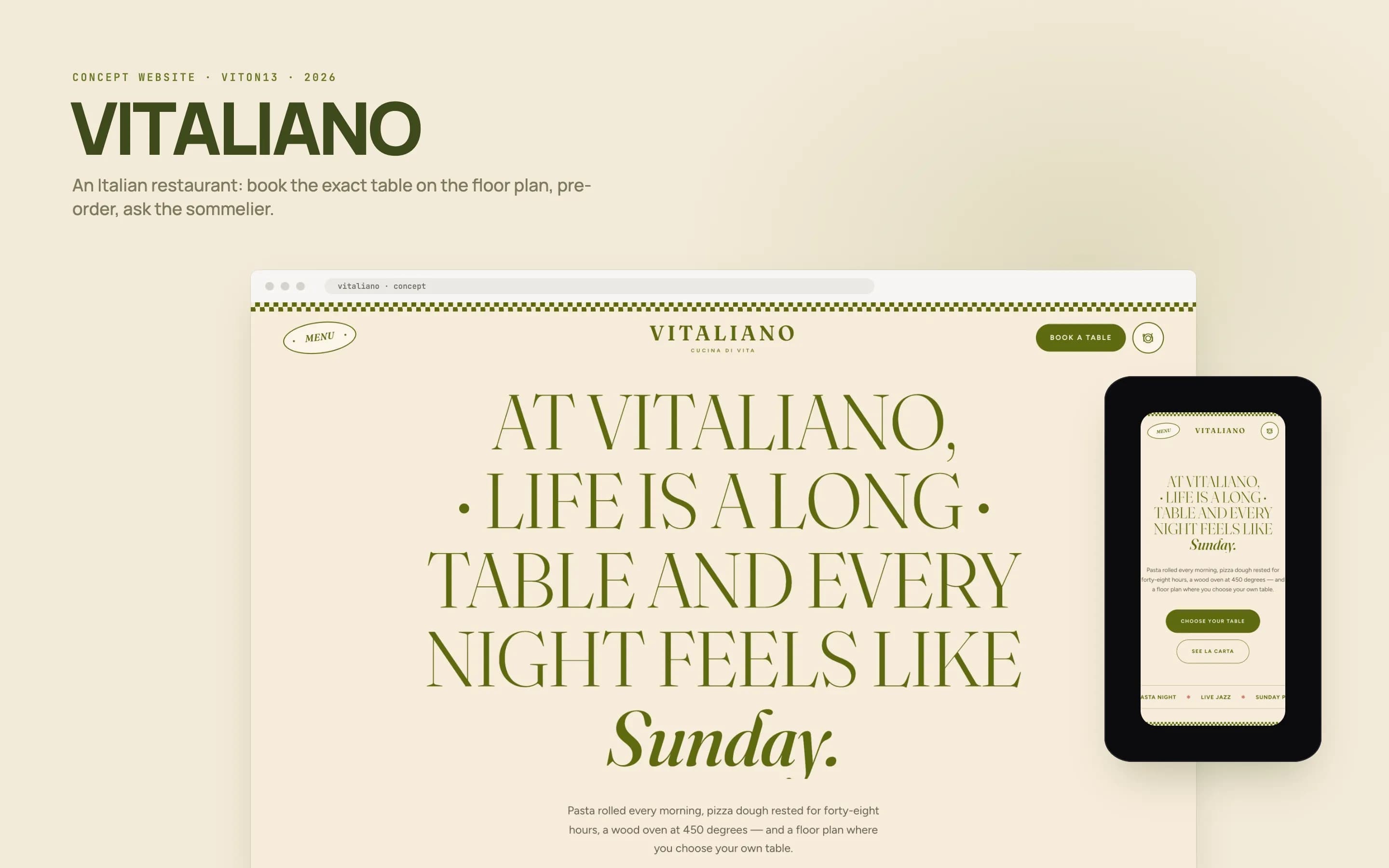
VITALIANO is a concept VITON13 designed and built for a fictional Italian restaurant group: 14 pages, a priced menu, a sommelier tool and table booking on a floor plan. Checked on 22 September 2026, all 13 rendered pages had a unique title and one H1 and no broken internal link; the mobile home page scored 70 for performance and 94 for accessibility. Yet canonical tags, Open Graph tags and structured data were on 0 of 13 pages, with no sitemap. That is the layer a redesign most easily drops: an old site may already have it, and the new one must keep it.
What this does not prove
- It is a concept: the restaurant, dishes, prices and addresses are fictional, and the site has no domain, visitors or bookings.
- It is not a redesign: there was no old site, so no URLs were mapped or redirected.
- The Lighthouse scores are lab tests of the home page on one day, not field data from real visitors.
- It was not ordered as a package, so it says nothing about the price or window of one.
Read the case: VITALIANO: a concept restaurant site where guests choose their exact table
Questions and answers
How long does a website redesign take?
At agencies, weeks to months: Flowout quotes 8–12 weeks for a full redesign of a site with up to 15 pages. VITON13's design window is 7–12 working days with the texts ready, and the build and the migration each add their own window. In practice, content and approvals set the pace, not drawing screens.
Will we lose Google rankings after a redesign?
Some movement is normal: Google warns that rankings can fluctuate while a moved site is recrawled. Lasting losses usually come from missing redirects, dropped pages and stripped metadata. Keep URLs where you can, redirect the rest one to one, and compare Search Console over equal periods before and after launch. Nobody can promise rankings.
Who owns the new design files?
You should, and it belongs in writing. With VITON13 you receive the Figma file, the UI kit and the handover notes; what is handed over, and when, is stated in the scope you approve. Register every account the site runs on to your business, not to a designer or developer.
What if the AI-assisted layouts look generic?
Say so in the first revision round and point to the screens. In AI-assisted mode a designer directs and reviews every template, so a direction can be corrected within the rounds. If originality matters more than price, for a new brand or a flagship site, choose human-led from the start.
Should we redesign the whole site or only the key pages?
Start with the pages that carry the money: home, the main service pages and the enquiry path. If the audit places the problems there, redesigning those templates first costs less and shows results sooner, and the rest can follow in the same UI kit. Redesign everything at once only when the structure itself is wrong.
How is payment handled, and what if we stop halfway?
Scope and price are agreed in writing before work starts, and the order can be cancelled free of charge until you approve that scope. If you stop after work has begun, you pay for the work done and the rest is refunded. A delivery that misses the approved scope is corrected within the revision rounds.