
CONCEPTConcept — not a commissioned project
VITON13MEDICINE: a concept site for a fictional AI drug-discovery biotech
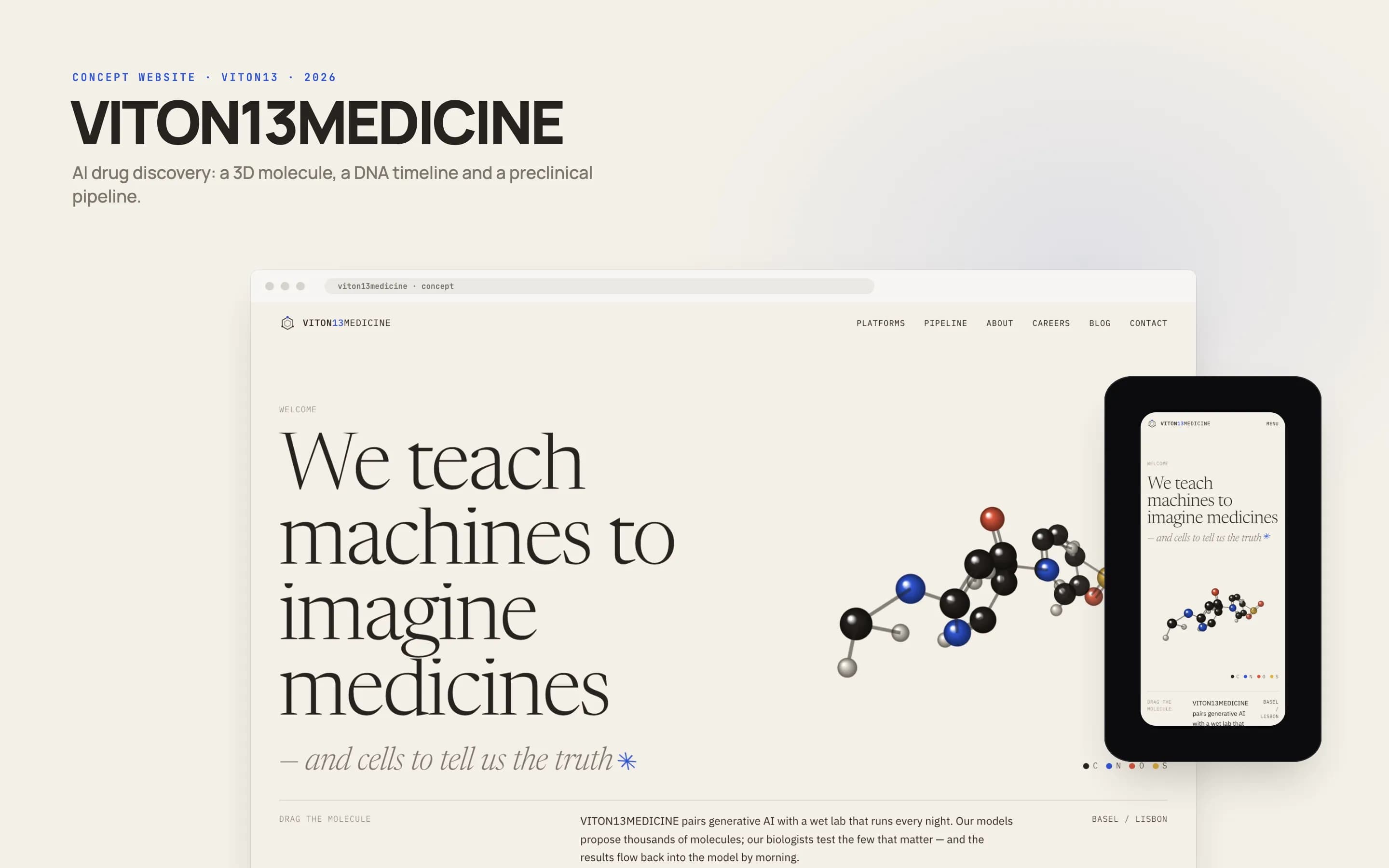
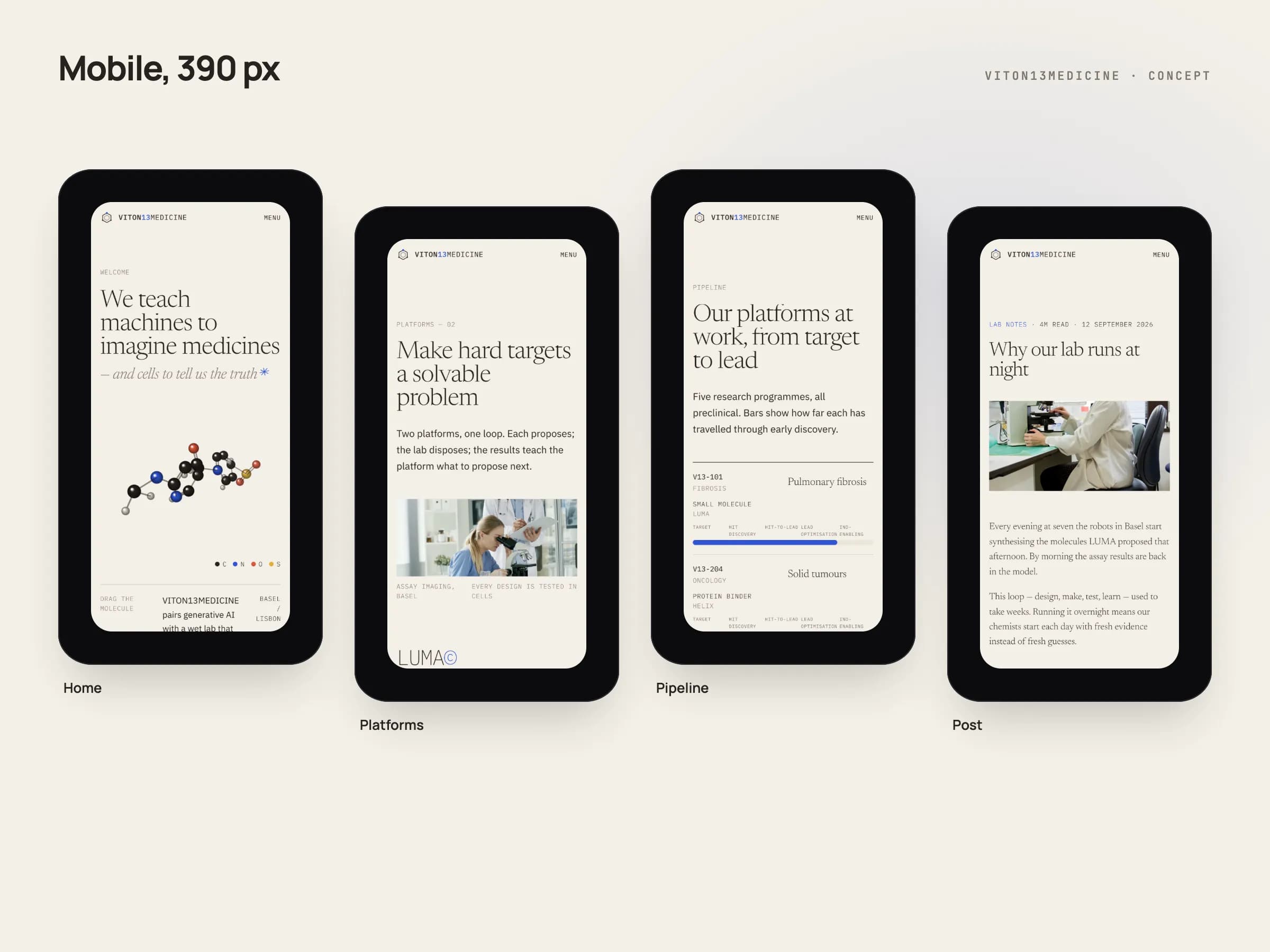
A concept VITON13 built to show range: the website of a fictional company that looks for drug candidates with AI, with its AI team in Lisbon and a wet lab in Basel. All five programmes on it are fictional and preclinical, and the site states that it is not medical advice.
- pages, from the home page to the 404
- 11
- fictional preclinical programmes in the pipeline
- 5
- home page weight in Lighthouse, 19 requests
- 0.5 MB
- Lighthouse performance, mobile / desktop
- 75 / 99
Task
VITON13 built this concept to show how the studio would present a science company: a fictional biotech that uses AI to discover drug candidates, with an AI team in Lisbon and a wet lab in Basel. The site had to explain two technology platforms, a research pipeline, open roles and a blog to a reader who knows the field, without overstating anything.
Medicine raises the stakes for copy. Every programme on the site is fictional and preclinical, and no sentence may read as a health or efficacy claim. The site therefore needed a clear notice that the company is fictional and that nothing on it is medical advice.
What we did
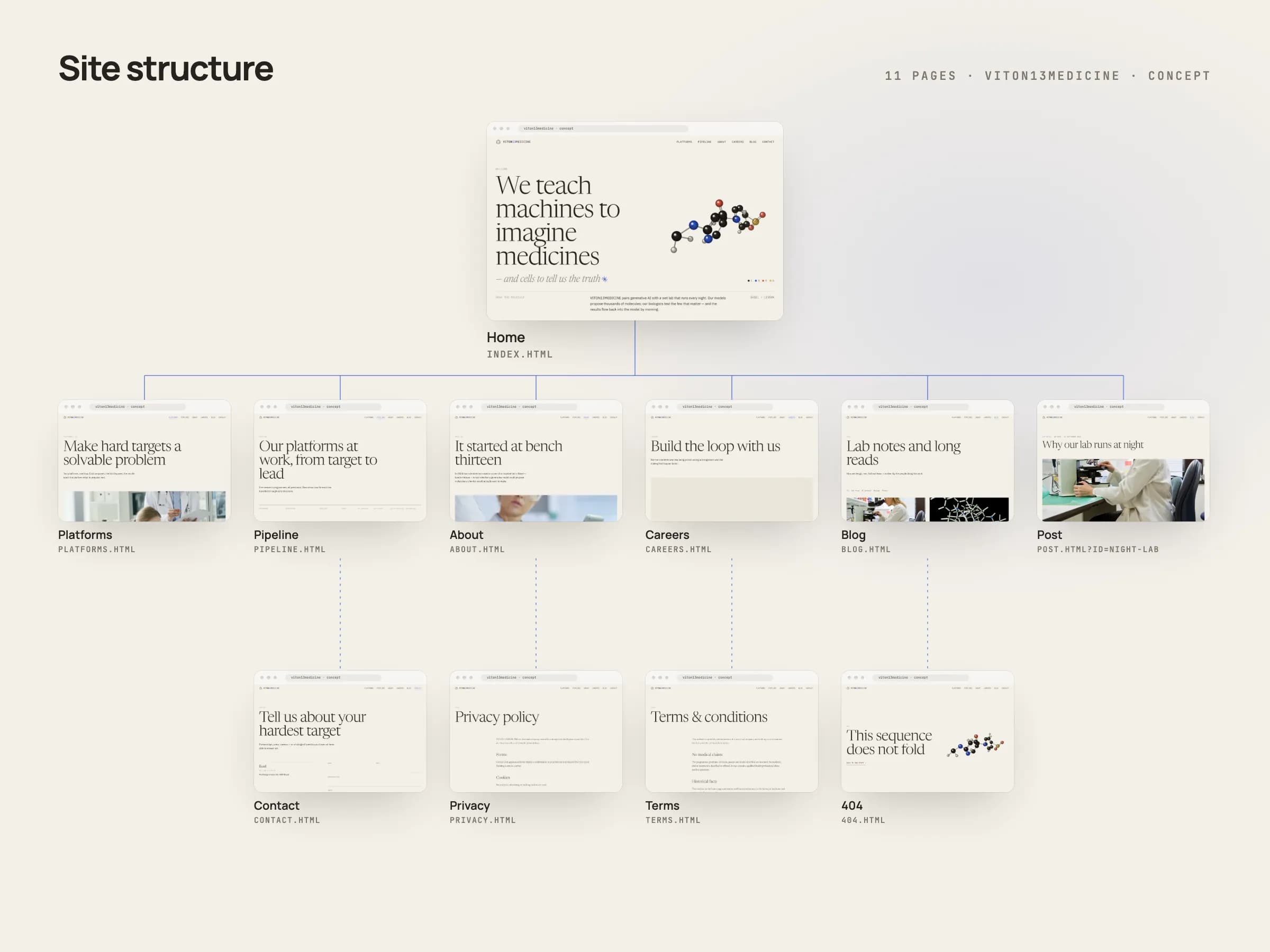
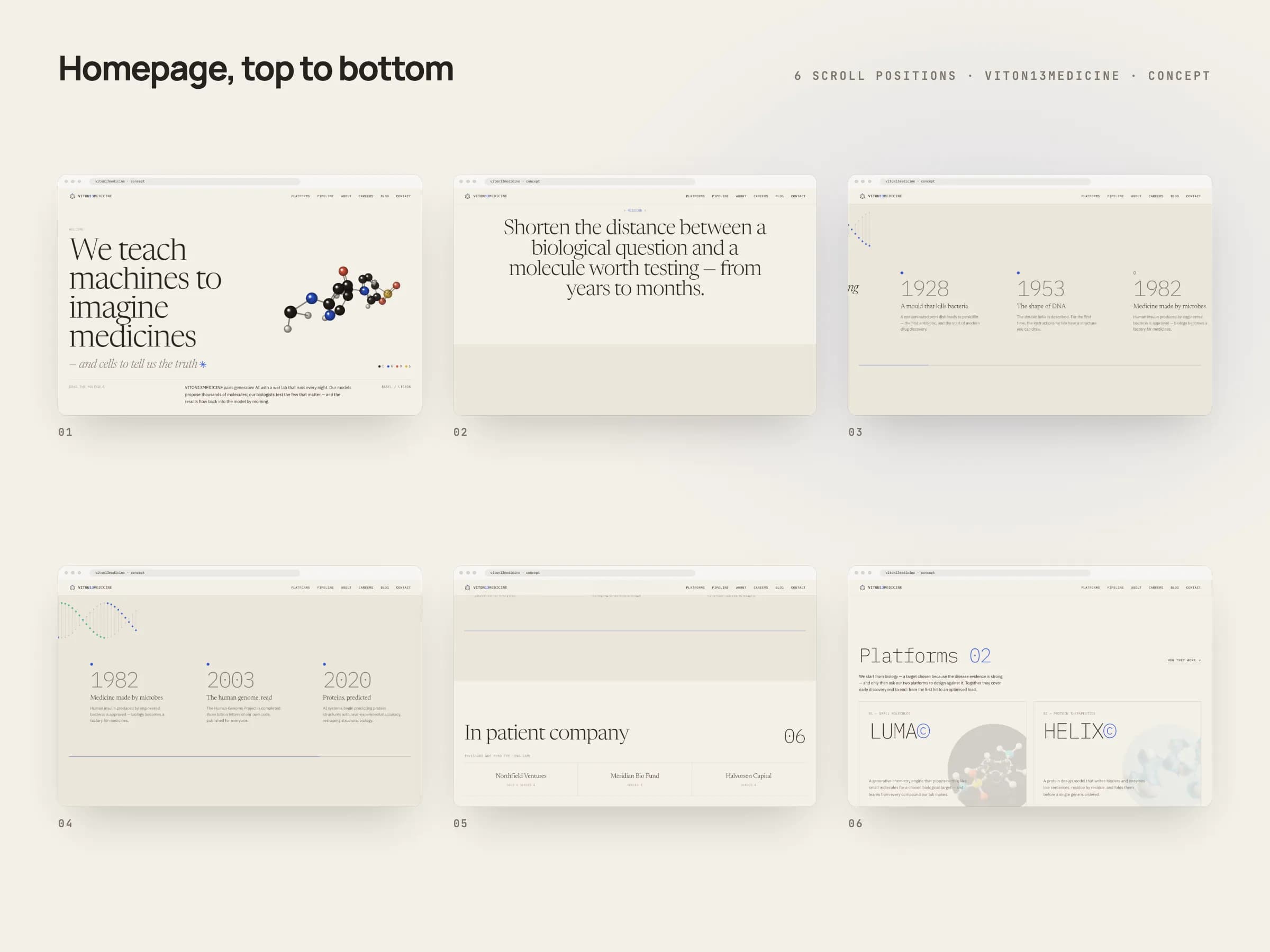
11 pages: Home, Platforms, Pipeline, About, Careers, Blog, a post template, Contact, Privacy, Terms and a 404. The home page opens with a 3D molecule drawn on canvas that the visitor can drag, followed by a history timeline of six milestones from 1928 to 2024 and an investors counter.
Platforms presents the two fictional platforms, one for small molecules and one for protein therapeutics, each with a problem, a solution and a design-make-test-learn loop. Pipeline shows five preclinical programmes in a table whose progress bars run across five discovery stages. Careers lists six open roles as an accordion, and the application form opens with the chosen role already selected. The blog has four posts with a category filter and article pages; Contact has an enquiry form. The footer of every page says the company is fictional and the site is not medical advice.
How it works
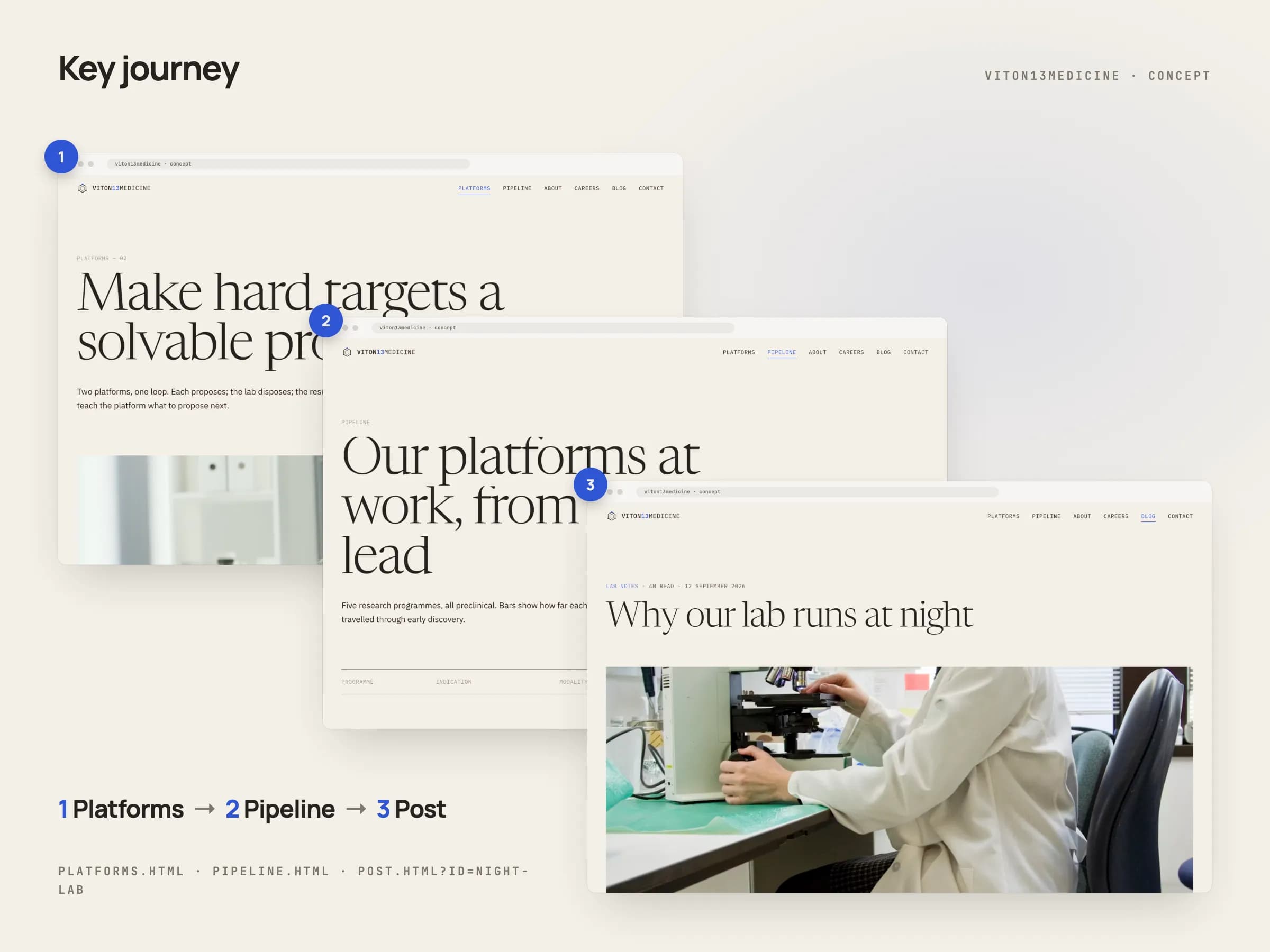
The first thing a visitor meets is the molecule: once dragged, it keeps turning with inertia, tilts towards the cursor and refits its camera to stay in frame. Further down, the timeline pins and moves sideways while a DNA helix draws itself in step with the scroll; on phones it becomes a vertical list. The key path runs from Platforms to Pipeline to a blog post.
Headlines rise line by line, images unmask with a clip-path and drift in parallax, pages change behind a curtain, and a custom cursor shows Drag, Read and Next labels. Underneath is plain HTML, CSS and JavaScript with no build step: one shared script renders the header, footer and overlays so every page stays identical, GSAP with ScrollTrigger and Lenis handle motion and scrolling, and the molecule and helix are drawn on canvas without a 3D library. Nothing typed into the forms is sent anywhere.
What exists now
The concept exists as 11 working pages in English. On 22 September 2026 Lighthouse measured the home page at 0.5 MB in 19 requests, the lightest of the seven VITON13 concept sites measured that day. With mobile throttling it scored 75 for performance, with LCP at 4.3 s and CLS 0; on desktop it scored 99, with LCP at 0.6 s and CLS 0.021. Best practices scored 100 on both, with no third-party video loaded during the test, and SEO scored 100 on both.
Accessibility is the weak spot: 88 on mobile and 87 on desktop, because some text is too low in contrast and the headings are not in order. Across the 10 pages checked (all but the 404), all 10 have unique titles and one H1, every image has alt text and no internal link is broken.
What this does not prove
This is a concept built by VITON13 to show range, not a commissioned project. The company, its platforms, programmes, investors, people and addresses are fictional. It has no domain, no visitors, no search traffic and no sales, and the images are licensed stock photography and video from Unsplash and Pexels.
The programmes are invented and preclinical; nothing on the site is evidence about a real medicine or medical advice, and the site says so itself. The Lighthouse scores are lab measurements of the home page on one day, not data from real visitors, and a Lighthouse SEO score of 100 covers the basics only: canonical URLs, Open Graph, JSON-LD and sitemap.xml are still missing.
SEO review
Lighthouse on the home page, 22 September 2026: SEO 100 and Best practices 100 on mobile and desktop, Performance 75 and 99, Accessibility 88 and 87. Across the 10 pages checked, titles, H1s, alt text and internal links are in order, but only 4/10 titles and 6/10 descriptions are the right length, and canonical, Open Graph, JSON-LD and sitemap.xml are missing (0/10) because the concept has no domain.
Checked on 22 September 2026: 10 pages rendered in Chrome the way a search crawler sees them, plus Lighthouse 13 on the home page.
Lighthouse, home page
- Performance
- Mobile75Desktop99
- Accessibility
- Mobile88Desktop87
- Best practices
- Mobile100Desktop100
- SEO
- Mobile100Desktop100
On-page and technical checks
- Unique page titlesin place10/10
- Title length 30–65 charactersmissing4/10
- Meta descriptions 70–170 characterspartly6/10
- One H1 per pagein place10/10
- Page language declaredin placeen
- Mobile layout without sideways scrollin place390 px
- Images with alt textin place100%
- Broken internal linksin place0
- Canonical URLmissing0/10
- Open Graph title and imagemissing0/10
- Structured data (JSON-LD)missing0/10
- sitemap.xml and robots.txtmissing0/2
In place across the 10 pages checked: unique titles (10/10), one H1 per page (10/10), the page language declared (en), a mobile layout without sideways scroll at 390 px, alt text on 100% of images and 0 broken internal links. On the home page Lighthouse measured LCP 4.3 s on mobile and 0.6 s on desktop, CLS 0 and 0.021, total blocking time 0 ms, and 0.5 MB in 19 requests.
Before launch: canonical URLs (0/10 now); Open Graph titles and images (0/10); JSON-LD (0/10): Organization with the fictional-company disclaimer kept visible, BlogPosting for posts, JobPosting for the open roles and BreadcrumbList; sitemap.xml and robots.txt (missing). Lengthen the six titles shorter than 30 characters (only 4/10 are 30–65) and the four descriptions under 70 characters (6/10 are 70–170). For accessibility, raise the contrast of the faintest text and put the headings in order. The medical copy stays free of health claims.
Services this case shows
Describe the task on the service page; a written scope, timeline and price come back within one working day.
Discuss a similar projectMore cases
All cases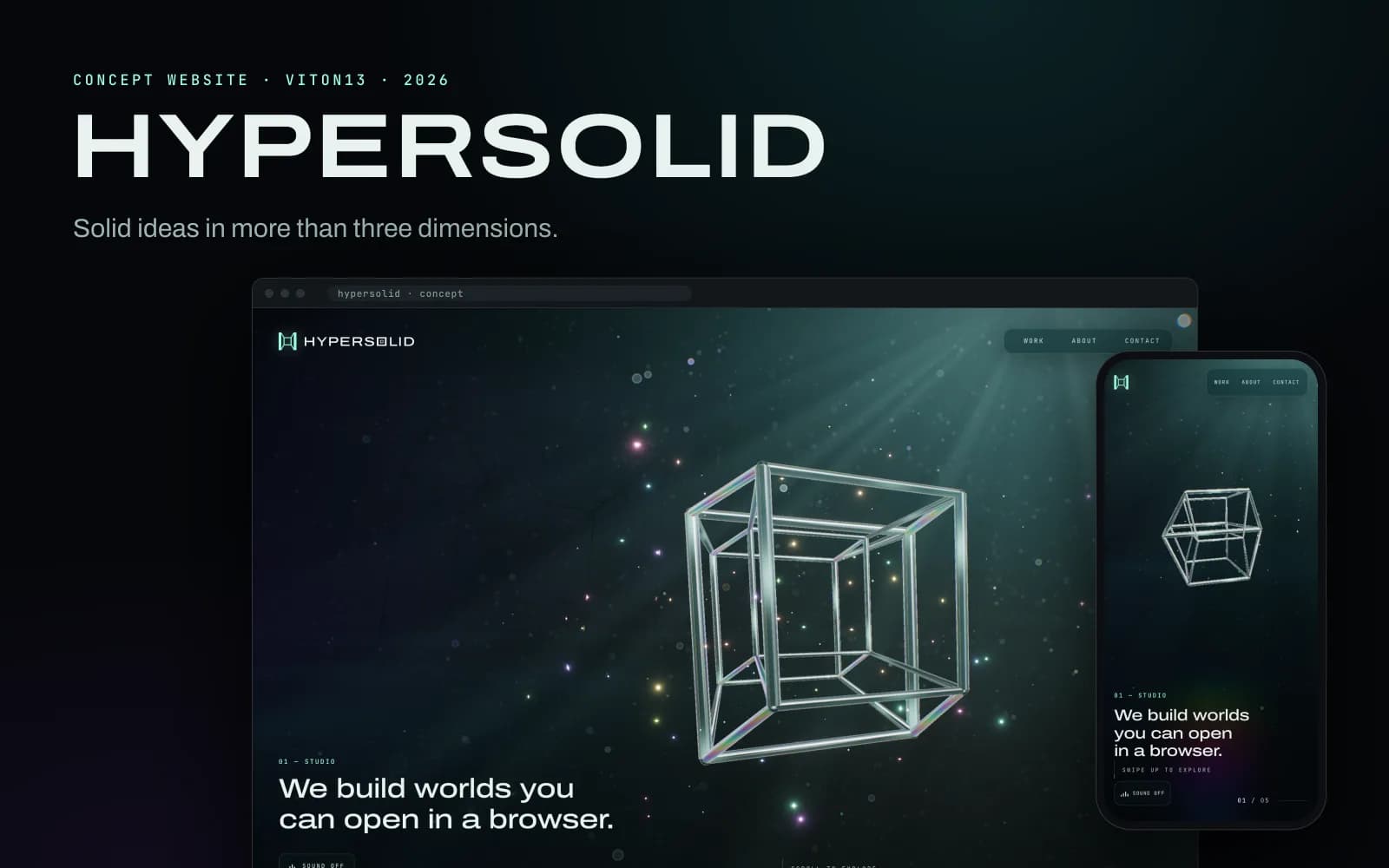
CONCEPTConcept — not a commissioned project
HYPERSOLID
Concept site · WebGL · English · 2026
HYPERSOLID is a fictional creative-technology studio, and this is the site VITON13 built for it as a concept to show range. The whole page is one real-time 3D scene in three.js: a glass tesseract rotating in four dimensions, a camera that scrolling moves through five chapters, a ring of eight live shader worlds and a soundtrack generated in the browser.
Read the case →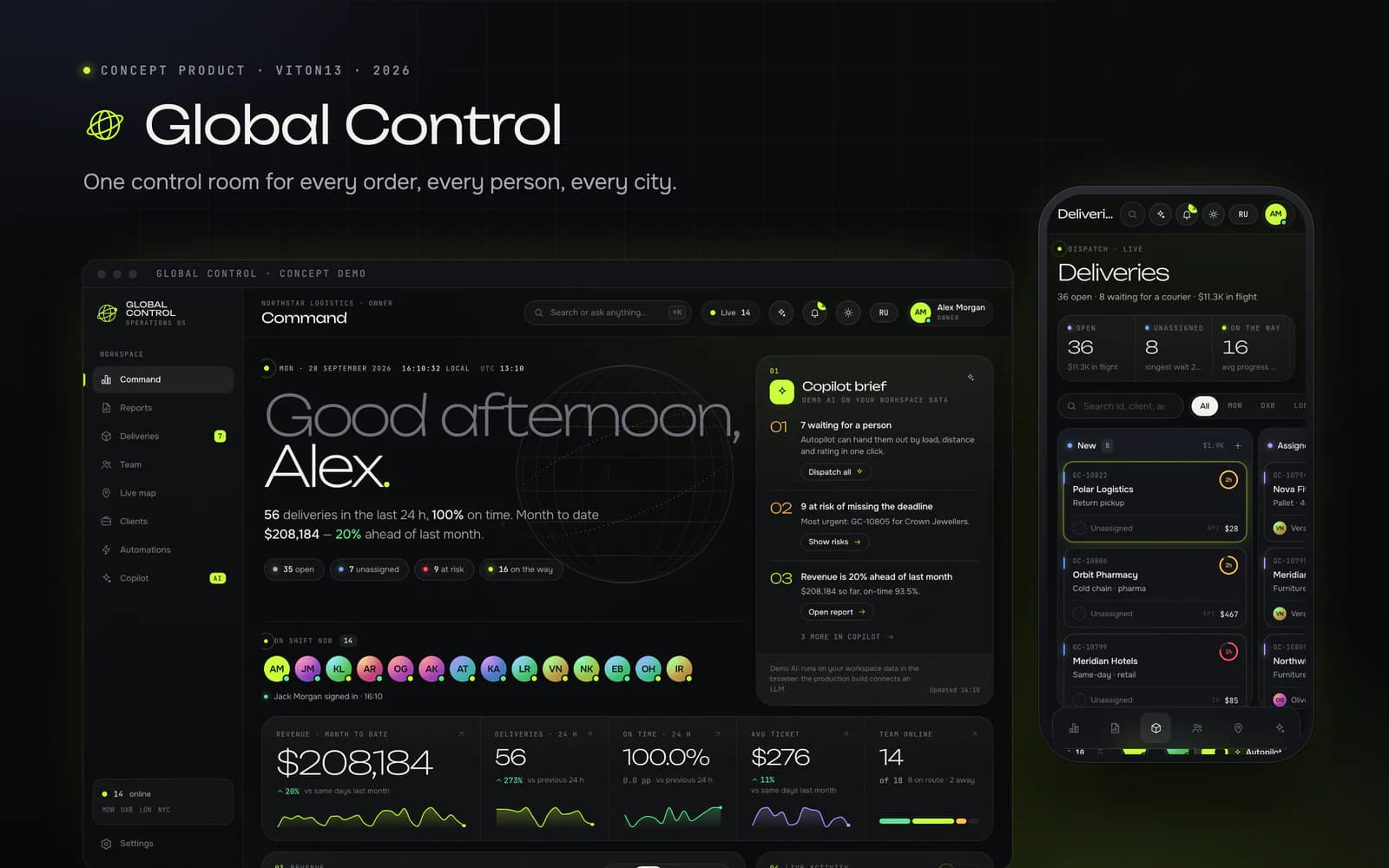
CONCEPTConcept — not a commissioned project
Global Control
Concept product · Web app · English, Russian · 2026
Global Control is an operations CRM VITON13 built as a concept, shown through Northstar Logistics, a fictional delivery company with hubs in Moscow, Dubai, London and New York. Every visitor builds their own sandbox in a short onboarding and gets a team, clients and two weeks of orders; a live simulation keeps the company moving while they dispatch orders, register people, read reports and talk to a demo AI copilot. Everything runs in the browser on generated data.
Read the case →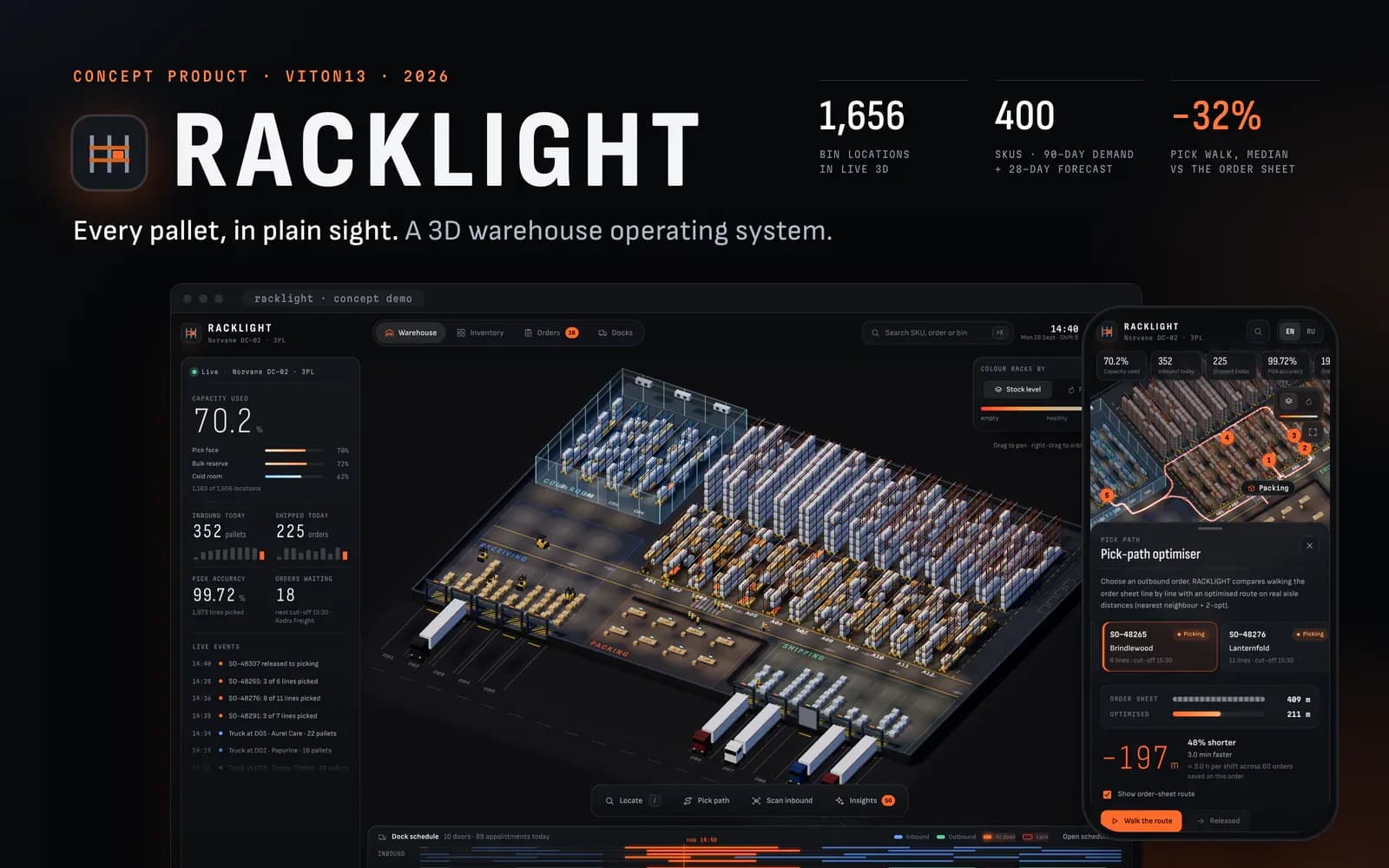
CONCEPTConcept — not a commissioned project
RACKLIGHT
Concept product · WMS · 3D · English and Russian · 2026
RACKLIGHT is a warehouse management system for Norvane DC-02, a third-party-logistics warehouse that does not exist. VITON13 built it as a concept to show what an operations product looks like when the warehouse itself is the interface: 1,656 bin locations as live 3D pallets, search that flies to any bin, a pick-path optimiser, inbound scanning with a putaway rule and demo AI for stock, which is rules and statistics in the browser and labelled as such.
Read the case →