
CONCEPTConcept — not a commissioned project
VOXA: a concept of a voice-first bank, with voice payments, money in chats and a shared dream jar
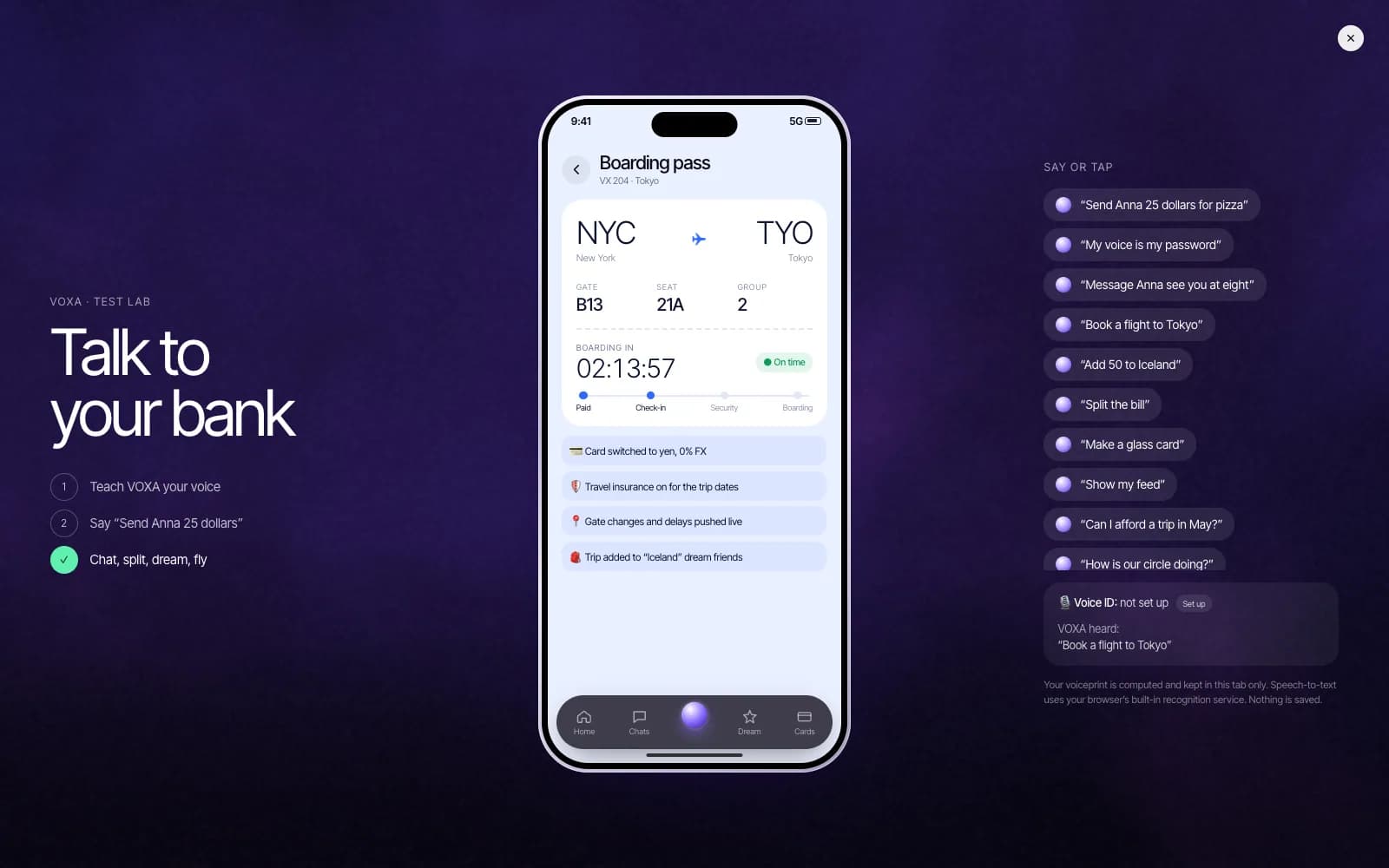
VOXA is a fictional bank of the future, and this is the site VITON13 built for it as a concept for banks and fintech products. A camera flies through one three.js world with ten features; each opens a working phone app where a visitor pays a friend by voice, saves for a shared dream, buys a flight that turns into a boarding pass or designs a card, and a closing scene with two Veo 3.1 films hands the microphone to the visitor.
Open the live project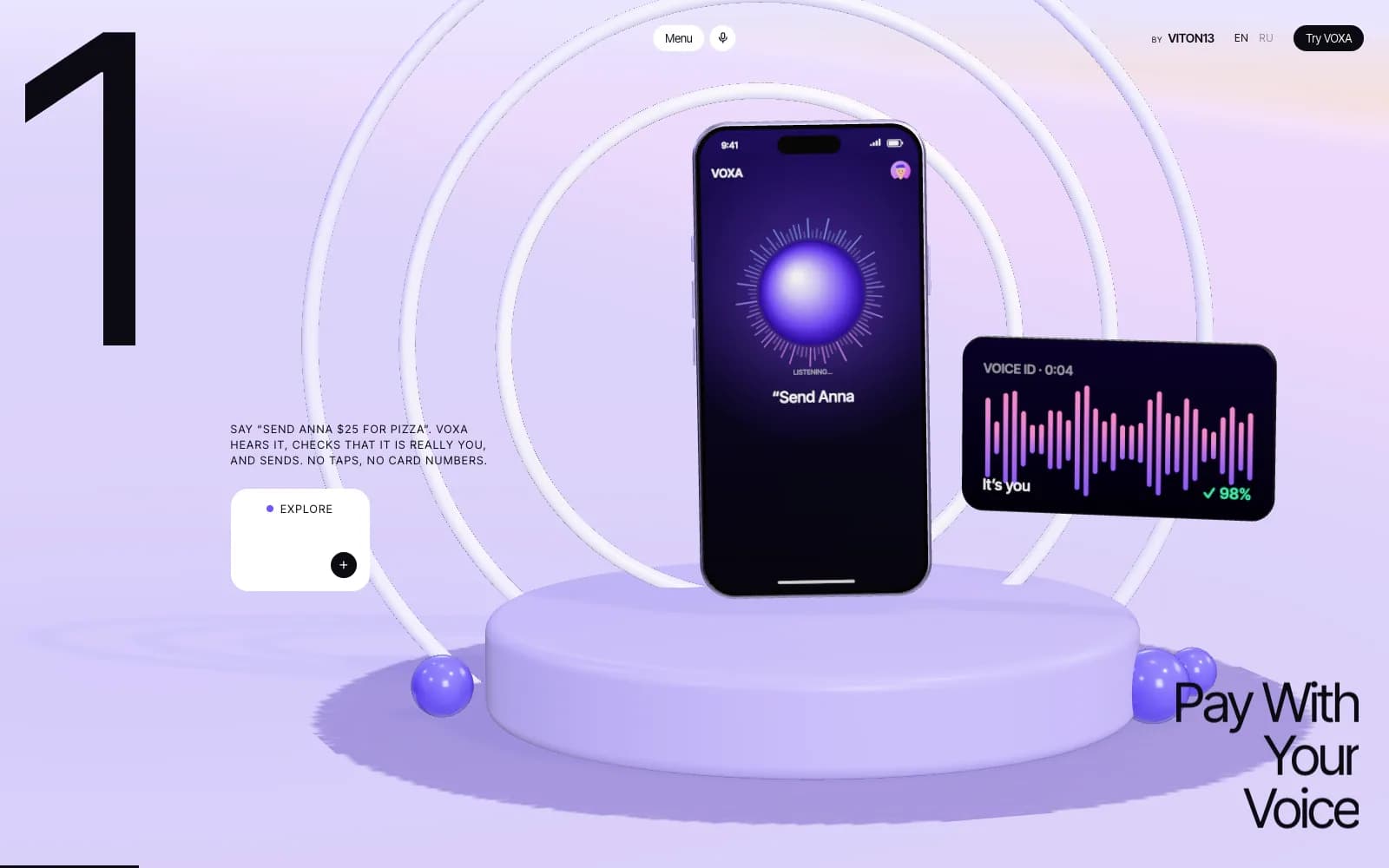
- features in one three.js world, each with a working phone demo
- 10
- test voice commands understood, 28 in English and 28 in Russian
- 56
- median frame rate resting and during camera flights on a MacBook with Apple M5 (lowest 58.1)
- 60 fps
- JavaScript gzipped, three.js included
- 0.24 MB
Task
VITON13 builds concept sites to show its range in sectors where it has no client project to point to yet. VOXA is the one for banking and fintech: the site of a fictional bank of the future, in the genre of interactive feature stories where a preloader counts to ten and a camera flies through one 3D world, a feature per stop. The bank, its customers, balances and flights are invented, and the site is in English and Russian.
The brief we set ourselves: a bank you talk to and spend time in. A voice replaces the card number, friends replace the list of payees, and a trip, a dream or a split bill becomes something people do together, so the bank becomes a second place online after the messenger. And it had to be something a visitor can try, not only watch.
What we did
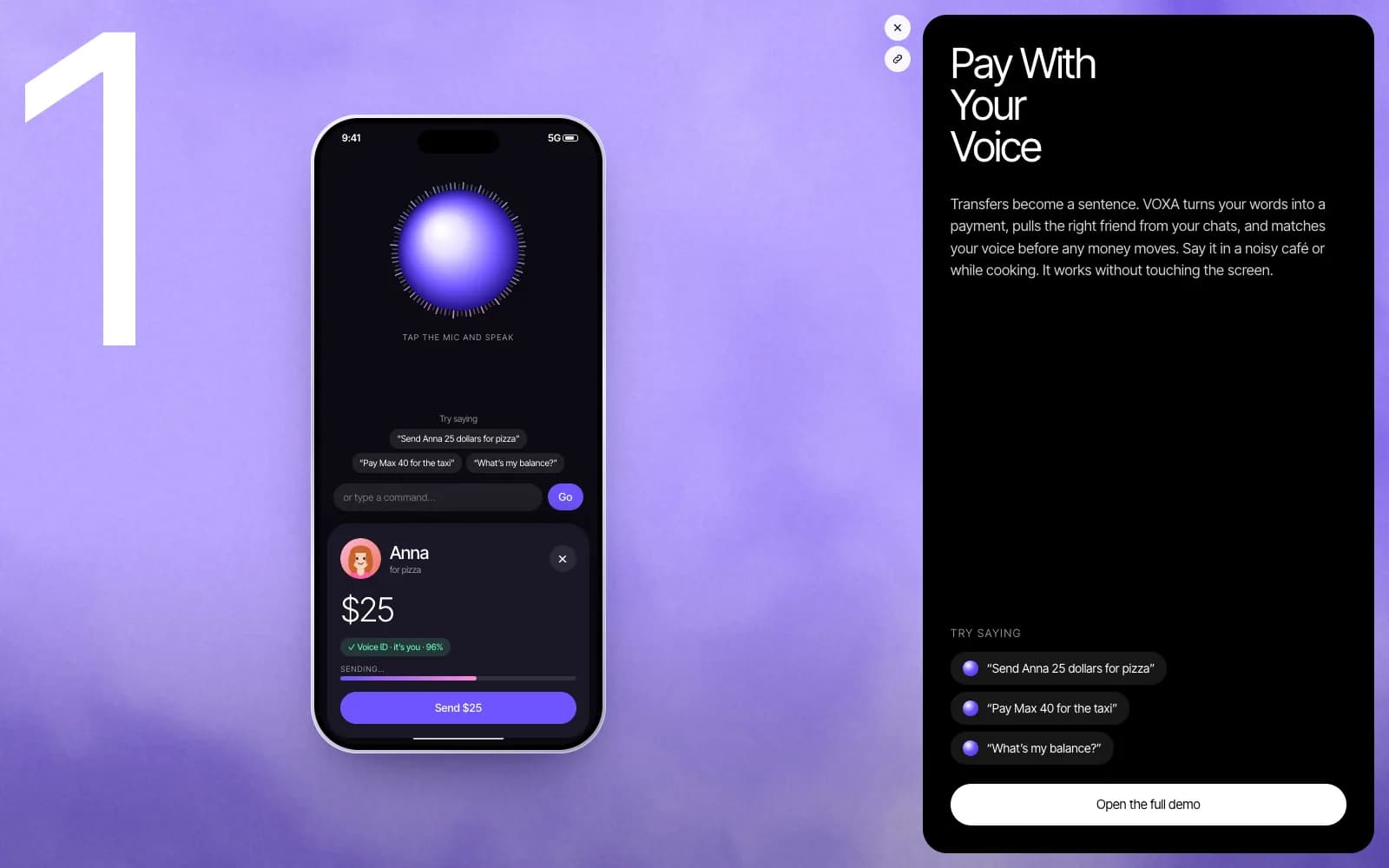
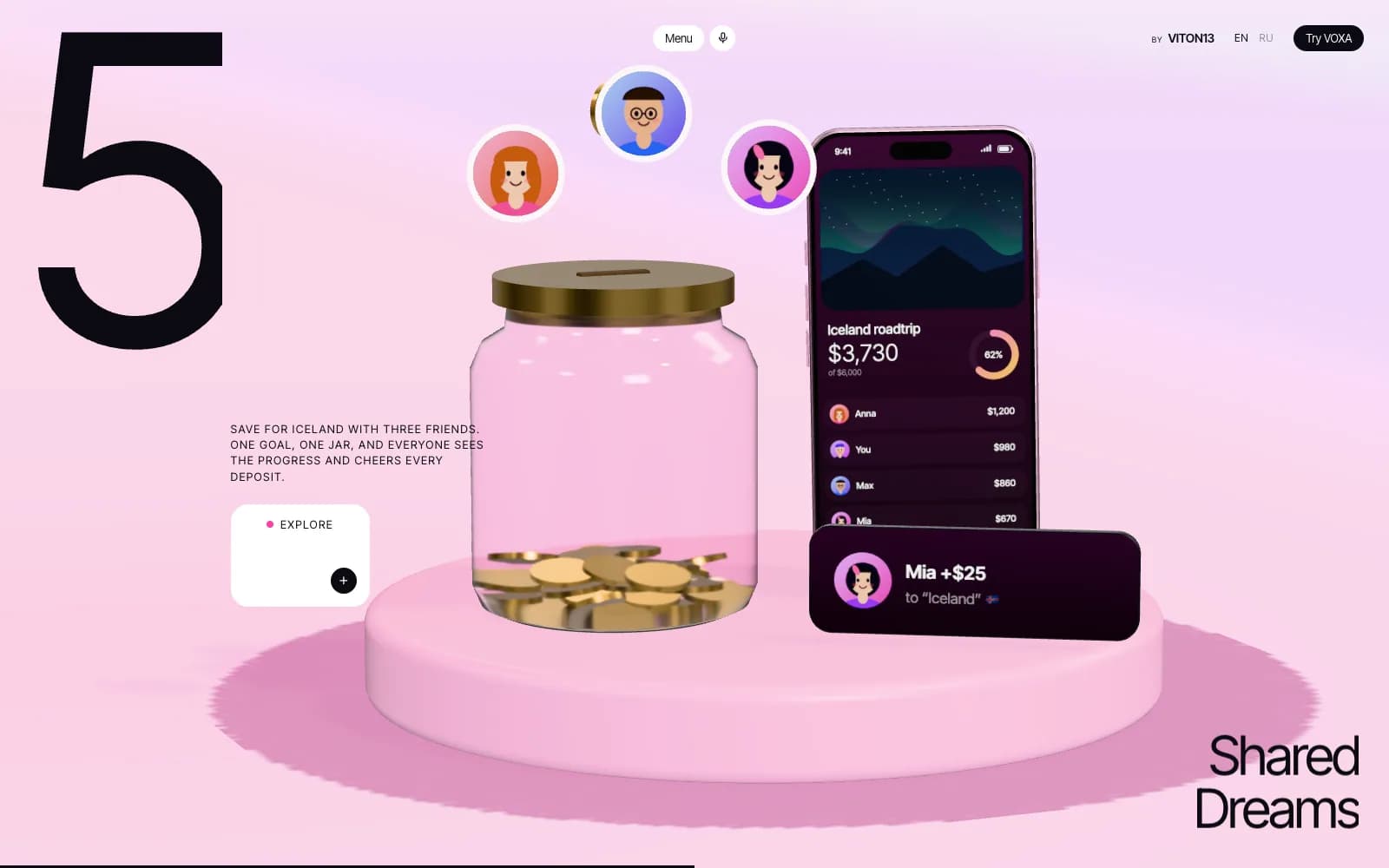
One page with ten features: voice payments, Voice ID, money in chats, flight-aware payments, shared dreams, bill splitting, a card lab with test and one-time cards, a friends’ feed with private amounts, an AI money coach and investment circles. Each feature has a diorama in the 3D world, a slide with a caption and an Explore panel that opens a working phone app at that feature; the menu lists all ten with thumbnails rendered from the scene.
The phone app runs on one shared state: money sent in a panel shows up in the chat, the balance and the test lab; friends reply and react; the dream jar fills while you watch; a bought ticket becomes a boarding pass with a live countdown, travel insurance and a local-currency note. A test lab gathers everything with commands to say or tap, and a microphone in the header steers the whole site by voice.
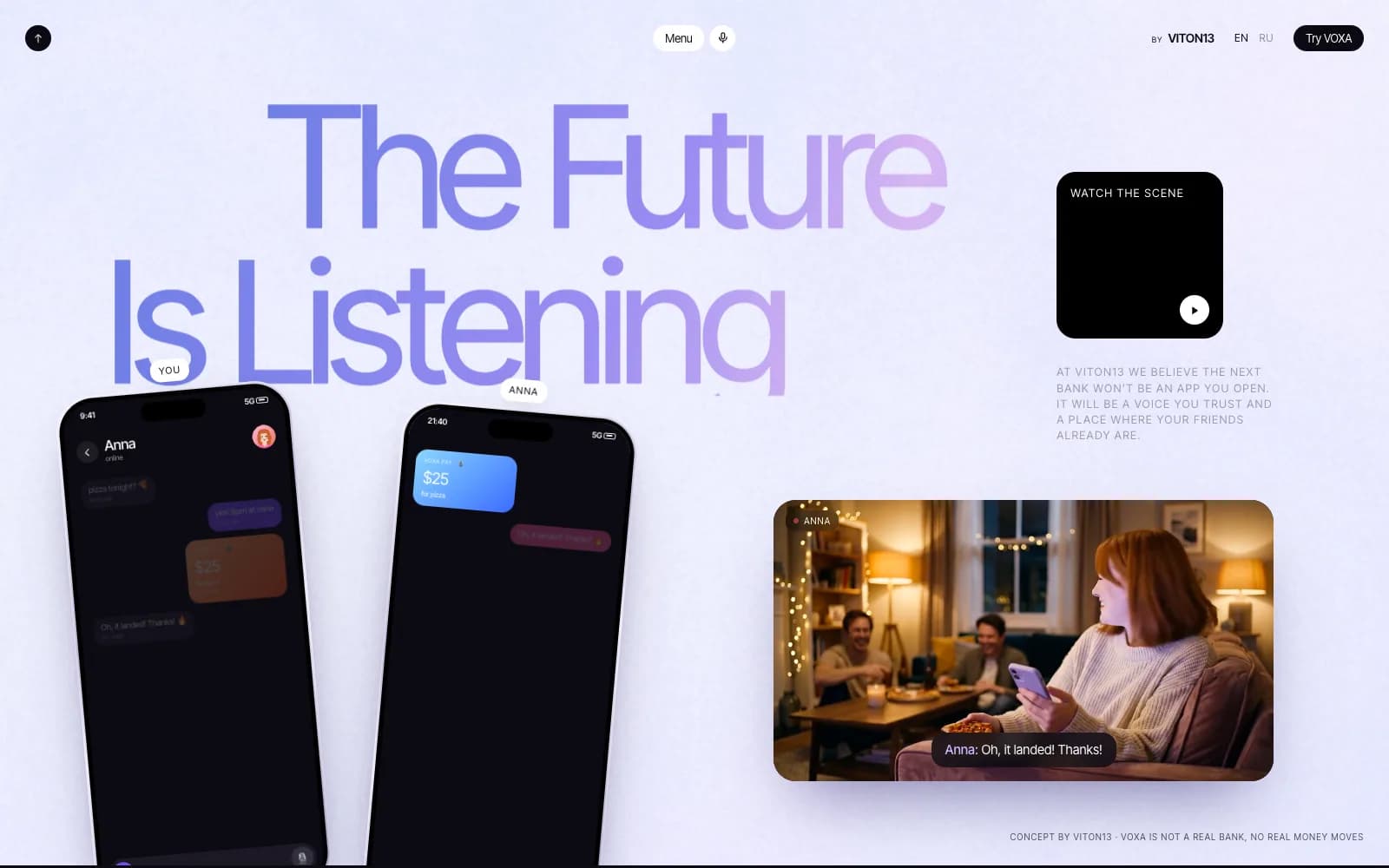
The closing scene cuts two 6-second films generated with Veo 3.1 (Alex asks VOXA to pay Anna for pizza; Anna laughs when it lands) together with the two phones on the page, then passes the microphone to the visitor. Every text is in English and Russian, and the films exist in both languages.
How it works
The world is one three.js scene: ten dioramas in a pastel studio whose colour flows from stop to stop, and a camera that flies between them along an arc with a slight lens breathing and follows the cursor. Every model is built in code, from phones whose screens are drawn on canvas to a white plane, a glass jar of coins, metal, glass and holographic cards and an arch carrying the members of an investment circle; the friends are illustrated portraits drawn in code, not photos.
Voice runs in the browser. Speech becomes text through the browser’s own recognition service and is parsed into an intent in English or Russian, Russian word forms such as «Ане» and «Максу» included. Voice ID records three phrases and keeps a voiceprint of the average spectral shape and pitch, computed in the tab and sent nowhere; spoken payments are checked against it, and a mismatch asks for Face ID. The site is built with esbuild into static files and served at /demos/voxa-bank/ with a header that allows the microphone on that path only.
What exists now
What exists now is a working concept at tarasovvitalii.com/demos/voxa-bank/, built on 28 September 2026. A parser run the same day understood all 56 test commands, 28 in each language. We counted frames with requestAnimationFrame for three seconds, twice resting on a slide and twice during a camera flight, in headless Chrome with ANGLE Metal on a MacBook with an Apple M5 at 1600 × 1000 on a Retina scale: 60.1, 59.8, 60.0 and 58.1 fps. The page loads 0.24 MB of JavaScript with gzip, three.js included; the build is 4.3 MB, 3.3 MB of it the four film clips.
The same day Lighthouse 13.5 ran three times per device on the live address. The medians: performance 47 on mobile and 61 on desktop, accessibility 100, best practices 100; LCP 3.5 s on mobile and 0.5 s on desktop, CLS 0.005, and the page transfers 0.4 MB on load. What holds the mobile score back is the start of the 3D world: building ten dioramas and compiling their materials block a simulated phone for 15,754 ms. The machine was heavily loaded that day (load average around 50), so the live address should be measured again.
What this does not prove
VOXA is a concept VITON13 built to show what we can make for banks and fintech products, not a commissioned project. The bank, the friends, the balances and the flights are fictional and no money moves; the two people in the films were generated with Veo 3.1 and Nano Banana Pro and are not customers. The site has no client, users, traffic or enquiries, and it proves nothing about conversion or retention.
Voice ID is a demonstration, not biometric security: it compares spectral averages, can confuse similar voices and was checked in headless Chrome with a synthetic microphone, not with real speakers. Speech-to-text needs Chrome, Edge or Safari. The frame rate comes from one machine on one day, and Lighthouse is a lab test that ran while the machine was under heavy load.
SEO review
On 28 September 2026 Lighthouse (three runs per device on the live address, medians) gave performance 47 on mobile (LCP 3.5 s, 0.4 MB) and 61 on desktop (LCP 0.5 s), accessibility 100 and best practices 100. SEO is 66 because the demo is marked noindex, nofollow in the page and in the server header, by design: the page meant for search is its case on the portfolio.
Checked on 28 September 2026: 2 pages rendered in Chrome the way a search crawler sees them, plus Lighthouse 13 on the home page.
Lighthouse, home page
- Performance
- Mobile47Desktop61
- Accessibility
- Mobile100Desktop100
- Best practices
- Mobile100Desktop100
- SEO
- Mobile66Desktop66
On-page and technical checks
- Unique page titlesin place2/2
- Title length 30–65 charactersin place2/2
- Meta descriptions 70–170 charactersin place2/2
- One H1 per pagein place2/2
- Page language declaredin placeen, ru
- Mobile layout without sideways scrollin place2/2
- Images with alt textin place10/10
- Broken internal linksin place0
- Canonical URLin place2/2
- Open Graph title and imagein place2/2
- Structured data (JSON-LD)in place2/2
- sitemap.xml and robots.txtpartly1/2
Checked on the one page in both languages (the English and Russian states of /demos/voxa-bank/), rendered in headless Chrome at 390 px. In place: a title of its own in each language, one H1, the language declared (en and ru), no horizontal scroll, a canonical URL, Open Graph with an absolute image, WebApplication JSON-LD, alt text on the ten menu thumbnails and robots.txt at the domain root. All 5 link targets resolve; the portfolio’s case pages /work/voxa-bank/ and /ru/work/voxa-bank/, which answered 404 on the day of the check, went live on 28 September 2026 and were re-checked (200). The demo is kept out of sitemap.xml on purpose.
If VOXA were a real bank’s site: remove noindex; give each language its own URL with hreflang instead of a switch on one page; list the pages in sitemap.xml; add FinancialService and FAQ JSON-LD for the product pages. For speed on phones, start the 3D world after the first paint, build the ten dioramas in smaller steps, lazy-load the film clips and the scene’s textures, and measure the live address again on a machine that is not under load.
Services this case shows
Describe the task on the service page; a written scope, timeline and price come back within one working day.
Discuss a similar projectMore cases
All cases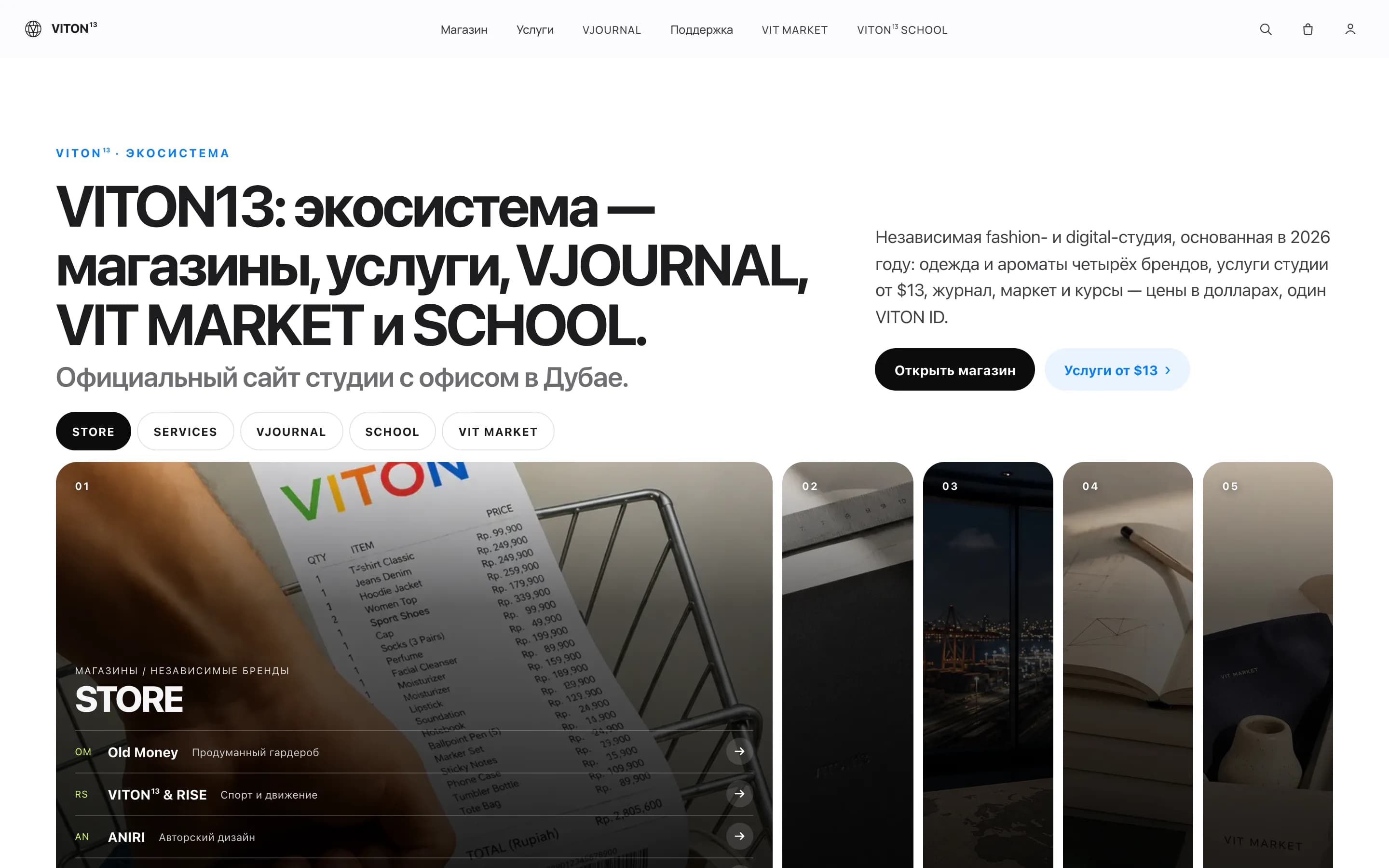
INTERNALOur own product
viton13.com
Next.js 16 · 5 languages · 7 hosts · 2026
VITON13’s own website: one Next.js application serves the main domain and six section subdomains in English, Russian, Spanish, French and Hindi. Before a release goes live, a crawl checks its internal routes.
Read the case →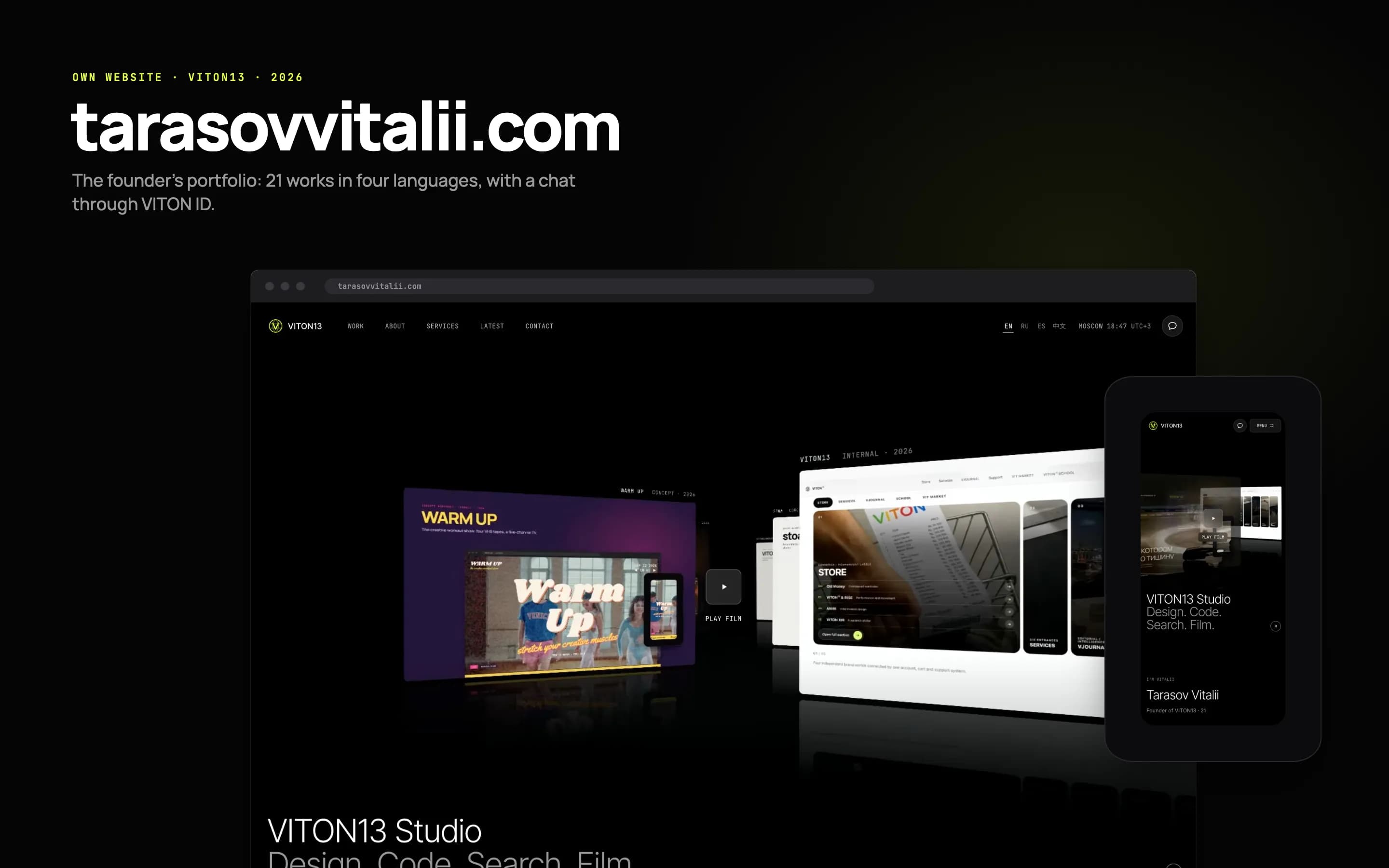
INTERNALOur own product
tarasovvitalii.com
Own website · 4 languages · 21 works · 2026
The personal website of Vitalii Tarasov, the founder of VITON13, designed and built by the studio and live since 23 September 2026. It shows 21 works, each labelled client, own product or concept, in English, Russian, Spanish and Chinese, lets visitors write to him through VITON ID and opens on a showreel drawn frame by frame in code, 47.6 seconds in full.
Read the case →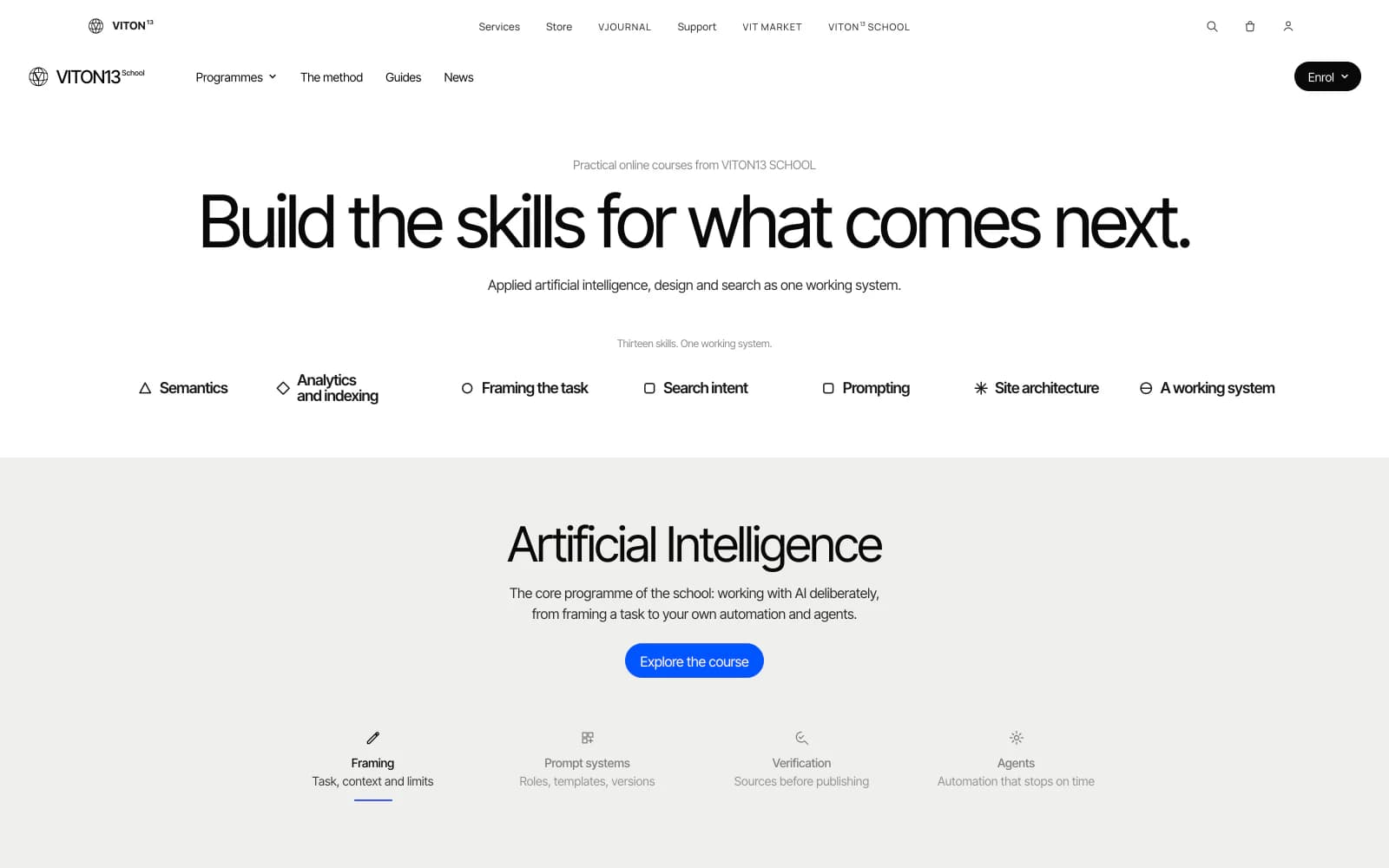
INTERNALOur own product
VITON13 SCHOOL landing page
Own website · 5 languages · 3 courses · 2026
The landing page of VITON13 SCHOOL, our online school of applied AI, AI design and SEO, rebuilt on 25 September 2026 as a calm product page in five languages. A lesson plays as live HTML on the screen of an AI-generated laptop photo, and on 27 September Lighthouse gave the page 93 for performance on a phone and 100 on desktop. Our own school, not a client project.
Read the case →