

VITON13 / Focused service
Real-time collaboration application
Build a shared workspace with live state, permissions, activity history and reliable conflict handling.
Start this service brief↘In short
What does Real-time collaboration application include?
Real-time collaboration application starts at USD 73 with AI-assisted production or USD 93 with a human-led route; typical delivery is 5–8 working days.
The published scope includes shared workspace model, live updates and presence, permissions and audit history.
VITON13 confirms deliverables, inputs, revisions, exclusions, handoff, timing and final price in writing before production begins.
What you get and on what terms
Real-time collaboration application
Build a shared workspace with live state, permissions, activity history and reliable conflict handling.
AI-assistedfrom $73
Human-ledfrom $93
- Shared workspace model
- Live updates and presence
- Permissions and audit history
- Timeline
- 5–8 working days
- Revisions
- the number of review rounds is confirmed in the written scope
- Included
- only the deliverables listed in the agreed package
- Not included
- external costs and work outside the agreed scope
- From you
- brief, current materials and any access needed for this scope
- You receive
- listed deliverables plus a written completion note
Both routes produce professional work. Scope, deliverables, timeline, revisions, required inputs, exclusions and handoff are confirmed before production. External costs are separate.
USD is the tariff currency; other currencies are indicative conversions.
Request
Describe your task
One message and one way to reach you are enough. No account needed. We confirm what is possible, the scope and the final price in writing before work starts.
- We reply using the contact you choose, usually within one working day.
- Scope in writing before work starts: deliverables, revision rounds and what is not included.
- Remote delivery worldwide, in five languages, with prices shown in your currency.
- No account needed. Attachments are encrypted in this browser before upload.
Other ways to reach the studio
Direct lineWrite to the studio directly
No account and no waiting on a form: what you write lands in the studio's cabinet the moment you send it, and the reply appears right here and in your email.
Reply in 1 to 13 minutesDuring studio hours. A message sent at night is answered first thing in the morning.What happensYou write what you want in your own words. The message goes straight into the studio's inbox with this service and the chosen package attached. The studio answers here, in this window, within 1 to 13 minutes during working hours, and a copy of every reply goes to your email. No account is created.What happens
Services from $13
AI reduces repetitive production time. VITON13 passes that efficiency back to the client while human review remains part of every delivery.
Order with V13 IDBuild a shared workspace with live state, permissions, activity history and reliable conflict handling.
01
Risks to resolve early — Shared workspace model
The failure to expose early is copying the current spreadsheet into software without deciding roles, exceptions, audit history and the one workflow worth simplifying. The route-specific failure appears when Live updates and presence changes state but Shared workspace model cannot prove the input and Permissions and audit history cannot reconstruct what happened. Two participants edit the same record while presence, version conflict, offline recovery and audit history stay coherent. We turn that risk into a test case or operational checkpoint instead of burying it in a generic “QA included” line. For Real-time collaboration application, the opening workshop uses a real blocked case and its accountable owner rather than a fictional product brief.
02
The business problem — Live updates and presence
Real-time collaboration application becomes relevant when a concrete workflow, decision or handoff can no longer be trusted. Build a shared workspace with live state, permissions, activity history and reliable conflict handling. We begin with the blocked action and its operational cost, then choose only the technology needed to remove that constraint. The evidence chain must connect Shared workspace model to Live updates and presence; if that link cannot be demonstrated, Permissions and audit history is not ready for acceptance.
03
What the build covers — Permissions and audit history
For Real-time collaboration application, the build boundary joins Shared workspace model, Live updates and presence, Permissions and audit history. Adjacent features stay outside until they have their own owner, data source and acceptance condition, so a focused commission cannot quietly become a platform rewrite. Shared workspace model is treated as an operating component, Live updates and presence as the controlled handoff and Permissions and audit history as the record a future maintainer can inspect.
04
Life after release — Shared workspace model
Real-time collaboration application continues after deployment through ownership, monitoring, maintenance and a usable handover. The final package records access, dependencies, known limits and the action to take when the normal route fails. A failure exercise begins at Live updates and presence, follows the affected user or operator back to Shared workspace model, and verifies recovery through Permissions and audit history.
05
How delivery is approved — Live updates and presence
The page is not accepted because a demonstration looks polished. Acceptance means one end-to-end role journey completed with real states, permissions, recovery and an accountable operations owner. Sign-off requires one normal and one failed trace across Shared workspace model, Live updates and presence and Permissions and audit history. Representative content, permissions, error states and recovery are exercised before the release is called complete. The buy-versus-build comparison is written specifically around ownership of Shared workspace model, continuing operation of Live updates and presence and portability of Permissions and audit history.
06
How the quote is formed — Permissions and audit history
Real-time collaboration application starts at $73 with a usual window of 5–8 working days. That published entry point remains valid for the stated outputs; integrations, migrations or risk controls outside them are estimated separately before approval. The final review does not ask whether real-time collaboration application looks complete; it asks whether Shared workspace model, Live updates and presence and Permissions and audit history survive the agreed representative case.
Shared workspace model
Shared workspace model is the working artifact used with a representative input. Its owner and expected state are named before production, so approval cannot depend on a polished demo.
Live updates and presence
Live updates and presence carries the controlled transition. We exercise one normal path and one interruption against this risk: copying the current spreadsheet into software without deciding roles, exceptions, audit history and the one workflow worth simplifying. The route-specific failure appears when Live updates and presence changes state but Shared workspace model cannot prove the input and Permissions and audit history cannot reconstruct what happened. Two participants edit the same record while presence, version conflict, offline recovery and audit history stay coherent.
Permissions and audit history
Permissions and audit history is the handover and proof layer. A second authorised maintainer must be able to reproduce the result and verify one end-to-end role journey completed with real states, permissions, recovery and an accountable operations owner. Sign-off requires one normal and one failed trace across Shared workspace model, Live updates and presence and Permissions and audit history.
Read the full guide before ordering
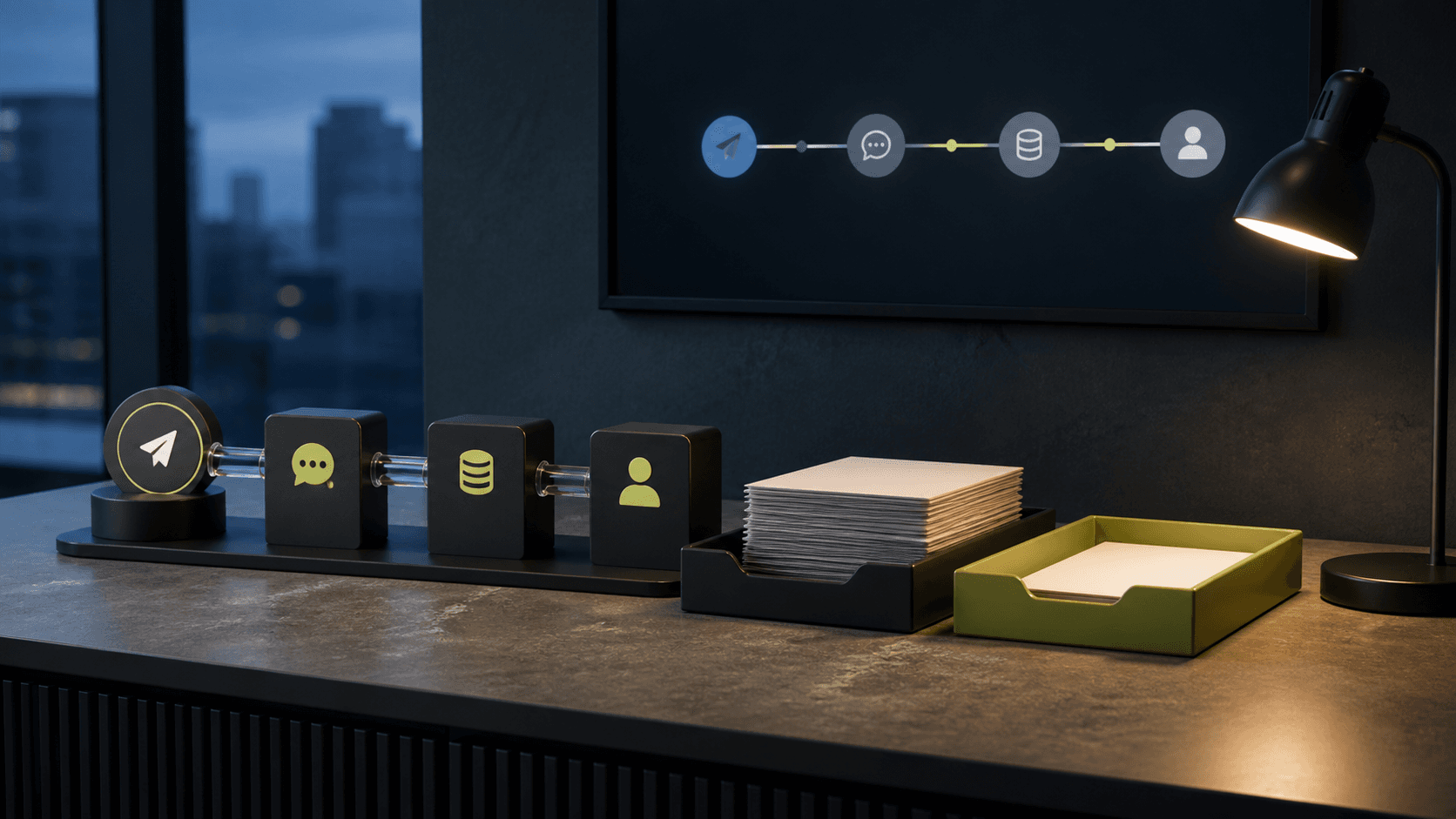
Shared workspace model — Plan Real-time collaboration application around the first end-to-end user journey
Plan Real-time collaboration application from the first working Shared workspace model through Live updates and presence to an operable Permissions and audit history. The guide orders dependencies, checks and ownership before production begins.
Open the article↗Questions people ask before buying
01What evidence should exist before real-time collaboration application starts?+
Bring one normal example, one failed example, the current stack, access constraints and the person who will accept the result. That is enough to expose unknowns without pretending the whole specification is finished. For Real-time collaboration application, the opening workshop uses a real blocked case and its accountable owner rather than a fictional product brief.
02What is the acceptance test for Real-time collaboration application?+
Acceptance is not a presentation. For this service it means one end-to-end role journey completed with real states, permissions, recovery and an accountable operations owner. Sign-off requires one normal and one failed trace across Shared workspace model, Live updates and presence and Permissions and audit history, using representative data, permissions and at least one failure state. The evidence chain must connect Shared workspace model to Live updates and presence; if that link cannot be demonstrated, Permissions and audit history is not ready for acceptance.
03Which risk changes the scope most?+
The decisive risk is copying the current spreadsheet into software without deciding roles, exceptions, audit history and the one workflow worth simplifying. The route-specific failure appears when Live updates and presence changes state but Shared workspace model cannot prove the input and Permissions and audit history cannot reconstruct what happened. Two participants edit the same record while presence, version conflict, offline recovery and audit history stay coherent. If it cannot be tested safely, the proposal must include discovery, a pilot or a smaller boundary before production. Shared workspace model is treated as an operating component, Live updates and presence as the controlled handoff and Permissions and audit history as the record a future maintainer can inspect.
04Could an existing tool replace custom real-time collaboration application?+
Sometimes. We compare the requested ownership with configuring an existing product when the workflow is standard and ownership is not strategic. If Live updates and presence can remain in the current stack, commission only the missing ownership and verification layer. Custom work is justified only when the operating difference matters more than the continuing complexity. A failure exercise begins at Live updates and presence, follows the affected user or operator back to Shared workspace model, and verifies recovery through Permissions and audit history.
05How are price and timing confirmed?+
The published entry point is $73 and 5–8 working days for the listed outputs. Dependencies outside that boundary are priced before approval. The buy-versus-build comparison is written specifically around ownership of Shared workspace model, continuing operation of Live updates and presence and portability of Permissions and audit history.
More in this category
Business website development
Launch a fast, manageable website with clear service routes and enquiry tracking.
↗
Next.js website development
Build a scalable modern site with server rendering, structured routes and controlled deployment.
↗
Ecommerce development
Connect catalog, product, cart and checkout into a stable commerce journey.
↗
Landing page development
Turn an approved design into a responsive, measured and production-ready campaign page.
↗