
Video
AI video or a film shoot: what each costs and when AI is enough for a brand
A filmed commercial typically runs $15,000–$50,000 or more, and expert-led AI video starts near $5,000 for 30 seconds; at VITON13 an AI video is $53 AI-assisted or $73 human-led. AI is enough for mood, product atmosphere, loops and ad variations. Film when the video must show real people, speech, exact product detail or proof of how something works.
How much does AI video cost compared with a film shoot?
The two routes put money in different places. A shoot pays for people and days: crew, talent, a location, kit, then the edit. An AI film pays for direction and iteration: the treatment, many generated takes, one look held across shots, repairs and a rights check.
| Route | Price | What it covers | Source |
|---|---|---|---|
| DIY: AI video tool | Runway Standard $15 a month, Pro $35 a month | Standard's monthly credits make about 52 seconds of Gen-4.5 video, failed takes included; no direction or edit | Runway pricing |
| Freelancer using AI tools | About $500 for a simple short asset, up to $5,000 for a polished one | Output, rights checks and revisions vary by person | Lemonlight, March 2026 |
| Expert-led AI production | From $5,000 for a polished 30-second video | An agency directs, generates and finishes the film | Lemonlight, March 2026 |
| AI video, VITON13 | $53 AI-assisted or $73 human-led | Generative treatment, a continuity-controlled scene set, a rights and delivery record; 3–5 working days | VITON13 AI video production |
| Filmed social clip | $1,500–5,000 | One camera, 15–60 seconds, a light edit | Vidico, September 2026 |
| Filmed commercial or brand film | $15,000–50,000+ | Multi-day shoot, professional talent, heavy post-production | Vidico, September 2026 |
| Filmed, VITON13 | From $213 | A compact controlled shoot; talent, locations and travel are estimated and approved before booking | VITON13 commercial production |
Treat the DIY row with care: a subscription price is not a video price. Credits buy attempts, and most attempts are thrown away because a hand melts, a label warps or the camera drifts off the product. The real budget is the hours a person spends choosing, repairing and checking.
What pushes each budget up?
On a shoot, the number of days drives the bill. Vidico's September 2026 figures:
- A crew of three to five: $2,500–8,000 a day.
- On-screen talent: $500–1,500 a day; a voice-over session, $300–1,000.
- Equipment rental: $1,000–4,000 a day; a studio or location, $500–3,000.
- Extra revision rounds: $500–2,000 each.
In AI production, other things drive it:
- Continuity: the same product, face or room across ten shots takes more attempts than one beautiful shot.
- Physics: pouring liquid, hands, folded fabric and reflections fail far more often than skies and light.
- Lettering: models still misspell and bend text, so labels, prices and logos are added afterwards.
- Review: someone compares every frame with the real product before the video runs.
Where is AI video good enough for a brand in 2026?
Generated footage works where the viewer reads a mood rather than weighs evidence.
- Product atmosphere: a bottle in mist, a shoe on wet stone, light across packaging, as long as the product matches a real photo.
- Website hero loops and backgrounds that set a tone and make no claim.
- Ad variations: ten openings or a seasonal version of one idea, tested before anyone books a shoot.
- Cutaways between filmed shots: city, sky, texture, abstract motion.
- An animatic that shows the crew what the real shoot should look like.
When does a film shoot still beat AI?
A camera wins whenever the video is meant as proof.
- Real people: customers, staff, the founder. A generated face posing as a customer is a fake testimonial, however well it moves.
- Dialogue and performance: timing, humour and unscripted reactions.
- Exact product fidelity: true colour, fit, fabric, the texture of food or skin, the real size in a hand.
- Demonstrations of how something works or lasts. The UK advertising regulator warns that an AI image of a cosmetic effect real use does not deliver is likely to mislead, and that an AI disclosure does not cure it.
- Events and places that really happened.
The dividing line is the claim, not the polish. A model can make a clean picture of your product; it cannot make a true one.
How does a studio make an AI film that holds up?
- TreatmentOne page: idea, shot list, look, what must stay real, what may be generated, where it runs.
- Real referencesPhotos of the product, packaging, colours and fonts; scenes are generated from them.
- Takes in batchesSeveral takes per shot; a person keeps those where product, light and motion hold.
- Continuity passShots are compared side by side for the same object, colour and light; weak ones are redone.
- Words set by handLettering is never left to the model. Text, prices and the logo sit on top, so a new price means a re-render.
- Sound, label, sign-offLicensed or code-made sound, an AI label where required, and a last check against the real product.
Our own films follow this pattern. In our four studio Reels, every frame is drawn from an HTML scene, imagery and voice are generated, and the words and prices laid over them are typeset in code. The loops heading our store and studio sites are AI-generated too; they play silent and pause when a visitor's system asks for reduced motion.
Who owns AI footage, and when must you label it?
- Copyright. In January 2025 the US Copyright Office concluded that prompts alone do not make someone the author of an AI output, while human selection, arrangement and changes can be protected. Your script, edit and typography are safer ground than any single generated shot.
- Tool terms. Runway's terms, updated 15 September 2026, claim no ownership of outputs and allow commercial use, but warn that outputs may not be unique and may be used to train its models. Upload nothing you are not allowed to share.
- Platform labels. YouTube asks for disclosure of realistic synthetic footage; its own example is AI-generated extra footage of a real place in a travel promo. Obviously unreal scenes and colour filters need none.
- EU rules. From 2 August 2026, Article 50 of the AI Act requires a clear label on deepfakes, and the definition covers objects, places and events as well as people. Evidently artistic or fictional work may disclose in a lighter way.
What does a hybrid plan look like: film once, generate the rest?
For most small brands the answer is not either-or. Capture what must be true once, then let generation and editing multiply it.
| Step | What is real | What is generated | VITON13 service |
|---|---|---|---|
| 1. A short product shoot or real photos | Packshot, hands using it, true colour | Nothing | Product video, $53 AI-assisted or $73 human-led |
| 2. AI scenes | The product reference | Settings, seasons, weather, abstract motion | AI video production, $53 AI-assisted or $73 human-led |
| 3. Campaign cut | Filmed shots carry every claim | Generated shots carry the mood | Campaign Edit, $73 AI-assisted or $93 human-led |
| 4. Test and refresh | Results from the ads themselves | New openings for the versions that work | Another AI video round if needed |
Real footage comes first: it gives the model a reference and the campaign its evidence. Generated shots never stand in for the product doing something it cannot.
What should you prepare before ordering AI video?
- Placement and length: a 15-second 9:16 ad and a 16:9 website loop are different jobs.
- Real references: product photos from several angles, packaging, brand colours and fonts.
- A must-be-true list: size, colour, results and anything else a viewer may take as fact.
- A no-go list: faces, places, competitors or claims that must never appear.
- Two videos you like and one you dislike, with a line on why.
- One approver and the launch date.
When is AI video the wrong purchase?
- You need a testimonial, a case study or the founder speaking.
- The video is the proof: a before-and-after, a durability test, a size comparison.
- You work in health, finance or food, and nobody has checked the script.
- Fine print or a pattern must be exact in every frame, and you have no footage of it.
- The budget only works if the review step is cut. An unchecked AI video is cheap to make and expensive to pull after it has run.
If your brief falls into one of these, our estimate says so and points to a shoot, a product video or an edit of footage you already have.
How VITON13 does it
We treat AI video as a directed production, not a prompt. By the next working day you have a written scope and a fixed price, AI-assisted or human-led. We agree what must stay real, generate scenes from your product references, hold one look from shot to shot, set every word on screen ourselves and hand over a record of tools, terms and labels.
AI video production
- Price
- $53 AI-assisted or $73 human-led
- Timeline
- 3–5 working days
Campaign Edit
- Price
- $73 AI-assisted or $93 human-led
- Timeline
- 3–5 working days
AI-assisted: AI drafts inside defined steps, a person directs and checks every result. Human-led: a specialist does the work and AI assists.
What is included
- 1 generative treatment: idea, shot list, look and the line between filmed and generated
- 1 continuity-controlled scene set, cut to the agreed length and formats
- On-screen text, prices and logo set in design or code, never generated
- 1 rights and delivery record: tools used, their terms, the AI label setting for each platform
- A written completion note that lists every file handed over
Not included
- Filming, actors, locations and travel (quoted as commercial production)
- Paid tool credits on your own accounts, stock footage and music you license
- Legal review of advertising claims
- Ad spend, posting and any work outside the written scope
Revisions: AI video production: 1 revision round on the deliverables; Campaign Edit: 2 rounds on the cut and 1 on the grade
Get an estimate in 1 working dayWritten estimate within 1 working day
Example
INTERNALOur own product
Four studio Reels: generated imagery, text drawn in code
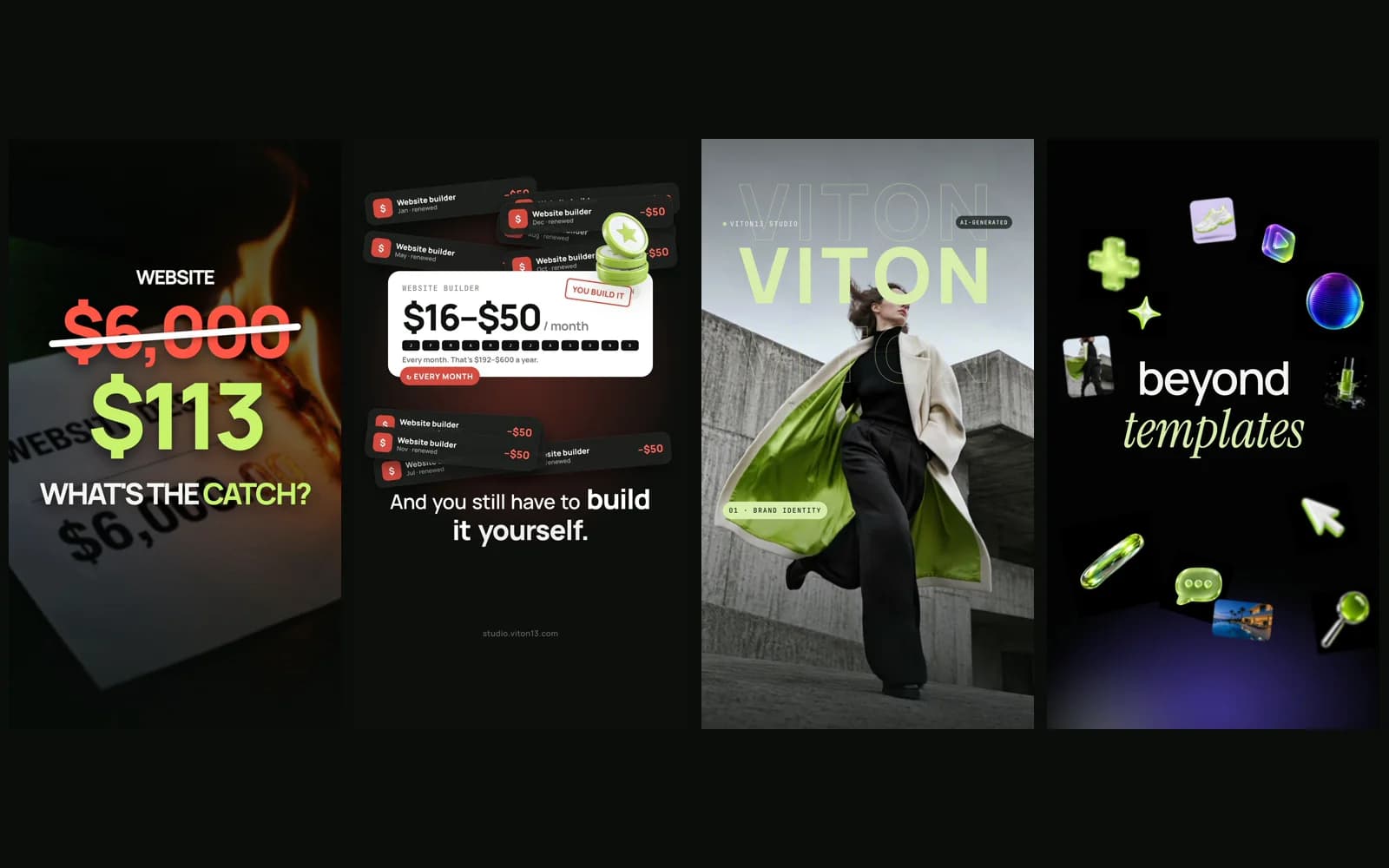
We have no published client AI video case yet, so this is our own work: four vertical Reels for the studio's Instagram, 1080×1920 at 30 fps, 140.6 seconds and 4,218 frames in all, each frame drawn from an HTML scene. Imagery, voice and presenter are AI-generated; the sound is synthesised in code, so no licensed track is used. One frame shows a bottle splashing on wet stone under the words “No studio. No shoot.”, marked AI-generated in the frame, and the presenter carries an “AI presenter” label. On-screen prices come from our live offer, so a change is a re-render.
What this does not prove
- These are our reels for our own account, not a client brief with an approval chain and a deadline.
- There is no reach, view or sales data. An AI prediction helped choose between openings; it says nothing about how the reels performed.
- No real client product was matched in them, so they do not show how closely a model can reproduce your packaging.
Read the case: Four Reels rendered from code, with AI imagery and an AI presenter
Questions and answers
How long does an AI video take compared with a shoot?
Our AI video package is delivered in 3–5 working days once the references and the treatment are agreed. A filmed commercial adds casting, locations, shoot days and post-production; our commercial production runs 15–30 working days, with the estimate approved before anything is booked. Put a fixed launch date in the brief: a priority slot is confirmed only after we see it.
Can AI show my exact product?
Close, not exact, unless it works from real references. We generate scenes around photos of your product and compare every frame with it. Fine print, dense patterns and transparent materials still drift, so labels are added in design, and the frames where the product must be precise use a real packshot.
Who owns the finished AI video?
You receive the delivered files with the usage rights set out in the written scope. Copyright is narrower: in the US, prompts alone do not create authorship, while the human script, edit and design can be protected. Each tool's terms apply on top, so the delivery record lists every tool and its terms next to the master files.
Do viewers have to be told the video is AI?
Often, when a generated scene looks real. YouTube asks for disclosure of realistic synthetic footage, and the EU's deepfake rules apply from 2 August 2026 to objects and places as well as people. Stylised or plainly fantastical scenes usually need no label. The delivery record notes the right setting for each platform.
What if the AI output looks wrong after I approve the treatment?
Send one consolidated list of notes within the included revision round, and we regenerate or recut the shots in question against the approved treatment. A new idea, new scenes or a different length after approval is new scope, quoted separately before any work starts.
What is the difference between the AI-assisted and human-led price?
The deliverables, the scope and the timeline are identical. In AI-assisted work, models draft the takes and a specialist directs, selects and signs off. Human-led adds specialist hours: more direction on the treatment, more hand selection and more manual finishing of type and continuity. Choose it when the video fronts a launch or a paid campaign.
Sources
- Vidico — Video Production Cost: What You'll Actually Pay in 2026 —
- Lemonlight — AI Video Production Cost: What Brands Should Expect —
- Runway — Pricing —
- Runway — Terms of Use —
- U.S. Copyright Office — Copyright and Artificial Intelligence, Part 2: Copyrightability —
- YouTube Help — Disclosing use of GenAI content —
- European Commission — Transparency obligations under Article 50 of the AI Act (FAQ) —
- ASA | CAP — Disclosure of AI in advertising: striking the balance between creativity and responsibility —