
Websites and development
How much does a mobile app cost in 2026, and what makes the price move?
An agency-built mobile app usually costs tens of thousands of dollars: Velvetech’s 2026 guide puts simple apps at $40,000–$100,000 and complex ones at $200,000–$400,000. One cross-platform codebase, a small first release and a PWA where stores are optional cut that most. VITON13 starts cross-platform apps from $213.
What do mobile apps cost in 2026?
There is no single price for “an app”, because the word covers anything from a loyalty card with three screens to a banking product with real-time transfers. The useful question is which class your idea belongs to, because that sets the order of magnitude before anyone argues about details. Agency guides agree on the shape of the market even when their numbers differ: a narrow first release is cheap, every extra role, integration and live feature multiplies the work, and regulated industries pay a premium for security and review.
| Class of app | What it usually contains | Typical agency range |
|---|---|---|
| Simple | A handful of screens, sign-in, content pulled from an existing system, push notifications | $40,000–$100,000 |
| Medium | Payments or subscriptions, chat, maps, an admin panel, several user roles | $100,000–$200,000 |
| Complex | Real-time features, heavy integrations, offline sync, strict security and compliance | $200,000–$400,000 |
Hourly rates explain much of the spread. The same guide lists cross-platform developers at about $60–$130 an hour in the USA, $30–$50 in Europe and $20–$35 across much of Asia. A quote that looks cheap may simply come from a cheaper region; a quote that looks expensive may include design, testing and store release that a cheaper one leaves for later. Always compare what is inside the price, not only the total.
Native, cross-platform or PWA: which route should you pay for?
The route you choose decides the budget more than any single feature. Native means two separate apps, one written for iOS and one for Android, each with its own code, testing and release. Cross-platform means one codebase in Flutter or React Native that produces both store apps. A progressive web app (PWA) is a website that installs on the home screen, works offline for chosen pages and sends notifications, but is not listed in the App Store or Google Play.
| Route | Codebases | In the stores? | Where it fits |
|---|---|---|---|
| Native iOS + Android | Two | Yes | Heavy graphics, deep device features, large product teams |
| Cross-platform (Flutter, React Native) | One | Yes | Most business apps and a first store release |
| PWA | One (a website) | No, installed from the browser | Catalogues, bookings, loyalty and internal tools |
Cross-platform is not a compromise for most businesses. Booking, delivery, loyalty and service apps rarely need anything the frameworks cannot reach, and one team maintaining one codebase is cheaper for years, not only at launch. Native starts to earn its cost when the app lives on the camera, sensors, complex animation or the latest system features on the day Apple or Google releases them.
Which features make the price jump?
Screens are cheap; behaviour behind them is not. The same ten screens can cost twice as much when they need to work offline, update in real time or talk to an old accounting system. Before asking for quotes, mark each feature on this list as “needed at launch” or “later”.
- Payments and subscriptions: card processing, receipts, refunds and the store rules for digital goods.
- Real-time features: chat, live tracking, auctions or anything that must update without a refresh.
- Maps and location: geofencing, routes and background location, which also need careful permission texts.
- Offline mode: local storage and sync rules for what happens when two devices change the same record.
- Integrations: CRM, 1C, ERP, booking engines or payment providers, each with its own quirks and test accounts.
- Roles and an admin panel: every extra role doubles the testing of permissions and edge cases.
- Security and compliance: medical, financial or children’s data raise review, logging and hosting costs.
A good first release keeps one of these heavy features, not five. The rest go into a second phase, paid for by what the first version teaches you about real users.
How much would your app cost with VITON13?
Tick what your first release needs. The totals add the live starting prices of VITON13 packages, in both production modes, so you can see the order of magnitude in a minute rather than after a week of calls.
Cost calculator
Build your first release
Choose one route, then add the work your app needs at launch.
Your estimate
- AI-assisted
- from $306
- Human-led
- from $426
- Timeline
- 15–45 working days
stages can overlap; the written estimate fixes the dates
Get a written estimate in 1 working dayStarting prices of VITON13 packages; the written estimate confirms the final scope and price before work begins.
The timeline shown is a range: design and development can overlap, and a scope with fewer unknowns lands closer to the lower number. A cross-platform app starts from $213 AI-assisted and $313 human-led, because store release, device testing and review take real time.
What does an app cost after launch?
Launch is the start of the bill, not the end. Phones update their operating systems every year, stores change their rules, libraries publish security fixes, and your users will ask for improvements. Budget for these from the first day, so the app does not quietly break a year later.
| Item | Cost | Who charges it |
|---|---|---|
| Apple Developer Program | $99 a year | Apple |
| Google Play developer account | $25 once | |
| Store commission on digital sales | 15% under Apple’s Small Business Program, more above its threshold | Apple, Google |
| Updates, fixes and OS compatibility | About 15–20% of the build cost a year | Your developers |
| Servers, push, SMS, maps, analytics | Depends on users and providers | Each provider |
How can you spend less without getting a worse app?
- Build one journey first, the one that makes or saves money, and ship it to real users.
- Choose cross-platform unless a specific device feature forces native.
- Ask whether stores are needed at all: a PWA can cover catalogues, bookings and loyalty.
- Reuse the systems you already pay for, such as your CRM or booking engine, instead of building an admin panel from scratch.
- Design the screens before coding, so changes happen in a design file, where they are cheap.
- Write down what is out of scope; most budget overruns start as an undocumented “small addition”.
The cheapest app is the one whose first version answers a question: will people use this? Everything you add before that answer is a bet. A tight release that proves demand makes the next budget easy to justify, to yourself or to investors.
How long does it take to build a mobile app?
Time follows scope, not ambition. With VITON13 a cross-platform first release takes 15–30 working days once the design and access are ready, and the app design itself takes 8–15 working days. Store review adds its own wait, usually days, sometimes longer if the reviewers ask questions about payments, accounts or permissions.
Bigger products are delivered in stages: the first release goes out, real users arrive, and the next stage is planned on what they do rather than on a long feature list written before launch. That rhythm keeps the calendar honest and each invoice tied to something you can open on your phone.
When should you not build a mobile app at all?
An app is the wrong purchase when it repeats your website, when you do not yet know who will use it, or when customers visit you once a year. In those cases a fast mobile website or a PWA gives the same result for a fraction of the cost and without store reviews. Build a store app when people come back often, when notifications add real value, or when the phone’s camera, location or payments are the product.
How VITON13 does it
We build one cross-platform app for iOS and Android around the journey that matters first, with the store release included. AI-assisted: AI drafts code and tests, and an engineer directs, reviews and signs off every change. Human-led: an engineer writes the code, with AI assisting. You receive the written scope and final price within one working day; nothing starts before you approve it.
Cross-platform mobile app development
- Price
- $213 AI-assisted or $313 human-led
- Timeline
- 15–30 working days
The final price is fixed in writing after a short scope review.
Mobile app UX/UI
- Price
- $93 AI-assisted or $113 human-led
- Timeline
- 8–15 working days
Progressive web app
- Price
- $53 AI-assisted or $73 human-led
- Timeline
- 3–5 working days
AI-assisted: AI drafts inside defined steps, a person directs and checks every result. Human-led: a specialist does the work and AI assists.
What is included
- Mobile product architecture: screens, data and roles for the first release
- One iOS and Android application from a single codebase
- Store release workflow: builds, listing checklist and submission support
- Delivery: 15–30 working days once design and access are ready
- App design if you need it: $93 AI-assisted or $113 human-led, 8–15 working days
Not included
- Apple and Google developer fees and store commissions
- Servers, push, SMS, maps and other third-party usage fees
- Content, translations and legal texts such as the privacy policy
- Support after release, quoted separately
Revisions: 2 revision rounds per stage; the written scope confirms the stages
Get an estimate in 1 working dayWritten estimate within 1 working day
Example
INTERNALOur own product
VITON ID: the account system behind our own site
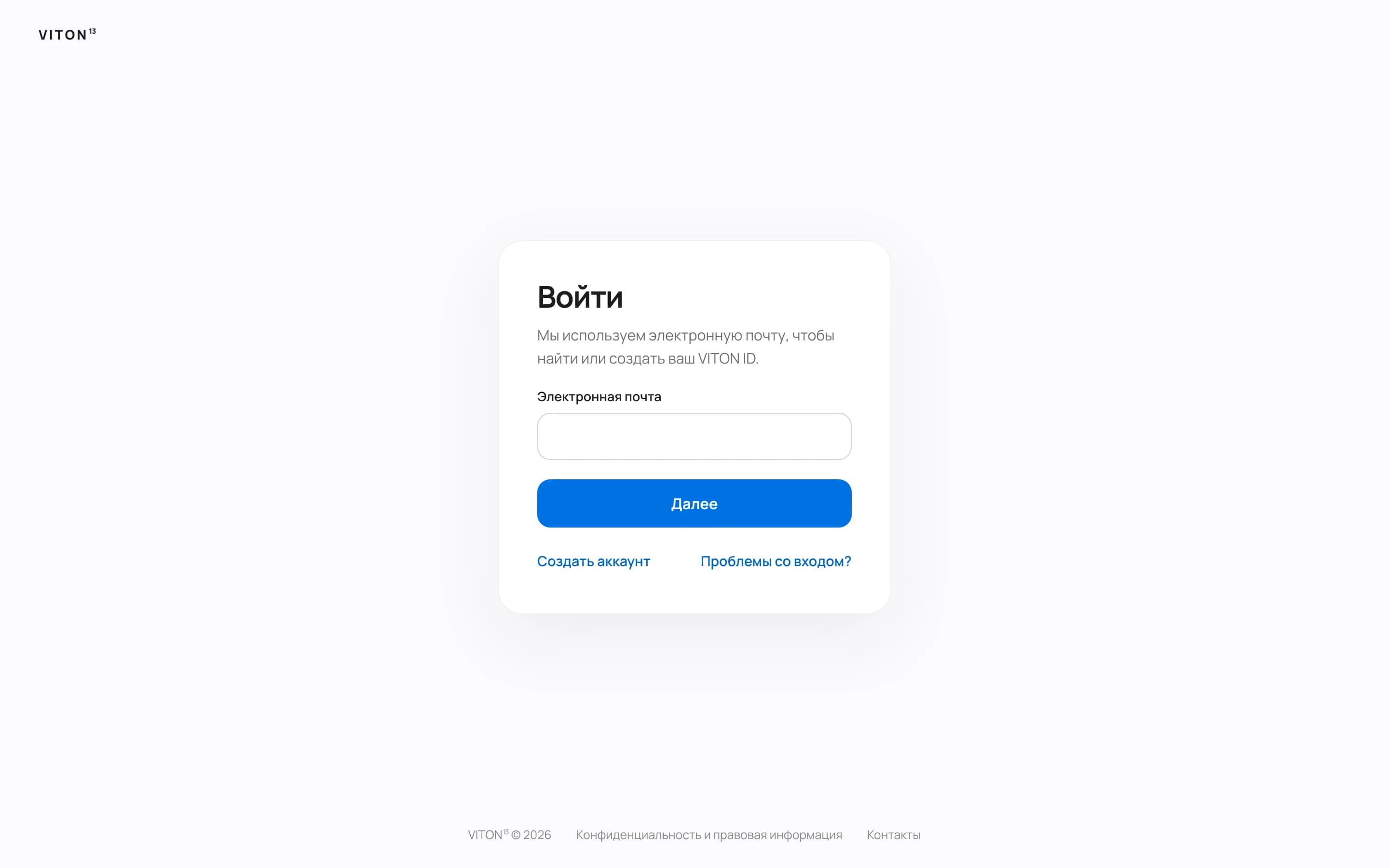
VITON ID is the sign-in and cabinet VITON13 built and runs for viton13.com. Each ID has 13 digits, the last one a Luhn check digit; the cabinet has ten views plus a console only admins see; files attached to a studio order are encrypted in the browser with AES-GCM-256 before upload. These are the same back-end questions a mobile app has to answer: accounts, roles, orders and safe files.
What this does not prove
- It is a web product, not a native or cross-platform app, and it is not in any app store.
- There is no payment layer: payment for an order is agreed by hand.
- No member, order or revenue figures are published, so it says nothing about demand.
Read the case: VITON ID: one account for sign-in, orders, messages and bonuses
Questions and answers
Can one app work on both iPhone and Android?
Yes. A cross-platform framework such as Flutter or React Native produces both store apps from one codebase, so you pay for one team and one set of tests. Native apps are only worth the extra cost when the product depends on the newest device features.
Is a progressive web app a real app?
It installs on the home screen, opens full screen, can work offline for chosen pages and can send notifications. It is not listed in the App Store or Google Play, so it suits catalogues, bookings and loyalty better than products that need store discovery.
Who owns the code and the store accounts?
You do. The developer accounts at Apple and Google are opened in your company’s name, the repository sits on your account, and the rights pass to you when the final price is paid. We work through access you grant and can remove.
How much does it cost to keep an app running each year?
Plan about 15–20% of the build cost a year for updates, fixes and new system versions, plus Apple’s $99 annual fee and the servers or services your app uses. Ignoring upkeep is the most common reason apps stop working a year after launch.
Can AI build the whole app for less?
AI speeds up drafting code and tests, which is why our AI-assisted mode costs less. It does not replace an engineer who decides architecture, checks security and handles store review. Every AI-drafted change is reviewed by a person before release.
What should I send to get an estimate?
A short description of who uses the app and the one journey that matters most, a list of features marked “launch” or “later”, examples of apps you like and any systems it must connect to. That is enough for a written estimate within one working day.