
Marketing, SEO and AI search
What is a sales funnel? Stages, examples, conversion and audit
A sales funnel is the path a buyer takes from first hearing about you to paying and buying again, split into stages where some people drop out. You measure it in numbers: how many people enter each stage and what share moves on. An audit starts at the step whose conversion has fallen furthest.
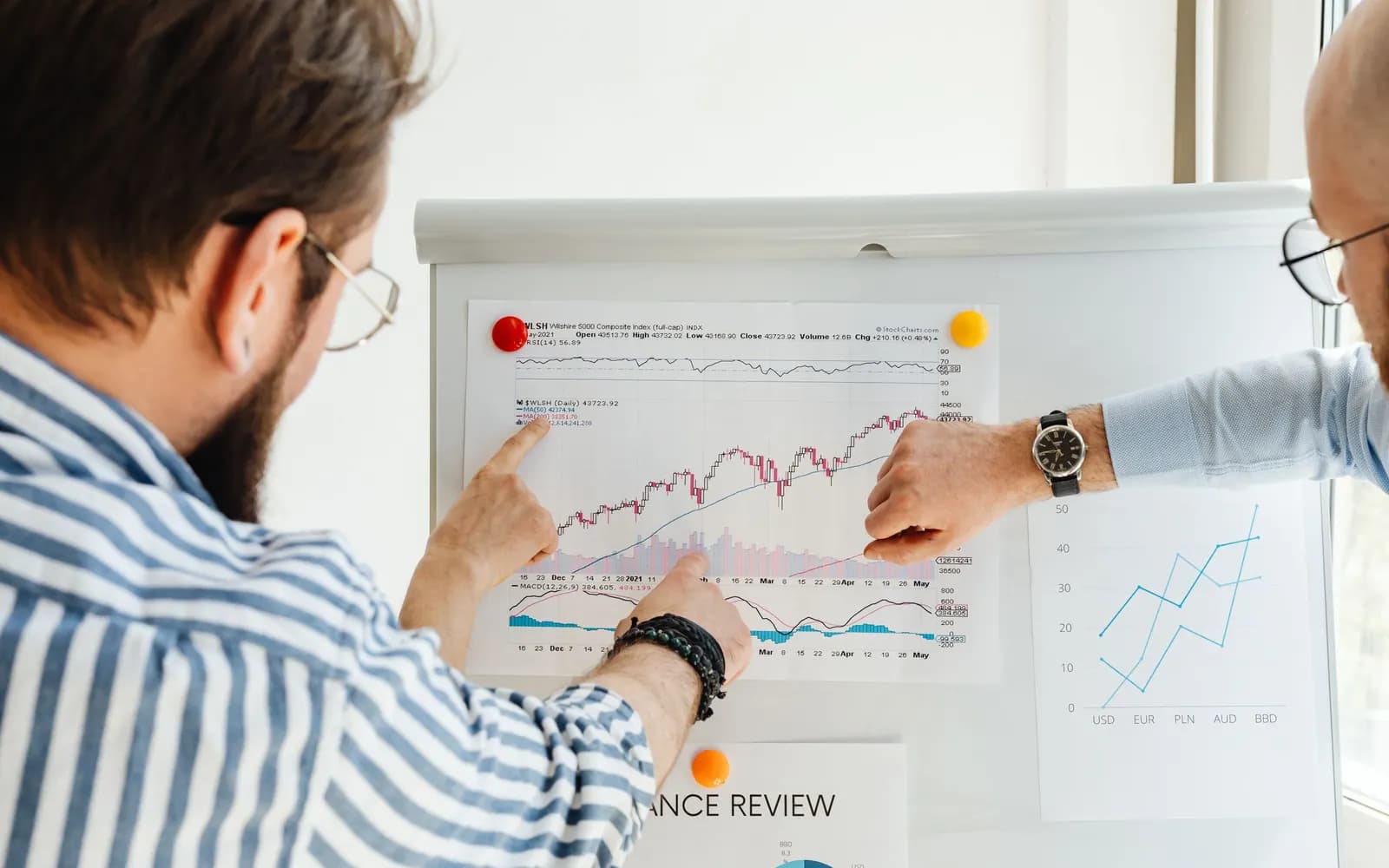
What is a sales funnel, in plain words?
A sales funnel models the route a buyer follows: they see an ad, visit your site, get in touch, talk to someone, pay and, ideally, come back. It is a funnel because fewer people remain at each step: of a thousand visitors, a few dozen enquire and a handful pay.
Two things share the name. The marketing funnel runs up to the enquiry: impressions, clicks, visits, forms. The sales pipeline in HubSpot, Salesforce or Pipedrive runs after it: qualification, meeting, proposal, payment. A useful funnel joins both, or nobody sees the money lost in between.
Every stage must be countable: 'interested' is not a stage, 'attended the call' is, because it has an event and a date.
What are the stages of a sales funnel: AIDA or a practical model?
The classic model is AIDA: attention, interest, desire, action, usually credited to the advertising pioneer E. St. Elmo Lewis in the late 1890s. In 1911 Arthur Sheldon's Successful Selling added satisfaction, to stress repeat business. AIDA describes the buyer's mind, not what to count, so a business needs a practical model.
| Stage | What you count | AIDA step | Owner |
|---|---|---|---|
| Traffic | Visits, calls, followers per channel | Attention | Marketing |
| Interest | Pricing or case-study views; add to basket | Interest | Marketing and website |
| Enquiry | Form, call, message or order | Desire | Website and marketing |
| Qualification | Need, budget and timing fit | — | Sales |
| Proposal | Meeting, demo, quote or invoice sent | Action | Sales |
| Payment | Money received, not promised | Action | Sales and finance |
| Repeat purchase | Second order, renewal, referral | Satisfaction (Sheldon) | Customer success |
AIDA has no qualification step, yet in B2B that is where you decide whether a lead deserves a salesperson's time.
What does a sales funnel look like for a shop, a B2B service and an online course?
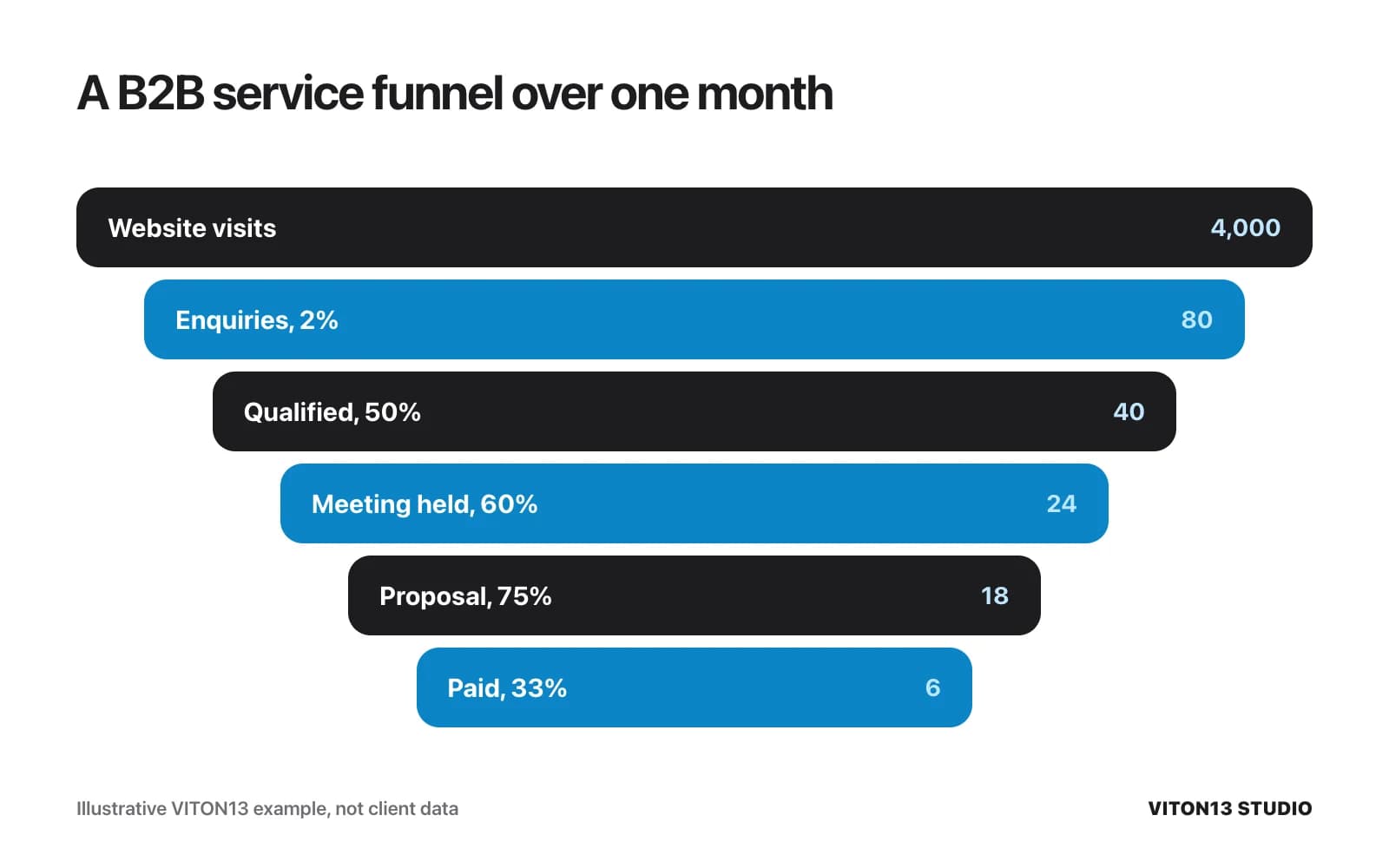
Below are three illustrative monthly funnels with round numbers. They are not VITON13 client data or a norm for your market; brackets show conversion from the previous step.
| Step | Online shop | B2B service | Online course, one webinar |
|---|---|---|---|
| 1 | Visits: 20,000 | Visits: 4,000 | Registrations: 1,000 |
| 2 | Product page: 9,000 (45%) | Enquiries: 80 (2%) | Attended live: 350 (35%) |
| 3 | Basket: 900 (10%) | Qualified: 40 (50%) | Stayed for the offer: 210 (60%) |
| 4 | Checkout started: 450 (50%) | Meeting held: 24 (60%) | Applied: 42 (20%) |
| 5 | Paid: 270 (60%) | Proposal sent: 18 (75%) | Paid: 21 (50%) |
| 6 | Bought again within 90 days: 54 (20%) | Paid: 6 (33%) | — |
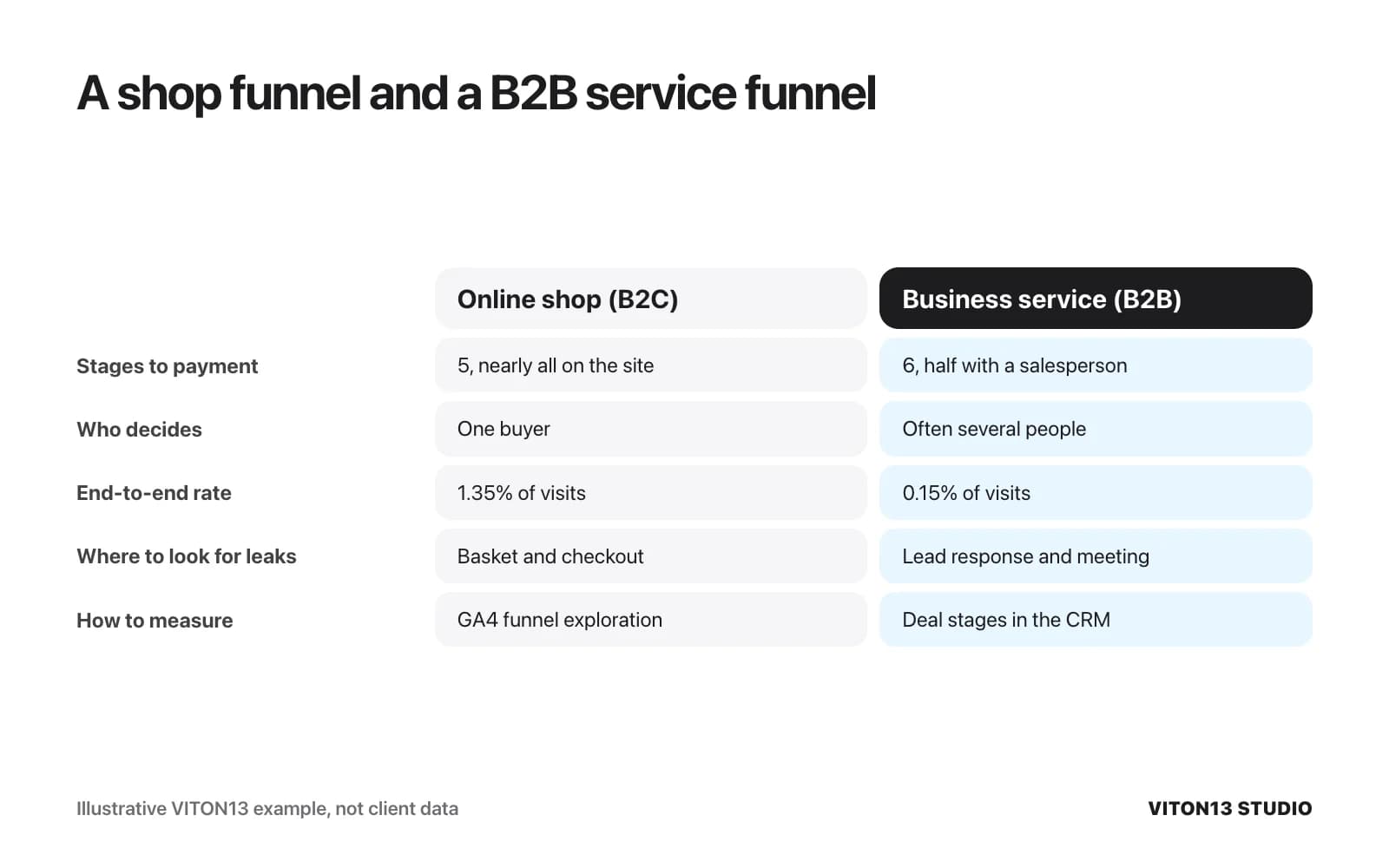
| End-to-end | 1.35% of visits order | 0.15% of visits, 7.5% of enquiries | 2.1% of registrations |
A shop's route runs on the website, where analytics sees it. Half the B2B stages happen with a salesperson, so without a CRM that funnel stops at the enquiry.
How do you calculate funnel conversion and find the leak?
Stage conversion is the share of people who reach the next stage out of all who entered the current one: 24 meetings from 40 qualified leads is 60%. End-to-end conversion is the product of the step rates: 50% × 60% × 75% × 33% = 7.5%.
The lowest number is not automatically the leak. Proposal-to-payment looks worst at 33%, but it has sat there all year. A leak is a step that fell against its own history or sits well below a comparable benchmark.
Here is the arithmetic. Last quarter 75% of qualified leads reached a meeting; this month 60% did, and nothing else changed. At 75% there would have been 30 meetings, 22.5 proposals and 7.5 deals, not 6. Those 1.5 deals, $6,000 a month at a $4,000 first order, are lost at one step, so look first at who calls back and how fast.
The calculator runs the same funnel as if all traffic were paid: 4,000 clicks at an assumed $2.50 is $10,000. Replace the defaults with your own figures.
Cost calculator
Test your own funnel, from budget to paying customers
Enter your budget, cost per click, visit-to-enquiry rate and the share of enquiries that pay.
What this budget buys
- Visits
- 4,000
- Enquiries
- 80
- Cost per enquiry
- $125
- Paying customers
- 6
- Cost per customer
- $1,667
- Revenue from first orders
- $24,000
- Revenue per dollar of traffic
- 2.4×
This is funnel arithmetic on your inputs, not a forecast: real rates depend on the offer, response speed, season and market.
What is a good conversion rate for each funnel stage?
There is no single norm: each researcher defines stages differently and measures its own customers.
| Source | What was measured | Figure |
|---|---|---|
| Dynamic Yield, last 12 months | Online shops worldwide: visit to purchase | 2.68% |
| Dynamic Yield, same data | Abandoned baskets | 77.38% |
| First Page Sage, August 2026 | B2B SaaS: lead → MQL → SQL → opportunity → closed | 39% → 38% → 42% → 37% |
| First Page Sage, same report | IT and managed services, same steps | 19% → 38% → 41% → 46% |
| HubSpot default pipeline | Win probability, 'appointment scheduled' to 'contract sent' | 20%, 40%, 60%, 80%, 90% |
| Harvard Business Review, 2011 | Calling a lead within an hour versus later | Nearly 7× as likely to qualify it |
Your best benchmark is your own funnel last quarter, with the same stages and tracking. An outside figure shows where to look.
The most actionable figure is speed: in the HBR study, firms that tried to reach a lead within an hour were nearly seven times as likely to qualify it as those that waited one hour longer.
How do you build a sales funnel and check it step by step?
- Define stages as eventsWrite the route from first touch to repeat purchase as 5–8 stages, each with one clear event: form sent, call attended, invoice paid.
- Give every stage a data sourceAnalytics counts the site (a GA4 funnel exploration takes up to 10 steps), the CRM counts deals, the bank counts payments. A stage nothing records is your first gap.
- Pull numbers for one periodUse one period for every stage; for long cycles, follow one month's enquiries to their outcome.
- Find the step that slippedCompare each step with earlier periods, then with benchmarks, and turn the gap into lost deals and money.
- Name an owner for every hand-offMarketing owns enquiries, sales owns response and proposal, customer success owns the second order. Leads vanish at hand-offs nobody owns.
- Change one step at a timeChange one step and compare the same rate before and after over a full sales cycle.
What is an automated sales funnel?
An automated funnel runs from first contact to payment without a salesperson: a useful resource in exchange for an email address, a sequence of emails or bot messages, then an offer with online payment. It is a script of what people learn at each step, not just a newsletter.
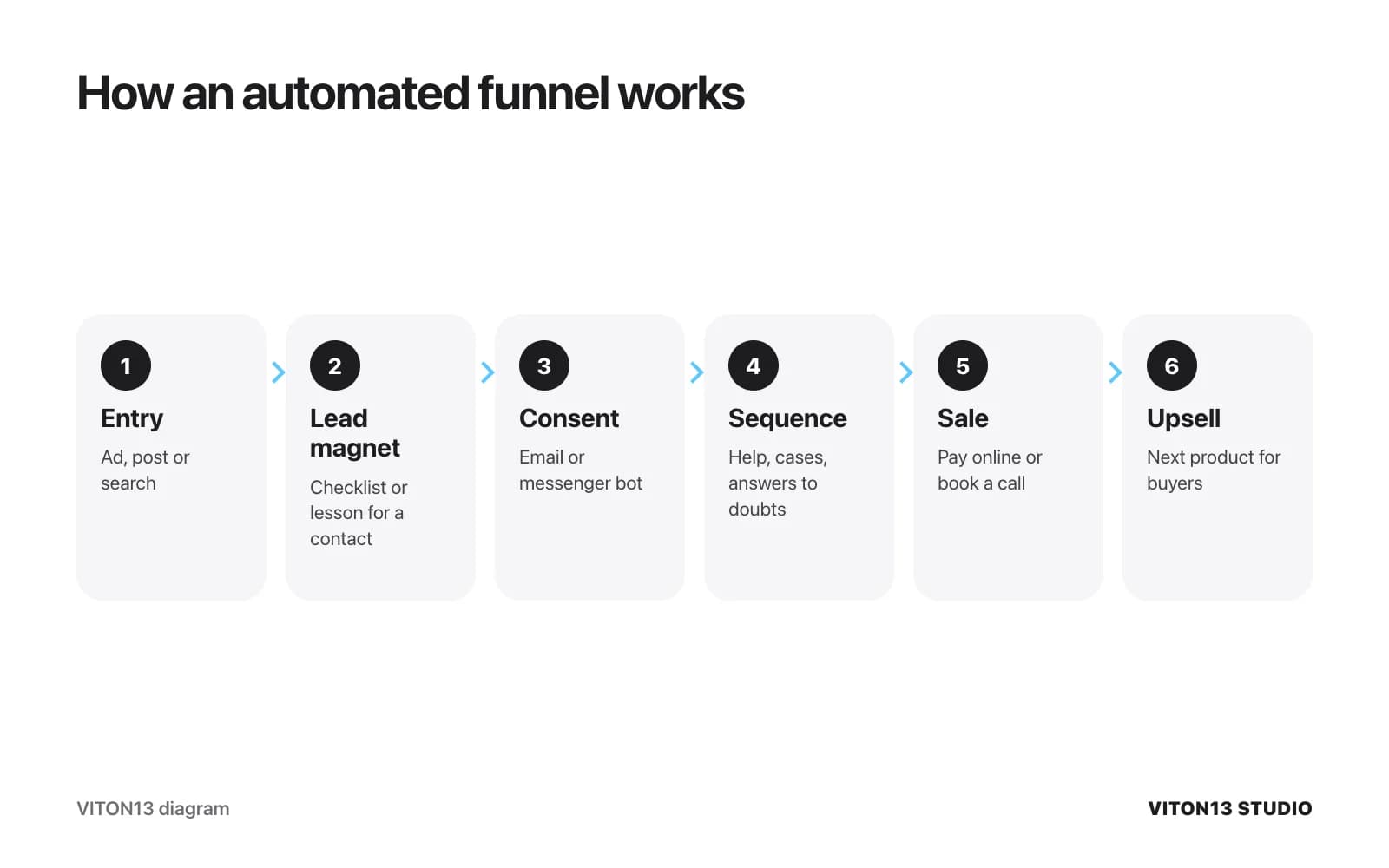
It suits low-priced, simple products: courses, subscriptions, goods people reorder. In B2B, automation keeps a contact warm until the call rather than replacing it.
Consent is part of the funnel: the ICO's PECR guidance says you must not email or text marketing to individuals without specific consent, except under the soft opt-in for previous customers.
How is a sales funnel audit different from a sales team audit?
A funnel audit finds which step loses buyers and why, from traffic to repeat purchase. A sales team audit looks inside sales: how people sell and how targets and incentives work.
| Question | Funnel audit | Sales team audit |
|---|---|---|
| Scope | The whole route: channels, site, enquiries, response, deal, repeat | Salespeople's calls, scripts, incentives, targets |
| Key question | Where and why buyers drop out | How well the team sells |
| Inputs | Web analytics, CRM export, ad reports | Call recordings, CRM, KPIs, playbooks |
| Output | Loss map, prioritised fixes, measurement gaps | Call errors, incentive and process changes |
| When | Enough enquiries, too few sales | Same enquiries, falling win rate |
Self-check
Where is your funnel leaking?
Tick what you already have. Each unticked item is a blind spot.
ticked 0 of 9
Your result: There is no funnel in numbers yet, so no leak can be found. Define the stages and a data source for each; an audit starts there too.
How much does a sales funnel audit cost?
Price follows scope: reviewing one CRM export costs a fraction of a joint audit of marketing, ads and sales. Prices below were checked on 16 October 2026.
| Who | Price | What it covers |
|---|---|---|
| Fiverr: 30 gigs with 'funnel' and 'audit' in the title | $5–$490 basic package; median about $38 | From a landing-page review to a full-funnel CRO audit |
| Codeur.com, France: 'conversion close to zero', July 2026 | 13 quotes averaging €400, 2 days | One e-commerce site's conversion |
| Codeur.com, France: 'traffic and conversion loss', May 2026 | Average quote €2,750, 11 days | SEO, UX and analytics together |
| VITON13: sales funnel audit | $33 AI-assisted or $53 human-led | Journey diagnosis, friction priorities, experiment backlog; 2–3 working days |
| VITON13: marketing analytics | $33 AI-assisted or $53 human-led | Measurement model, event plan, dashboard; 2–3 working days |
Compare deliverables, not prices: numbers per step, fixes in priority order and an owner for each stage.
How VITON13 runs a sales funnel audit
The funnel audit is a one-off job of 2–3 working days. We trace the journey from first visit to payment — attention, enquiry, qualification, response and sale — and mark where people drop out and where evidence about them is lost. We need one recent customer or campaign case, your material on the current route and the person who makes commercial decisions. AI-assisted: AI makes the first pass, a marketer checks every finding. Human-led: a marketer runs the review. If the route is already observable and owned, we propose repairing one proven bottleneck instead.
Sales funnel audit
- Price
- $33 AI-assisted or $53 human-led
- Timeline
- 2–3 working days
Marketing analytics setup
- Price
- $33 AI-assisted or $53 human-led
- Timeline
- 2–3 working days
Conversion rate optimisation
- Price
- $53 AI-assisted or $73 human-led
- Timeline
- 3–5 working days
AI-assisted: AI drafts inside defined steps, a person directs and checks every result. Human-led: a specialist does the work and AI assists.
What is included
- Journey diagnosis from first visit to payment
- Loss map by step, with measurement gaps
- Friction priorities: what to fix first and why
- Experiment backlog and an owner for every hand-off
- Delivery: 2–3 working days after the brief and access
Not included
- Advertising and ad spend
- CRM implementation, a separate CRM marketing automation service
- Call reviews and sales training
- Website changes and A/B tests (conversion rate optimisation)
- Promises of more leads or sales
Revisions: 1 round of revisions on the findings
Get an estimate in 1 working dayWritten estimate within 1 working day
Example
PILOTPilot in progress
No published funnel audit case yet
Every number in this guide's examples illustrates the arithmetic and none is VITON13 client data. We have not yet published a funnel audit case with client figures.
What this does not prove
- The 1.5 lost deals come from invented numbers, not a forecast for your funnel.
- Dynamic Yield and First Page Sage measure their own clients, not your market.
Questions and answers
What is funnel conversion rate?
The share of people who move from one stage to the next: those who moved on divided by those who entered, times 100. End-to-end conversion is the share of entrants who reach payment, the product of every stage rate.
Is a sales funnel the same as a sales pipeline?
Not quite. The funnel is the whole journey from first visit to repeat purchase; the pipeline is the part after the enquiry, the deal stages in HubSpot, Salesforce or Pipedrive. Without web analytics, a pipeline cannot show where people left before enquiring.
Can you build a sales funnel without a CRM?
A shop can, because the route to payment happens on the website and a GA4 funnel exploration covers up to 10 steps. When a person sells, a funnel without a CRM or at least a shared sheet of stages and dates ends at the enquiry.
How often should you review your sales funnel?
Check stage numbers monthly against last quarter, or against the same month last year if you are seasonal. A full audit pays off before raising ad spend, after a new website or CRM, and when sales fall while enquiries hold.
What should you prepare for a sales funnel audit?
Read-only web analytics access, a CRM export of deals with stages and dates for 3–6 months, ad reports for the same period, one recent customer's route from first touch to payment, and the person who will act on the findings.
Sources
- Wikipedia: AIDA (marketing) —
- HubSpot: pipelines —
- First Page Sage: funnel benchmarks 2026 —
- Dynamic Yield: conversion rate —
- Dynamic Yield: cart abandonment —
- HBR: The Short Life of Online Sales Leads —
- Google Analytics Help: funnel exploration —
- ICO: email marketing (PECR) —
- Fiverr: search 'sales funnel audit' —
- Codeur.com: low-conversion project —
- Codeur.com: conversion-loss project —