
Websites and development
Multilingual website in 2026: what it costs and how to structure languages for Google
A multilingual website costs the one-language build plus three lines for every added language: translation, set-up of its pages and hreflang, and upkeep whenever the source text changes. Published 2026 rates run from $0.03 a word for post-edited machine output to $0.30 for professional translators. VITON13 builds the first edition from $113 AI-assisted or $173 human-led.
What does each extra language cost?
Budget each language as three lines that fall due at different times. Translation is paid per word, and again for every word you change later. Set-up is paid once: the extra pages, their titles, the switcher and the hreflang tags. Upkeep never stops: every new service or price change needs a translated twin, or the editions drift apart.
| Cost line | Published figure | Source |
|---|---|---|
| Raw machine translation | Free to under $0.01 per word | Transphere, Mar 2026 |
| Machine translation with post-editing by a linguist | $0.03–$0.12 per word | Transphere, Mar 2026 |
| Professional human translation | $0.10–$0.30 per word; Weglot puts the professional average at $0.17–$0.50 | Transphere; Weglot, Feb 2026 |
| Translation plugin or service | Weglot: $17 a month for 10,000 words in 1 language, $87 for 200,000 words in 5; TranslatePress: from €99 a year | Weglot pricing; TranslatePress, May 2026 |
| Engineering on a simple site | 14 hours, $350 at $25 an hour | Transphere's example |
Worked example: a service site holding 3,000 words costs $90–$360 per language with post-edited machine translation and $300–$900 with professional translators. Transphere's own case, a 2,000-word site in five languages, totals about $2,600 with engineering, testing and project management, roughly $525 per language. Its list also shows the pair matters: $0.10 a word from English into Spanish, $0.16 into Japanese.
Quotes also move with the number of page templates, translated URL slugs, right-to-left scripts such as Arabic that mirror the layout, and booking or payment tools that must work in every language.
Subfolders, subdomains or country domains: which structure fits?
Google's first rule is simple: give every language version its own URL, rather than switching the language by cookie or browser setting. After that you pick one of three structures.
| Structure | Example | Strength | Cost to you | Fits when |
|---|---|---|---|---|
| Subfolders | example.com/fr/ | Easy to set up and maintain on one host | A weaker local signal; one server for all editions | One team, one platform: most small businesses |
| Subdomains | fr.example.com | An edition can run on another server | Visitors may not read the address as local | A separate team or tool runs that language |
| Country domains | example.fr | The clearest local signal | Each domain bought, renewed and grown separately | Local entity, prices and team per country |
| URL parameter | example.com/?lang=fr | None worth having | Not recommended by Google | Avoid it |
Subfolders usually win: one domain gathers every link and one release ships every language. Our projects use them. SB Excursions keeps each language in a folder such as /bali/ru/, and viton13.com serves English at the root and other editions under /ru, /es, /fr and /hi; its subdomains split company sections, not languages. Language and country are separate choices too: one Spanish edition can serve Spain and Mexico until prices or delivery differ.
What must hreflang and the language switcher get right?
Hreflang tags tell search engines which pages translate each other, so a French searcher lands on the French page. Google reads them in the page head, an HTTP header or the sitemap. The rules that break most often:
- Return links: each edition lists itself and all the others; a one-way pair may be ignored.
- Full addresses with https:// and the domain, never relative paths.
- Codes: ISO 639-1 for the language (fr), optionally an ISO 3166-1 region (fr-CA).
- x-default: one fallback page for visitors whose language you do not serve.
- Closed editions: a noindex page stays out of the set; our technical SEO audit checklist covers this.
- Yandex reads hreflang in the page head but no longer from sitemaps, so keep the tags in the HTML if Russian-language search matters.
Hreflang does not set a page's language: Google detects it with its own algorithms, so a French URL with English body text counts as English. The switcher should open the same page in the other language, not the home page, and Google advises against redirecting visitors to another language automatically.
Machine translation or a human translator: where is each enough?
- Home page, service pages, prices and forms: a human translator, or thorough post-editing by a native speaker. These pages sell.
- Terms, privacy notice and refund rules: a professional translator, plus a local lawyer where the law differs.
- Blog posts and help articles: post-edited machine translation, with a native reader for anything that ranks.
- Reviews and user messages: raw machine output, labelled as automatic.
Search needs more than translation. People in each market type their own phrases, often not the literal rendering of your English headline, so check local search terms before translating titles.
Google's spam policies count translating scraped content into pages at scale as abuse; your own text is not scraped, yet unreviewed bulk output adds little for readers. We apply the same caution at home: Spanish and French editions of newer VITON13 service pages written by AI agents stay noindex, outside the sitemap and the hreflang set, until a native speaker reviews them. Hindi service pages wait for that review too.
What does each language need before it goes live?
A translated page is not yet a working edition. Check that a customer can finish the whole journey in it:
- Prices in a currency that market understands, or one currency stated plainly everywhere.
- An enquiry form whose messages reach someone who can reply in that language.
- The contact channel that market actually uses, with the time zone of whoever answers.
- Privacy notice, terms and refund rules translated and checked. France, for example, requires French for the offer and description of goods and services sold to its consumers, sales websites included.
- Dates, numbers, addresses and phone numbers in local formats.
- A translated title, description and alt text on every page, and the edition's URLs in the sitemap.
SB Excursions takes the simplest route: tour prices stay in US dollars and every edition sends enquiries to one WhatsApp number. A shop selling into several countries usually needs local currency and delivery terms per market.
What does VITON13 charge for a multilingual build?
Our prices are published, and a multilingual site is assembled from the same parts. The business website package covers one language edition; each further language is priced in the written estimate before work starts.
| Service | Starting price | Timeline | What it covers |
|---|---|---|---|
| Business website development | $113 AI-assisted or $173 human-led | 3–5 working days | Up to 5 pages in 1 language, an editable CMS, a tracked enquiry form, launch |
| International SEO plan | $53 AI-assisted or $73 human-led | 3–5 working days | Up to 3 markets on 20 queries each, structure and hreflang rules, a 3-phase roadmap |
| CMS integration | $73 AI-assisted or $93 human-led | 5–8 working days | A multilingual content model and editor workflow |
| Technical SEO implementation | $53 AI-assisted or $73 human-led | 3–5 working days | Up to 10 audit findings fixed on a live site, hreflang included |
| Each extra language | Quoted in writing | Set in the estimate | Pages, switcher, hreflang and sitemap entries; translations from you |
The cheapest order is usually: markets and structure first, then the first language built with that structure, then one language at a time as each market proves itself. AI-assisted means AI drafts and a developer reviews every page before sign-off; human-led means a specialist builds by hand with AI as a helper. For the business website that is $113 against $173.
When is a multilingual site the wrong investment?
- Nobody on your side can answer an enquiry in that language or deliver the service there.
- There is no sign of demand yet; one landing page in the language is a cheaper test.
- Content changes daily and nobody is budgeted to keep translations current.
- That market buys through marketplaces or partners, where a local listing reaches buyers sooner.
How VITON13 does it
We plan the languages before the build: which markets, which structure, which pages each edition needs on day one. The first edition is built on the structure agreed in the estimate, so later languages are added rather than retrofitted, and each one is priced in writing before work starts. Send your markets and page list: the scope, timeline and price come back in writing within one working day.
Business website development
- Price
- $113 AI-assisted or $173 human-led
- Timeline
- 3–5 working days
International SEO
- Price
- $53 AI-assisted or $73 human-led
- Timeline
- 3–5 working days
AI-assisted: AI drafts inside defined steps, a person directs and checks every result. Human-led: a specialist does the work and AI assists.
What is included
- Up to 5 pages in the first language, with a CMS your team edits
- 1 enquiry form with tracking, sent to your email or CRM
- Domain routing, SSL and pre-launch checks
- Per extra language agreed in the estimate: its pages, the switcher, a complete hreflang set with x-default and sitemap entries
- A window of 3–5 working days for the first edition once texts and access are ready
Not included
- Translation and native-speaker review: you supply final texts in every language
- Domain, hosting and translation plugin subscriptions
- Legal texts and local legal advice
- Any promise of rankings in a new country
Revisions: 2 review rounds before launch, restated in the written scope
Get an estimate in 1 working dayWritten estimate within 1 working day
Example
CLIENTClient project
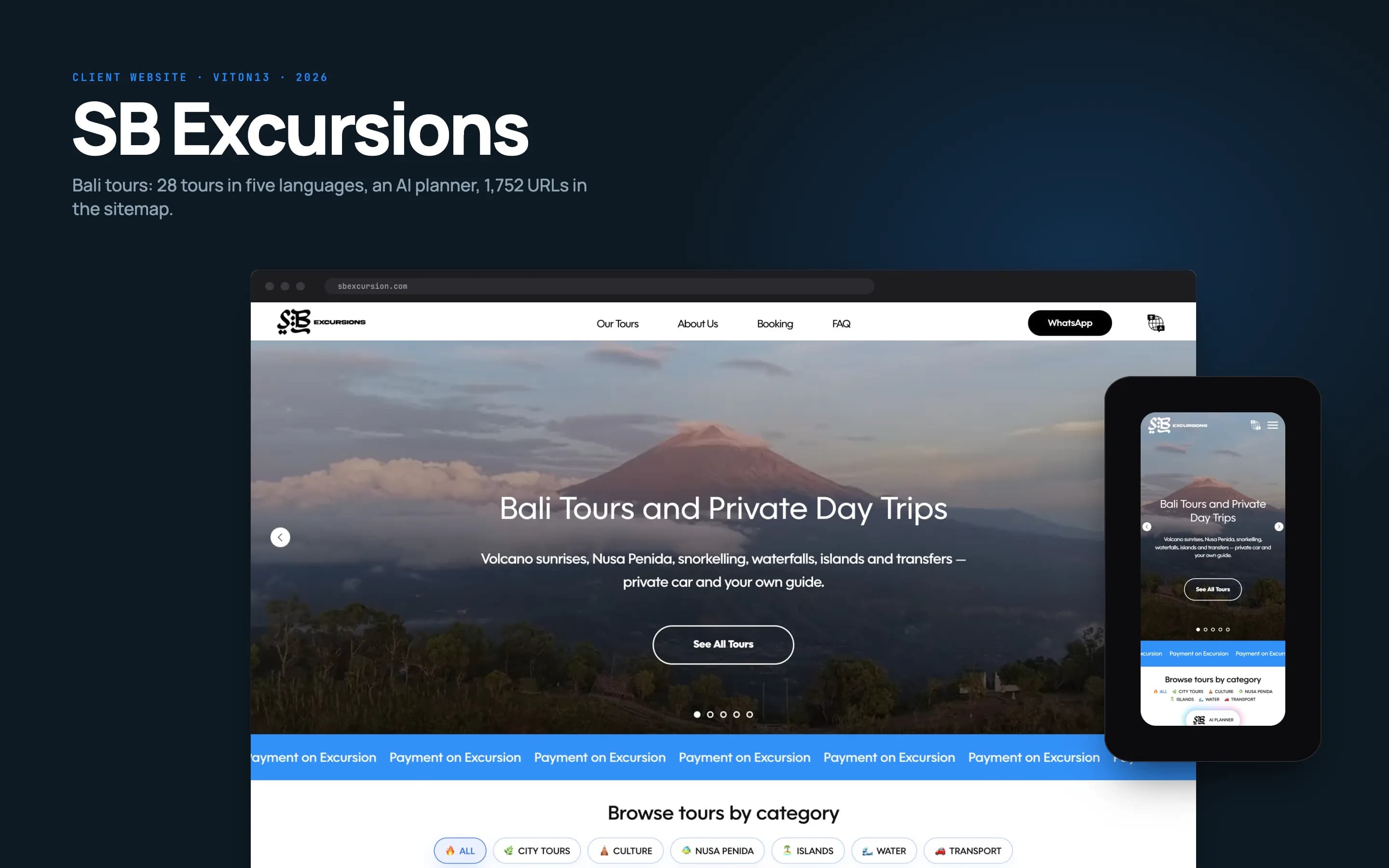
SB Excursions: a Bali tours site run in language folders
We designed and built SB Excursions for an excursion company in Bali. Each language has its own folder (/bali/en/, /bali/zh/ and so on); every page names its alternates with hreflang and an x-default pointing to English, and the sitemap repeats them. On 22 September 2026 the sitemap listed 1,752 URLs, about 330 per main language plus 103 in German; by 25 September the German folder held 342. Search Console, three months to 17 September 2026: 1.08K clicks and 92.2K impressions from Google.
What this does not prove
- These are search visits; bookings happen in WhatsApp chats and are not counted.
- The figures are not split by language, so they cannot show whether new editions or the travel season lifted daily clicks after 7 August.
- The site is far larger than the starting package, and its budget is not published.
Read the case: SB Excursions: a Bali tours website in five languages, built to be found
Questions and answers
Can I add a language later without rebuilding the site?
Usually, if the first build planned for it: a URL pattern with room for language folders, a CMS field per language, and templates that survive longer German or shorter Chinese text. Squeezing languages into a site designed for one often means reworking templates, URLs and redirects.
Should the URLs be translated too?
It helps readers; Google does not require it. Choose one pattern, such as /fr/ plus a French slug, before launch, because changing slugs later means redirecting every old address. On plugins check the plan: Weglot lists translated URLs from its Pro plan upward.
Is DeepL or Google Translate good enough?
As a first draft, often yes. Pages that sell, state prices or set legal terms need a native speaker's review before launch. Raw output is acceptable for low-stakes text such as user reviews, if you label it as automatic.
Who owns the translations and the code?
You should, in writing. Built-in translations live in your CMS and move with the site; a translation service keeps them in the vendor's account, so check the exit: on Weglot's pricing page, export and import appear from the Advanced plan. We set hosting up in your name and hand over the CMS logins at launch.
How long does a multilingual launch take?
The first edition takes 3–5 working days once texts and access are ready; each added language gets its own window in the estimate. Search engines then need weeks to months to index and rank a new edition, and nobody can honestly name the date.
What if a translation turns out to be wrong?
The review rounds before launch exist to catch it: read each edition on the preview address, or ask a native speaker to. After launch the texts are yours to correct in the CMS, and larger changes are estimated like any other request.
How do I pay, and can I cancel?
Prices are in US dollars. Work starts only after you approve the written scope, timeline and final price, and until then you can cancel at no charge. After work starts, the part already completed is charged and the rest refunded, as the sales policy states.
Sources
- Transphere — Website translation costs —
- Weglot — The cost of a multilingual website —
- Weglot — Pricing —
- TranslatePress — Website translation costs —
- Google Search Central — Localized versions of your page —
- Google Search Central — Multi-regional and multilingual sites —
- Google Search Central — Spam policies —
- Yandex Webmaster — Localized pages —
- French Ministry of Culture — Use of French (law of 4 August 1994) —
- SB Excursions — sitemap.xml —