
Websites and development
Website security audit in 2026: what it checks, free self-checks and what it costs
A website security audit checks admin access and two-factor login, updates of the CMS, plugins and libraries, HTTPS and security headers, forms, file uploads, secrets in code, backups and logs, usually against the OWASP Top 10:2025. Free tools show the outside; Spanish firm Hard2bit publishes pentests from €1,490. VITON13’s audit with fixes starts at $73.
What does a website security audit check?
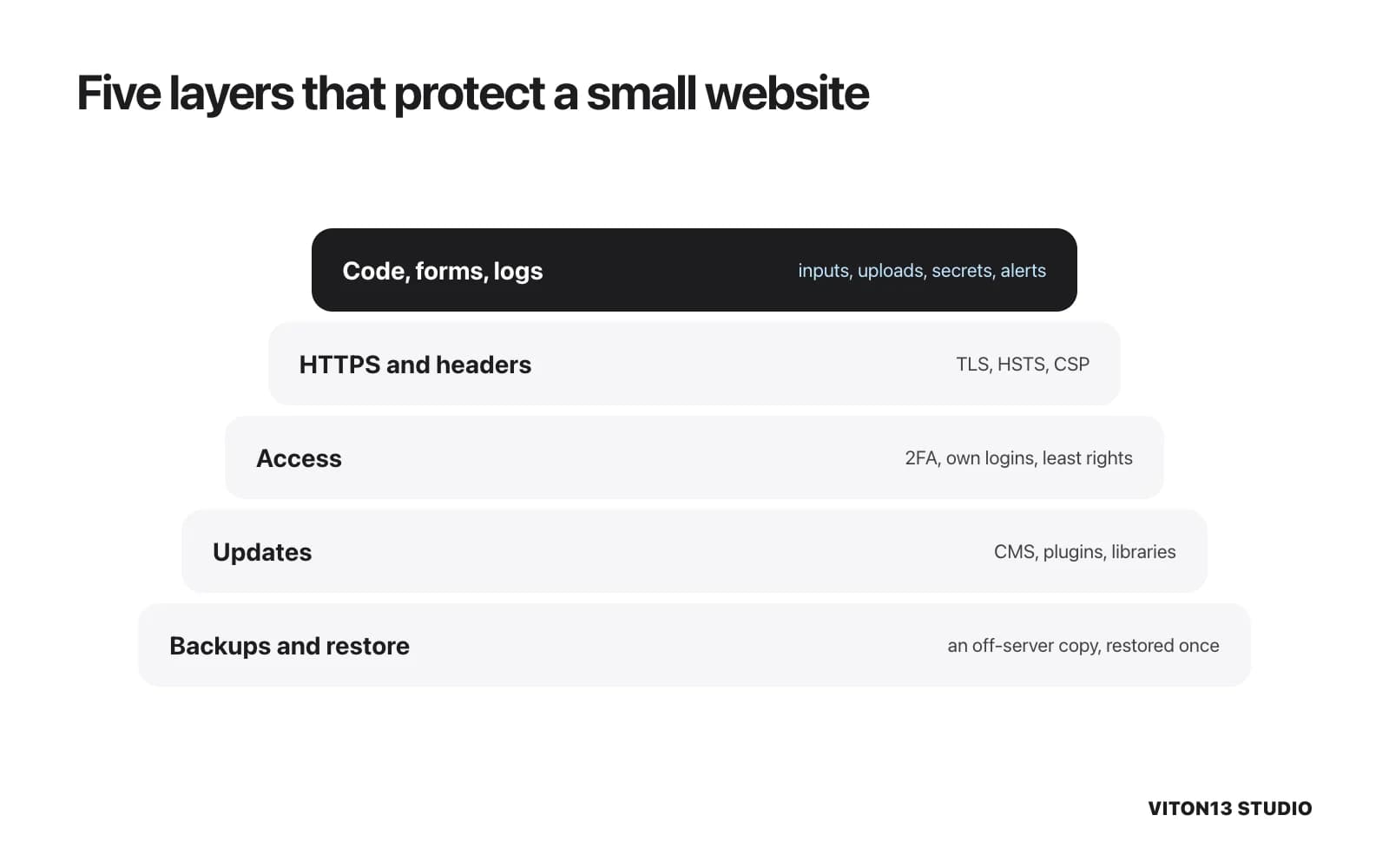
A website security audit checks who can get in, what an outsider can make the site do and how fast you could recover. Most auditors map findings to the OWASP Top 10:2025, the eighth edition of the list, where Broken Access Control stays first and Security Misconfiguration has risen from fifth to second.
| Area | What the auditor looks at | OWASP 2025 |
|---|---|---|
| Admin access | Personal accounts, two-factor login, limits on password guessing | A07 Authentication Failures |
| Roles | Whether one user can see or change another user’s data | A01 Broken Access Control |
| CMS, plugins, libraries | Known vulnerabilities, abandoned plugins, nested dependencies | A03 Software Supply Chain Failures |
| HTTPS and headers | TLS, the HTTPS redirect, HSTS, Content-Security-Policy | A02 Security Misconfiguration |
| Forms | Injection, cross-site scripting, spam limits | A05 Injection |
| File uploads | Allowed types, storage, whether a file can run | A06 Insecure Design |
| Secrets | Passwords and API keys in code or public files | A07 Authentication Failures |
| Errors and logs | Error pages that leak details; login logs without tokens | A10 Exceptional Conditions; A09 Logging and Alerting |
| Backups | An off-server copy and a restore that has been tried | Outside the list; GDPR art. 32 |
A useful audit also walks the paths only your business has, such as discount codes, bookings or customer exports, which no scanner understands.
How can you check your website’s security for free?
Free public tools show a site from outside, and your own admin panels show the rest. Test only domains you own.
- Test HTTPS in SSL LabsQualys SSL Labs’ free SSL Server Test analyses any public HTTPS server. Aim for an A; lower grades usually mean old protocols or a broken certificate chain.
- Grade headers in HTTP ObservatoryMDN’s HTTP Observatory starts at 100 points and adjusts them for redirects, HSTS, Content-Security-Policy, framing and referrer rules; an A needs 90.
- Check the blocklistsLook the domain up in Google’s Safe Browsing site status, then in VirusTotal, which consults more than 70 antivirus engines and blocklists.
- Read Search ConsoleIts Security issues report lists hacked content and malware; Google says a cleaned site usually leaves its unsafe list within 24 hours of review.
- Audit admin accountsList every admin in the CMS, hosting, registrar and code repository, delete orphaned accounts and switch on two-factor login.
- Update, then test a restoreUpdate the CMS and plugins, delete unused ones, then restore last night’s backup to a test copy: only a restore proves a backup works.
No tool here can tell whether one customer can open another’s order; that takes a person reading the access rules and code.
Self-check: how well protected is your website?
Self-check
How well protected is your website?
Tick what is true today, not what is planned.
ticked 0 of 10
Your result: High risk: a bot would probably find a way in. Start today with two-factor login, updates and a tested backup.
Scan, audit or pentest: which one do you need?
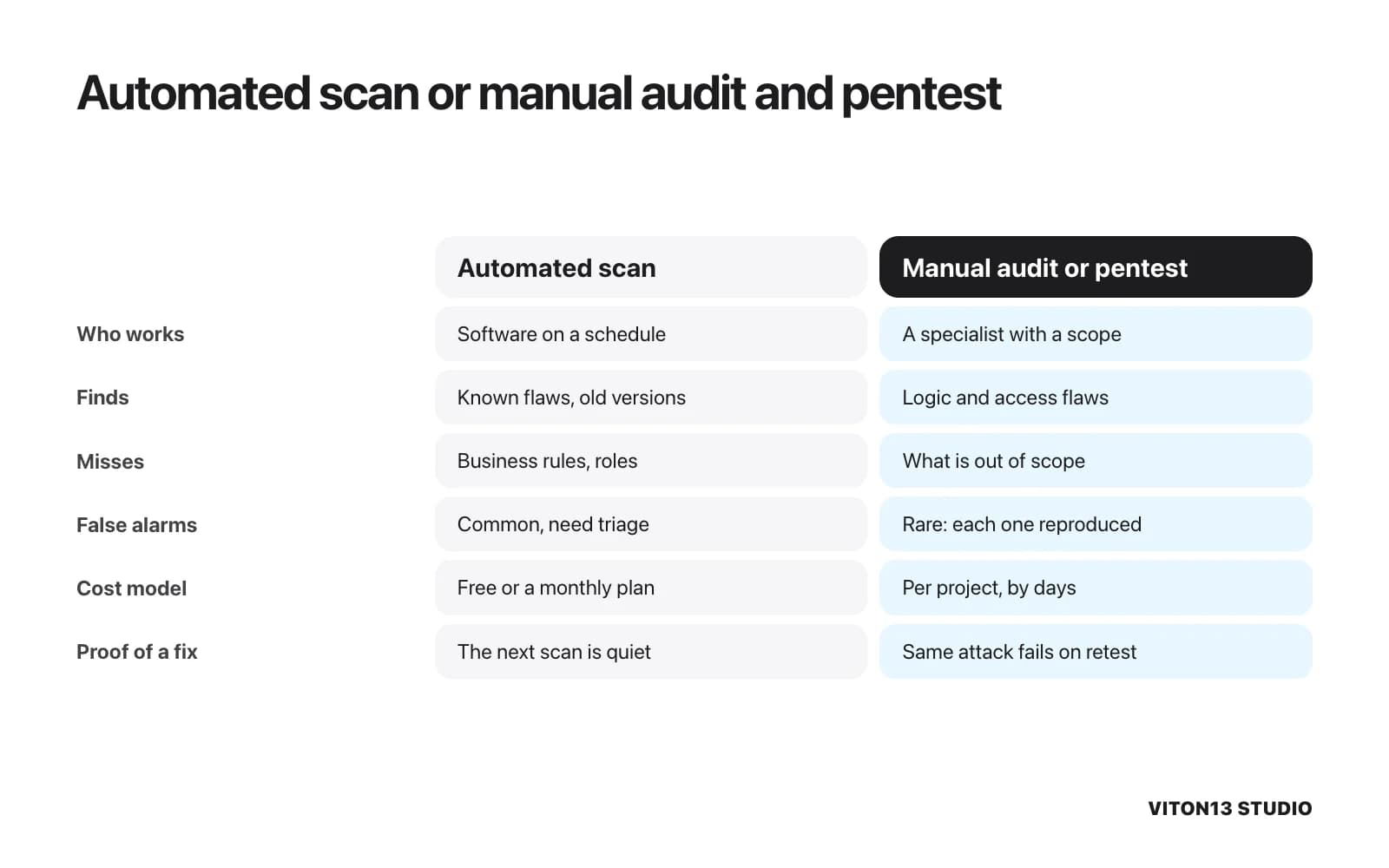
A scan is software matching your site against known problems, an audit is a specialist reviewing settings and code against your risks, and a pentest is a person trying to break in within an agreed scope. The UK’s National Cyber Security Centre advises against using pentests as the primary way to find vulnerabilities.
| Scan | Audit | Pentest | |
|---|---|---|---|
| Who | Software on a schedule | A specialist with settings and code | A tester with a written scope |
| Finds | Known flaws, old versions, missing headers | Weak settings, risky code, access rules | Exploitable chains, with proof |
| Misses | Business logic and permissions | Attacks nobody tried in practice | Anything out of scope |
| Result | Alerts to triage | Prioritised findings, often with fixes | An evidence report, often a retest |
Why do small websites get hacked?
Mostly through known holes left unpatched. Verizon’s 2026 Data Breach Investigations Report, published on 19 May 2026, says 31% of breaches began with an exploited vulnerability, the first time in 19 editions that this beat stolen credentials, and 48% involved a third party.
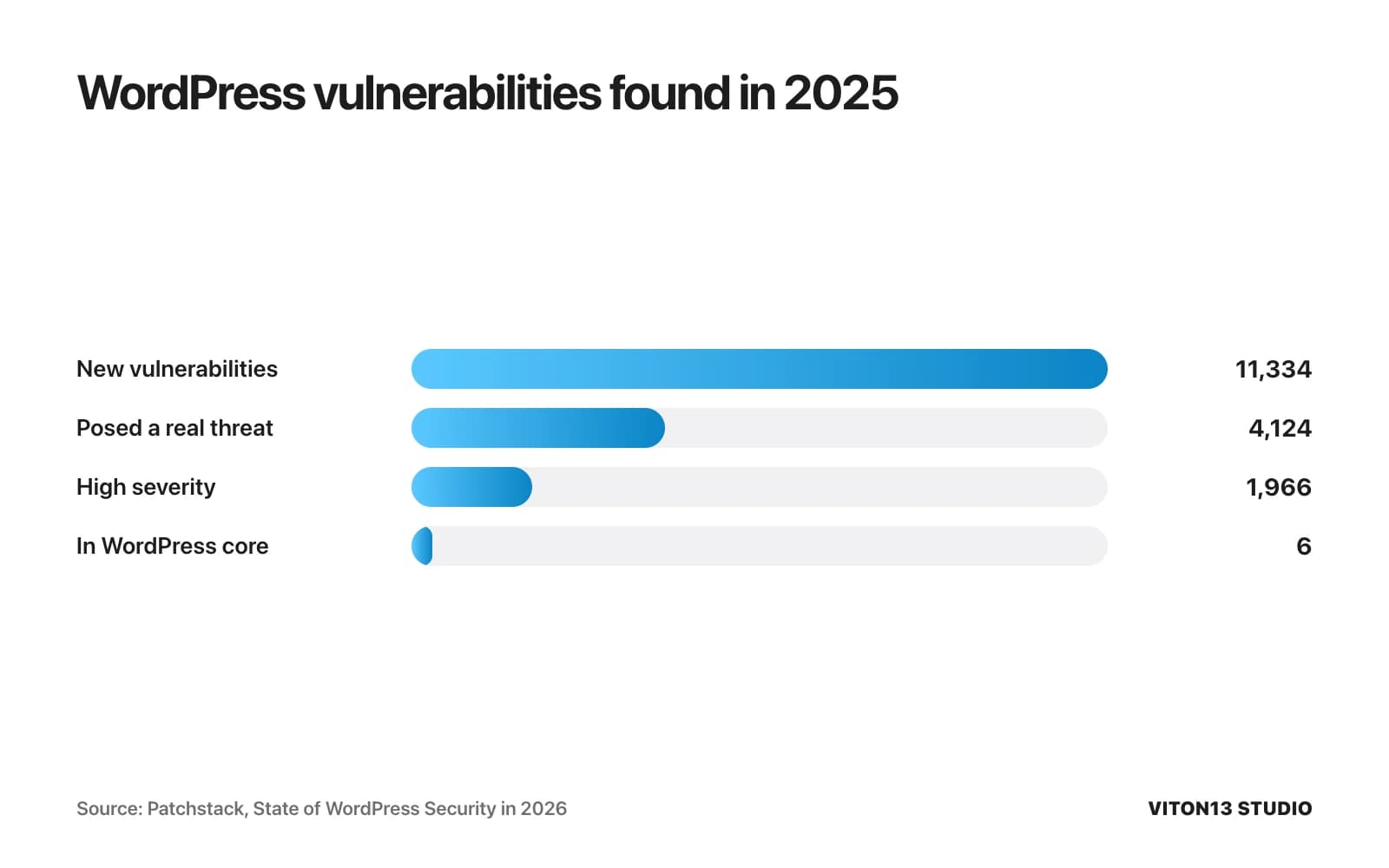
Patchstack counted 11,334 new vulnerabilities in the WordPress ecosystem in 2025, 42% more than in 2024: 4,124 posed a real threat and 1,966 were rated high severity. Plugins held 91% and themes 9%, while WordPress core had six minor issues.
Speed matters too. In 46% of cases no fix existed when the flaw went public, and heavily exploited flaws were attacked within a weighted median of five hours. The forgotten plugin or demo page is the usual door.
How much does a website security audit cost in 2026?
From nothing for the free tools to several thousand euros for a manual pentest. These are published starting points in October 2026.
| Provider | What | Published price | Note |
|---|---|---|---|
| Virusdie | Malware scan and cleanup | Free monthly scan; $15 a month per site | Automated |
| Sucuri | Security platform | $229 to $549 a year | Scans and cleanups |
| Astra Security | Scanner; pentest plan | From $69 a month; pentest $5,999 a year | Testers plus automated agents |
| Intruder | Web application pentest | From $3,500 per test | Described as AI-powered |
| Hard2bit, Spain | Limited web or API pentest | From €1,490 before VAT | Day rate €500–1,000 |
| LiteraFort, RTM Tech, Oreol Security | Website pentest in Russia | From 150,000 to 300,000 roubles | RTM Tech from 5 working days |
| VITON13 | Audit and hardening | $73 AI-assisted or $93 human-led | 5–8 working days; not a certified pentest |
Quotes rise with the number of roles and logins, with access to the code and when a retest is included. Oreol Security, for example, prices by application size, roles, API methods and business scenarios.
Cost calculator
Estimate your security work
Pick a starting point, then add what your site needs.
Your estimate
- AI-assisted
- from $73
- Human-led
- from $93
- Timeline
- 5–8 working days
stages can overlap; the written estimate fixes the dates
Get a written estimate in 1 working dayToday’s VITON13 starting prices; the written estimate fixes scope and price before work begins. None of these is a certified pentest.
Is it legal to test a website, and what does the law require?
Testing someone else’s site without permission is a crime in most countries: get the owner’s signed consent, scope and dates first.
| Market | Access without permission | If personal data leaks |
|---|---|---|
| United Kingdom | Computer Misuse Act 1990, s. 1: up to two years in prison | Notify the regulator within 72 hours (UK GDPR) |
| France | Code pénal art. 323-1: three years and €100,000 | 72 hours; GDPR fines up to €10m or 2% of turnover |
| Spain | Código Penal art. 197 bis: six months to two years | 72 hours; the same GDPR fines |
| Russia | Criminal Code art. 272: up to two years if data was destroyed, blocked, changed or copied | 24 hours; fines of 3–15 million roubles, repeat leaks 1–3% of revenue |
GDPR article 32 expects regular testing of security measures and timely restore of data, so a dated audit and a tested backup are evidence of care.
When do you need an accredited pentest company instead?
When someone else must rely on the report. A studio audit reduces your risk; it is not a certificate that a regulator, a bank or an enterprise client has to accept.
- A contract or tender demands a pentest by an accredited firm; for UK government systems the NCSC recommends testers from its CHECK scheme.
- Your PCI DSS assessor or ISO 27001 auditor asks for a penetration test report.
- In France, regulated operators and administrations use PASSI auditors qualified by ANSSI, the national cyber agency.
- In Russia, banks test under Bank of Russia regulations 683-P, 719-P and 757-P; LiteraFort lists that from 135,000 roubles.
Otherwise, run the free checks, then an audit with fixes, and book a formal pentest once the obvious holes are closed, so testers are not paid to report missing updates.
How VITON13 audits and hardens a website
Web application security hardening is a one-off package of 5–8 working days. We start from one normal user journey, one that failed or worries you, the current stack, the access you can grant and the person who accepts the result. Each threat is tied to the exposed asset, the permission boundary, an exploit test, the fix and the retest. Fixes stay in your current stack and can be reversed from a written runbook. For monthly checks, our website maintenance plan includes a security and dependency review.
Web application security hardening
- Price
- $73 AI-assisted or $93 human-led
- Timeline
- 5–8 working days
Cloud and DevOps setup
- Price
- $33 AI-assisted or $53 human-led
- Timeline
- 2–3 working days
Website bug fixing
- Price
- $13 AI-assisted or $33 human-led
- Timeline
- 1–2 working days
AI-assisted: AI drafts inside defined steps, a person directs and checks every result. Human-led: a specialist does the work and AI assists.
What is included
- Threat and access review: what is exposed and who can reach it
- Prioritised security fixes that your team can maintain
- Verification and response notes, with every fix retested
- $73 AI-assisted or $93 human-led; work beyond the agreed boundary is priced first
Not included
- A certified or independent penetration test report
- PCI DSS, ISO 27001 or other compliance certificates
- Round-the-clock monitoring and incident response
- Any promise that a site cannot be hacked
Revisions: 2 rounds of revisions on the deliverables
Get an estimate in 1 working dayWritten estimate within 1 working day
Example
INTERNALOur own product
Our own site: eight findings and eight fixes on tarasovvitalii.com
On 28 September 2026 VITON13 ran a white-box review of tarasovvitalii.com, the founder’s portfolio with a sign-in chat, a Node API, nginx in Docker and 15 concept demos. It confirmed eight findings: one high (script injection through a demo’s ?cat= parameter on the chat’s origin), one medium (no Content-Security-Policy on the demos) and six low. All eight were fixed and re-tested; 119 demo pages load under the new policy with zero violations.
What this does not prove
- It is our own site, reviewed by our own studio: not an independent pentest and not a certificate.
- It covers the code as of 28 September 2026 only.
- The attacks were replayed on a local copy of the production containers, not on the live server.
Read the case: Security audit of tarasovvitalii.com: eight findings, eight fixes
Questions and answers
What is the OWASP Top 10?
It is a list of the ten most critical security risks for web applications, published by the OWASP community. The current edition, OWASP Top 10:2025, is the eighth: Broken Access Control leads, and Software Supply Chain Failures and Mishandling of Exceptional Conditions are new.
How do I check my website for malware?
Look the domain up in Google’s Safe Browsing site status, scan it on VirusTotal and open the Security issues report in Search Console. A clean result does not rule out hidden code on the server, so also compare the site’s files with a clean copy.
Is a free online security scan enough?
For a brochure site without logins it is a start, not proof: MDN states that even an A+ from HTTP Observatory does not test for outdated software, SQL injection or vulnerable CMS plugins.
How long does a website security audit take?
Published timelines run from days to weeks: RTM Tech lists a website pentest from five working days, and Oreol Security two to three weeks for a web application. VITON13’s audit and hardening takes 5–8 working days, with the fixes and the retest included.
Does a security audit protect a site from DDoS attacks?
No. A DDoS attack floods a site with traffic, and protection comes from your hosting or a network provider; Cloudflare includes unmetered DDoS protection even in its free plan. An audit only checks that such protection is on and the server’s real address stays hidden.
What is a white-box security audit?
The reviewer reads the source code and configuration, not only the public pages. A black-box test sees what an outsider sees, and a grey-box test adds a user account. White-box review sees what is invisible from outside, such as keys in the code, which is why we reviewed our own site that way.
Sources
- OWASP Top 10:2025 —
- OWASP 2025: introduction —
- MDN: Observatory FAQ —
- MDN: Observatory scoring —
- Qualys SSL Labs —
- Google Safe Browsing status —
- Google: Safe Browsing FAQ —
- VirusTotal: how it works —
- NCSC: penetration testing —
- Verizon: 2026 DBIR —
- Patchstack: WordPress security 2026 —
- EUR-Lex: GDPR —
- Computer Misuse Act 1990 —
- UK GDPR, art. 33 —
- Légifrance: Code pénal —
- BOE: Código Penal —
- ConsultantPlus: art. 272 —
- ConsultantPlus: art. 13.11 —
- Virusdie: pricing —
- Sucuri: plans —
- Astra Security: pricing —
- Intruder: pricing —
- Hard2bit: pentest prices —
- LiteraFort: pentest —
- RTM Tech: pentest —
- Oreol Security: pentest —
- Cloudflare: plans —
- tarasovvitalii.com: case —