
Design
AI-assisted or human-led design: what changes in the result and the price
AI-assisted design: a generator produces the first options, and a designer steers, filters and checks them. Human-led design: a designer makes every decision and draws, with AI only helping. Scope, files, timeline and revisions stay the same. At VITON13 design starts at $33 AI-assisted or $53 human-led; the higher price buys a person's judgement at each step.
What is the difference between AI-assisted and human-led design?
Every design service on the VITON13 price list carries two prices: two ways of running the same job, not two sizes of it. Our pricing policy defines each tier in one line:
- AI-assisted: “For a defined production scope where AI removes repetitive work and a specialist reviews the delivery.”
- Human-led: “For work that benefits from a specialist leading the process, decisions and delivery from start to finish.”
- Complex: “For multi-part systems, advanced builds and scopes that need discovery before the final quote.”
In practice, AI-assisted means a generator supplies compositions, colour routes and lettering sketches; the designer briefs it, discards most of it and repairs what survives. Human-led means the designer builds the work, with AI on chores such as mockups.
What changes in the result, and what stays the same?
The package fixes the terms; the mode leaves them alone. What moves is who makes each decision and how much of the final artwork a person authored.
| Point of comparison | AI-assisted | Human-led |
|---|---|---|
| First drafts | Generated in volume, filtered by a designer | Sketched or built by the designer |
| Form, type and colour | Picked from generated options, then corrected | Decided by the designer from the brief |
| Consistency across a series | A person must lock one wordmark and one grid | Built in from the first sketch |
| Look-alike risk | Generated shapes can echo existing work; the check weighs more | Lower, never zero |
| Revision rounds | Set by the package: 1 on Logo Route, 2 on Brand Sprint | The same |
| Files and timeline | The package's list and published window | The same |
| US copyright in the artwork | Human selection, arrangement and edits only | As for any designer's work |
| Rights you receive | Agreed rights pass to you after payment | The same |
| Logo Route price | $53 | $73 |
Where is AI generation genuinely strong in design in 2026?
Faster exploration is real, and designers report it themselves. In Figma's State of the Designer 2026, a survey of 906 digital designers, 89% said they work faster with AI and 91% said new AI tools improve their designs.
Trust in raw output is another matter. In Figma's 2025 AI report, 78% of 2,500 users agreed AI makes their work significantly more efficient, yet only 32% said they can rely on its output. The AI-assisted mode is priced around that gap: quick drafts, then a person who decides what is usable.
- Direction options and moodboards, before anyone commits hours to one route.
- Campaign key visuals judged on screen before paying for a shoot, props or a model.
- Adaptations: one post in six formats, a banner in four sizes, a layout in three colour routes.
Which design decisions still need a person in charge?
Five kinds of decision fail quietly when nobody owns them, and each costs more to repair after launch.
- Brand logic: why this shape suits this business, and which rivals it must not resemble.
- One master version: generated series drift in letter shapes, spacing and weight. Someone has to draw the single version every supplier copies; our VITON13 SCHOOL globe-V is one such vector master.
- Contrast: WCAG 2.2 asks for at least 4.5:1 for normal text and 3:1 for large text. Logotypes are exempt; the taglines and buttons around them are not.
- Look-alike risk: USPTO examples show two marks can clash through one shared dominant design element, even when only one contains words.
- Production files: vector masters, print resolution, dielines, colour values.
Human-led does not mean AI-free. It means the person answering for these five points also makes the work, instead of reviewing output someone else prompted.
Who owns an AI-assisted design, and can it be protected?
Ownership is three things: the rights a studio assigns, whether copyright exists at all, and trademark protection. A contract hands over only what exists.
The U.S. Copyright Office concluded in January 2025 that copyright does not reach purely AI-generated material, and that prompting today's tools gives too little control over expression. What a person adds stays protectable: their own visible expression, the creative selection and arrangement of material, creative changes to it. Using AI to assist rather than replace a creator leaves protection untouched.
The Office's decision on the comic Zarya of the Dawn shows the split: protection stayed with the human-written text and the human arrangement of words and pictures, not with the Midjourney images. Registration applicants are expected to disclose AI material beyond a de minimis amount.
What does unchecked AI output cost you later?
Generation saves money at the draft stage. The bills arrive when an unchecked image meets a printer, a registry or a customer:
- A misspelled word inside a generated label, noticed after the packaging proof is paid for.
- Screen-only resolution: about 1,000 pixels wide is sharp on a phone and soft on a poster.
- Lettering that changes from image to image, which no supplier can follow.
- A mark close to a registered one, found when the application is refused and the signage exists.
- A realistic AI person or product presented as genuine in EU advertising, unlabelled. Under Article 50 of the EU AI Act, applicable since 2 August 2026, such deep fakes must be disclosed.
None of this argues against AI; each item is what the check in the AI-assisted price is for.
Which mode should you choose for each design task?
Decide task by task, not once for the whole brand. Use the cheaper mode where output is disposable or easy to redo; pay for a person where the work becomes an asset you will register, print or build on.
| Task | Mode we suggest | Why | Price: AI-assisted / human-led |
|---|---|---|---|
| Moodboard and direction options | AI-assisted | Breadth beats authorship; most options are discarded | Brand Sprint, $93 / $113 |
| Social templates and variants | AI-assisted | Many formats of one idea on a locked grid | $73 / $93 |
| Logo or mark | Human-led | You will register it and keep it for years | Logo Route, $53 / $73 |
| Brand identity system | Human-led | Rules for other suppliers need one author | $93 / $113 |
| Landing page layout | Either | Standard structure or unusual art direction | $73 / $93 |
| Packaging artwork | Human-led | Dielines and legal text leave no room for guesses | $93 / $113 |
| Pitch deck | AI-assisted | Speed and consistency on a deadline | $53 / $73 |
| Review of an existing brand | Either | Human-led if a rebrand decision depends on it | $33 / $53 |
When is the second price not worth paying, and when should you not order at all?
Skip human-led when the output has a short life: an event poster, internal slides, social variants of an approved design, a test of whether an idea deserves a shoot. A designer reviews the work in both modes, so the cheaper one is not unchecked.
Skip any studio when a free generator already does the job, such as a placeholder picture nobody will print or register. If your real question is legal, whether a mark can be registered in your classes, start with a trademark attorney. And a multi-part system with research or many screens belongs in the Complex tier, quoted after discovery.
What should you send so either mode works the first time?
- Where the design will live: screens only, or also print, signage, packaging or embroidery.
- The smallest and largest size it has to work at.
- Existing assets, and which of them may not change.
- Two or three competitors or marks the result must not resemble.
- Which parts you may later want to register.
- Whether AI-generated people or products are acceptable in visuals.
- One approver and one deadline.
Generated images you already like belong in the brief too: they are a clearer reference than adjectives.
How VITON13 does it
Each design service has an AI-assisted and a human-led price, and you pick the mode per service. Send the brief: within a working day the scope, mode, timeline, final price and payment route arrive in writing, and nothing is charged before you confirm.
Design
- Price
- $33 AI-assisted or $53 human-led
Logo Route
- Price
- $53 AI-assisted or $73 human-led
- Timeline
- 1–2 working days
Brand Sprint
- Price
- $93 AI-assisted or $113 human-led
- Timeline
- 1–2 working days
AI-assisted: AI drafts inside defined steps, a person directs and checks every result. Human-led: a specialist does the work and AI assists.
What is included
- A written scope: mode, deliverables, file formats, revision rounds, exclusions
- Logo Route: one drawn logo direction, primary and one-colour lockups, vector source files
- Brand Sprint: a direction board, a key logo route and a typography system
- A designer's review of every deliverable in both modes: spelling, contrast, sizes, file specs
- AI-generated images identified as such, as on our own case pages
- Agreed rights and editable files transferred after payment
Not included
- Trademark clearance and registration
- Legal advice on AI authorship
- Commercial font licences
- Copywriting and photography
- Printing and production
Revisions: Set by the package, identical in both modes: 1 round on Logo Route, 2 on the chosen direction in Brand Sprint, 3 across the system in a brand identity
Get an estimate in 1 working dayWritten estimate within 1 working day
Example
CONCEPTConcept — not a commissioned project
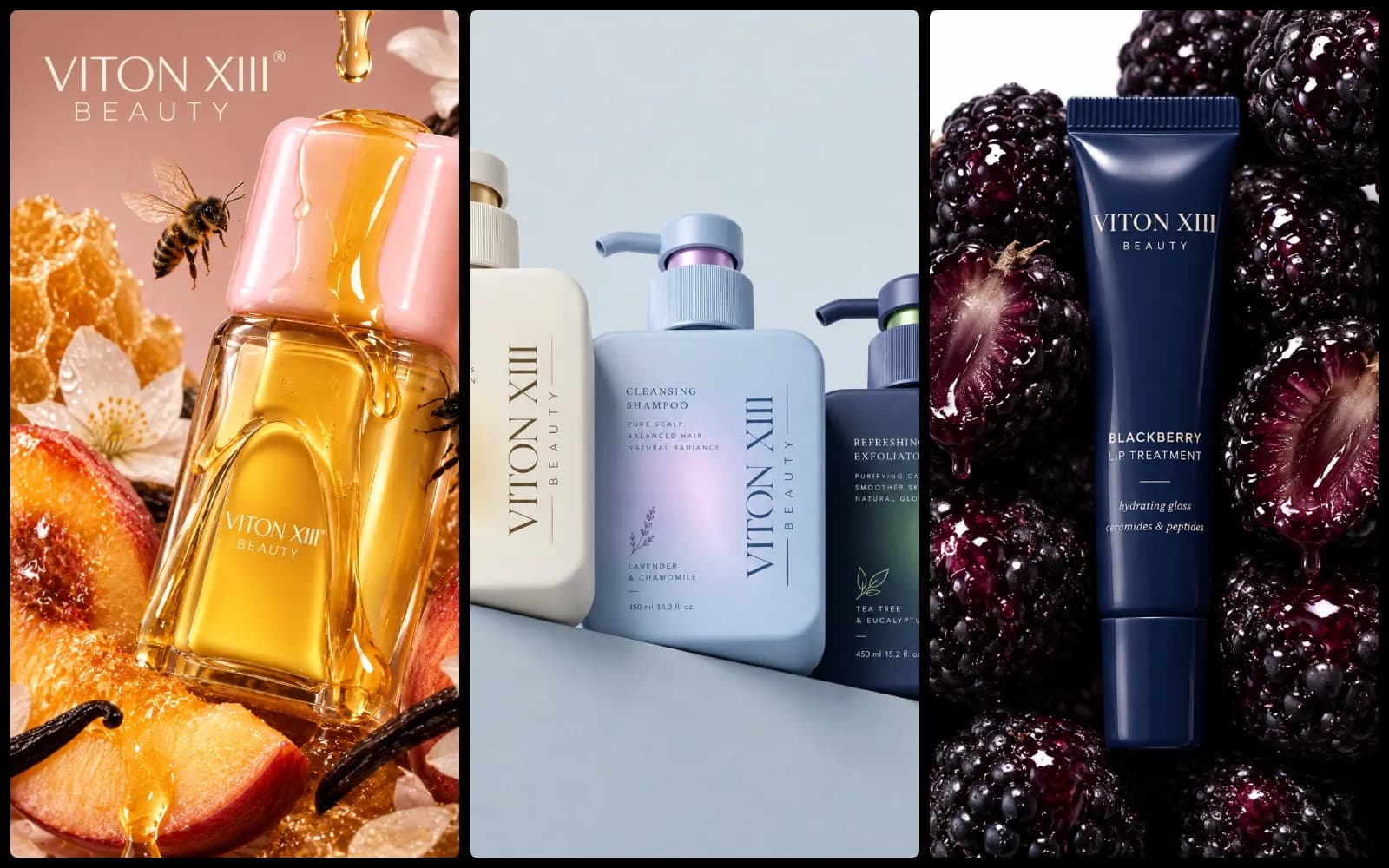
VITON XIII BEAUTY: six AI-generated key visuals, and what they left unfinished
VITON XIII BEAUTY is a self-initiated concept: a beauty extension of the VITON XIII fragrance line, art-directed by VITON13's founder Vitalii Tarasov in six key visuals dated 12 September 2026. All six came from an OpenAI image model, the campaign face included, and every original carries C2PA content credentials recording that. Generation handled exploration well: three product worlds (honey, pastel glass, dark berries) and eight packs, judged on screen without a shoot or a model. The finishing still needs a person: one label reads BEAAUTY, the VITON XIII lettering switches between a thin sans-serif and a serif, and the originals, 1,024 to 1,125 pixels wide, are too small for print.
What this does not prove
- It is a self-initiated concept, not a client brief: it shows nothing about approvals, deadlines or budgets.
- VITON XIII BEAUTY is not a launched line; apart from OBSESSION, no product shown is claimed to be on sale.
- It was not produced under a VITON13 package or at a package price.
- There is no audience, engagement or sales data for these visuals.
Read the case: VITON XIII BEAUTY: a beauty line concept in six AI-generated key visuals
Questions and answers
Is AI-assisted design lower quality than human-led?
Not by definition. Both modes pass a designer's review against the same scope and file list. The difference is where judgement enters: choosing among generated options, or making each decision. For variants the results can look identical; for a mark you will keep for years, that judgement is what you pay for.
Can one project use both modes?
Yes. The mode is set per service in the written scope, so a launch can pair AI-assisted social templates with a human-led logo. Settle the mark first and generate variants around it afterwards: a generator follows an approved style far better than it invents one that holds together.
What if the AI output is wrong or looks like someone else's work?
Catching that is the designer's job in the AI-assisted mode: spelling, contrast, file specs and an obvious look-alike check come before delivery. If an error still reaches you, raise it at handoff, since a misspelled label does not meet the written scope. Legal clearance sits outside every design package; for a mark you will register, consult a trademark attorney.
Will you put AI-generated people in my visuals?
Only if your brief allows it. Our VITON XIII BEAUTY concept uses an AI-generated face and says so in its captions. If a realistic AI person, product or place in your EU advertising could pass as genuine, Article 50 of the EU AI Act requires disclosure; the European Commission confirms it applies from 2 August 2026.
Do I own the files in both modes?
Yes, under the project terms: the agreed rights and editable files pass to you after payment. What differs is how much copyright exists to pass on: human-authored parts are protected as usual, purely generated parts may belong to nobody, at least in the US.
Does human-led design take longer?
Not on paper. Both modes share the published window from an approved brief: 1–2 working days for Logo Route, 6–10 working days for a brand identity. The higher price pays for a specialist's hours inside that window. The slowest step is usually collecting comments from every approver.
How do payment and cancellation work?
You get the scope, timeline, final price and payment route in writing first, and nothing is charged until you confirm. Cancelling before you approve the scope costs nothing. Once work has started, the completed part is charged and the unstarted remainder is refunded.
Why not just use Midjourney or ChatGPT myself?
For exploration you often should: it is cheap and shows you what you like. What you still lack afterwards is a vector master, print-ready files, a contrast and look-alike check and a written transfer of rights. Bring your favourite generated images to the brief; they speed up the first round.
Sources
- Figma — State of the Designer 2026 —
- Figma — 2025 AI report: designers and developers —
- U.S. Copyright Office — Copyright and AI, Part 2: Copyrightability —
- W3C — Understanding WCAG 2.2: Contrast (Minimum) —
- USPTO — Likelihood of confusion —
- European Commission — Article 50 AI Act transparency FAQ —
- C2PA — Content Credentials standard —